
Summary
Editor's rating
Value for money: solid deal if you want simple and reliable
Design: simple suitcase style with a few small annoyances
Durability: decent build, but don’t leave it in the rain
Ease of use: very straightforward, with a couple small quirks
Performance: heats fast and simmers better than you’d expect
What you actually get with this stove
Pros
- Good heat output (22,000 BTUs) with surprisingly decent simmer control on both burners
- Easy setup and use, with effective wind guards for normal camping conditions
- Compact suitcase-style design that travels well and is straightforward to clean
Cons
- No built-in ignition, non-slip feet, or included carry bag, so you’ll likely buy a few extras
- Prone to small rust spots if not dried and stored properly, so it needs basic care

Specifications
View full product page →| Brand | Coleman |
A simple stove that does what you expect
I’ve been using the Coleman Triton 2-Burner Propane Stove on weekend camping trips and as a backup at home when the power goes out. Nothing fancy in terms of concept: it’s a folding metal box with two burners, wind guards, and a propane hookup. But that’s kind of why I bought it. I wanted something I could throw in the car, set up in two minutes, and make coffee and eggs without swearing at it.
Out of the box, setup is basically idiot-proof. Open the lid, swing out the wind guards, drop the grate in place, screw on a 1 lb green propane bottle, and you’re ready. First time I used it, it lit on the first spark with a cheap long lighter. Since then, it’s been the same: turn the knob, light, and you’re cooking. No built-in ignition, so you do need a lighter or matches, but for this price point I wasn’t expecting more.
I’ve run it mainly on the small 1 lb cylinders, but I also tried it with a hose adapter on a 20 lb tank during a backyard cookout. Both work fine. The BTUs are enough to boil water quickly and sear meat without waiting all day. It’s rated at 22,000 BTUs total, and in real use that feels accurate: you’re not getting restaurant-level power, but for camping food, it’s more than enough.
Overall, first impression after a few trips is pretty straightforward: it’s not fancy, it’s not ultra-compact, but it’s reliable and easy to live with. If you want a basic two-burner camp stove that gets the job done without a ton of features, this one fits that description pretty well. It does have some quirks and a few corners clearly cut to keep the price down, but nothing that made me regret buying it.
Value for money: solid deal if you want simple and reliable
From a value perspective, I’d say the Coleman Triton hits a nice middle ground. It’s not the cheapest two-burner stove on the market, but it’s also noticeably cheaper than some of the higher-end models like the Camp Chef Everest. For the price, you get reliable ignition (with a lighter), decent build quality, and good burner control. You’re not paying for bells and whistles or premium materials, you’re paying for a basic workhorse that has been around for years and has a lot of positive feedback.
Compared to the really budget no-name stoves I’ve seen at big box stores, this one feels more trustworthy. The knobs are smoother, the wind guards actually help, and the overall fit and finish is better. I’ve had cheaper stoves where the regulator felt sketchy or the flame pattern was uneven. Here, both burners are consistent and easy to manage. That alone is worth spending a bit more, especially if you’re cooking for family or using it as a backup in a power outage.
On the flip side, it doesn’t come with extras that some people might expect. No included carry bag, no griddle plate in my case despite some listings mentioning one, no piezo ignition, no rubber feet. You might end up buying a bag, a hose to hook up a bigger tank, and some non-slip matting. That adds a bit to the total cost. Still, even with those add-ons, you’re usually under what you’d pay for the premium stoves with similar power.
Given how often I actually use it—several weekends a year plus the odd emergency—I feel like I got good value for money. It’s not perfect, and there are definitely fancier options out there, but for someone who wants a straightforward, dependable two-burner stove without spending a fortune, this is a pretty solid deal. If you’re ultra-budget and only camp once every few years, you might go cheaper. If you’re a heavy user or super picky about features, you might step up. For everyone in the middle, this hits the sweet spot.
Design: simple suitcase style with a few small annoyances
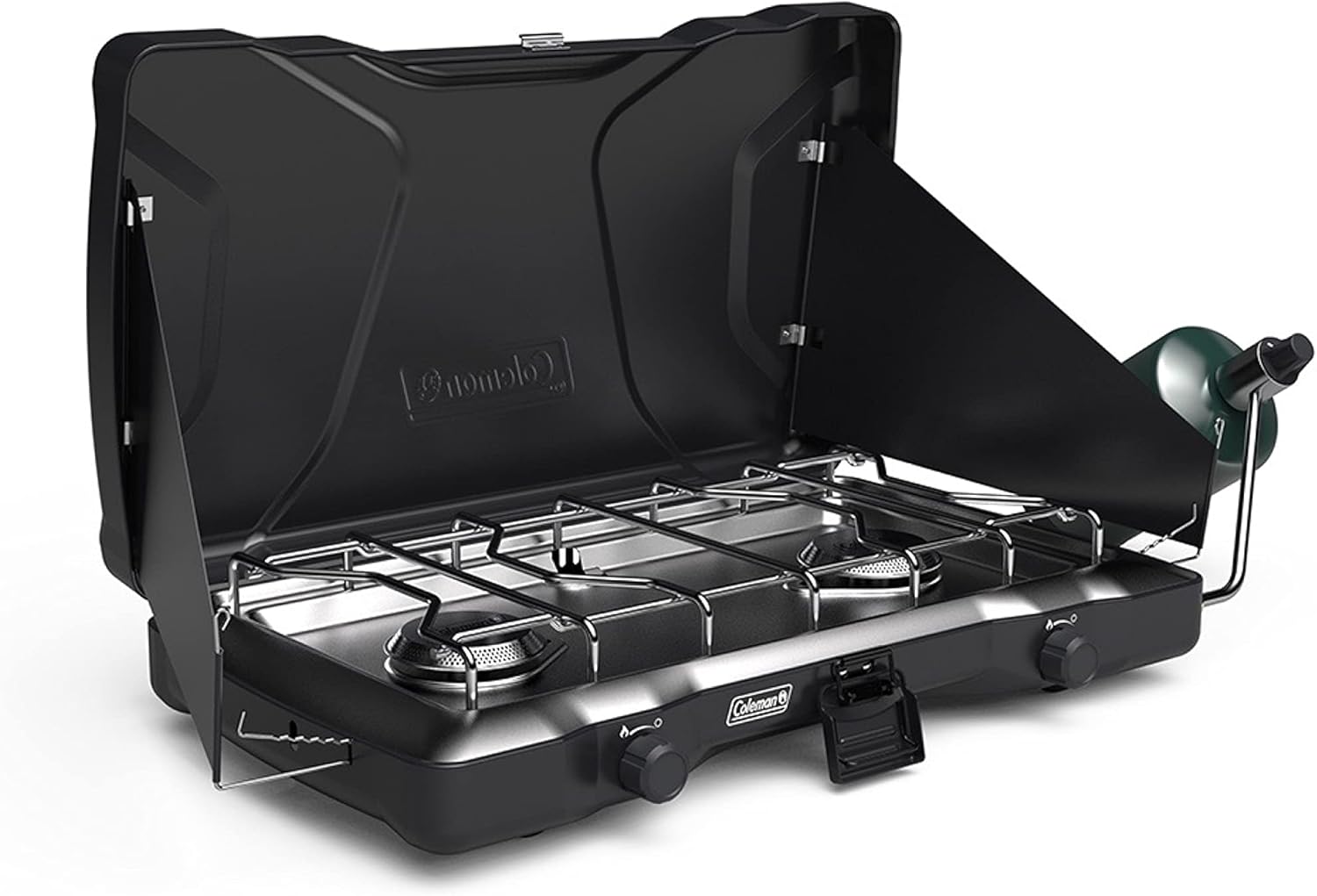
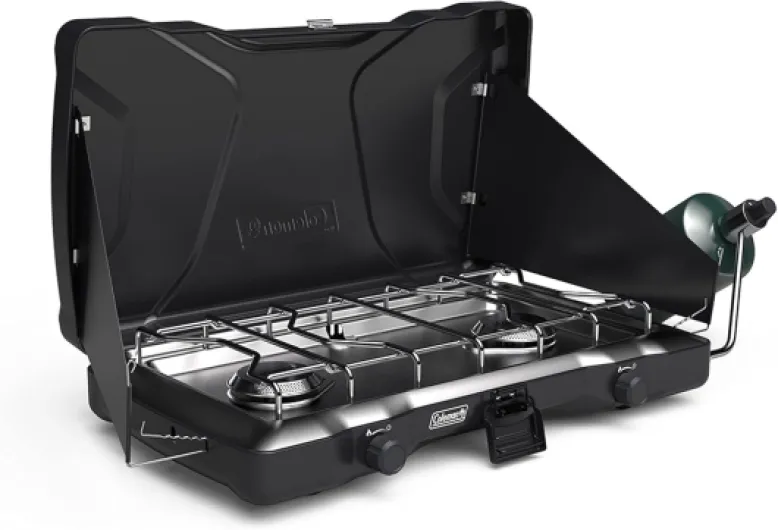
The design is very old-school Coleman, which I actually like. Matte black metal box, lid that flips up to act as a back wind guard, and two side wind guards that swing out and clip into place. It feels like something you’ve seen in a hundred campgrounds, just with a more modern color. The latch on the front is a single heavy-duty clip that keeps the whole thing closed for transport. Mine has stayed shut in the trunk without popping open, even when bouncing down some rough dirt roads, so that part is fine.
On the inside, the layout is basic but efficient. Two knobs on the front control the burners independently. The knobs have better rotation than older Coleman stoves I’ve used; you actually get a decent range between full blast and low simmer. The grate covers the entire cooking area and lifts off easily. Under the grate, the burners are exposed enough that if something boils over, it does make a bit of a mess, but at least you can wipe the tray underneath.
There are a few design misses. First, there are no rubber feet or pads on the bottom. On smooth picnic tables or a tailgate, the stove can slide around if you’re stirring a heavy pot. I ended up doing what another reviewer mentioned: I cut a piece of non-slip drawer liner and put it underneath, which solved the problem for cheap. Also, there’s no built-in ignition, so you always need a lighter or matches. Not a dealbreaker, but it’s one more thing to remember to pack.
In terms of portability, it folds down nicely and doesn’t take up much room, but it also doesn’t come with any kind of carrying case. I eventually bought a separate soft bag so I could keep the stove, a lighter, and a couple of propane bottles together. They easily could have added at least a basic handle or some way to store the regulator inside more neatly. So overall: the design is practical and familiar, works well, but you can tell it’s built to a price and not packed with extra convenience features.
Durability: decent build, but don’t leave it in the rain
In terms of durability, it feels like typical Coleman: sturdy enough if you treat it reasonably, but it’s still a fairly thin metal box, not a tank. The body is alloy steel with a matte black finish. It doesn’t flex much when you press on it, and the lid opens and closes without any weird play. The hinge and latch feel solid so far. I’ve thrown it in the trunk with coolers and bins on top, and it hasn’t bent or gone out of alignment.
That said, it’s not immune to rust. Other users mentioned tiny rust spots after leaving it outside in the rain a few weekends, and I can see how that would happen. I had mine out during one damp trip and didn’t wipe it down right away. A week later, I saw a couple of small spots starting near the edges. Nothing serious yet, but it’s a clear sign: this stove needs basic care. If you rinse or wipe it after messy cooking, dry it properly, and store it inside or at least out of the elements, it should last several years. If you just leave it under the picnic table all season, it’ll start looking rough faster.
The chrome-plated grate is holding up fine. It cleans up with a scrub pad and hasn’t warped on me, even after running both burners on high for longer boils. I’ve seen cheaper stoves where the grate starts to sag or twist; this one has stayed flat. The regulator and threads for the propane bottle still feel snug and secure. Just don’t cross-thread the bottle when you screw it in, because that’s one area where you can cause damage if you’re careless.
Overall, I’d call the durability “good enough for regular car camping.” It’s not bombproof, but for the price, I’m okay with the materials and build. If you’re the type who takes 3–5 trips a year and stores your gear in a garage or closet, this should last quite a while. If you want something to live full-time in the back of a truck in all weather, you might want to spend more on a heavier-duty model.
Ease of use: very straightforward, with a couple small quirks
Using this stove is about as simple as it gets, which is one of the main reasons I like it. Setup is quick: flip the latch, open the lid, swing out and clip the side wind guards, drop in the grate, screw on the propane bottle, and you’re ready. Even half asleep on a cold morning, I can have it running in under two minutes. There’s no confusing parts or weird assembly steps, so it’s very beginner-friendly.
The controls are also easy. Two knobs on the front, clearly marked, each one controls its burner. The improved knob rotation is not marketing fluff; you really do get a smoother adjustment than older camp stoves. Turning it from high down to low gives you a gradual change instead of jumping straight from full to almost off. That makes it less stressful to cook things that can burn quickly, like pancakes or rice. Lighting is manual, so you do need to remember a lighter or matches. I keep a long-neck grill lighter in the same bag as the stove and that solves it.
Cleaning is simple but not effortless. The removable grate is handy; you just lift it out and shake or scrub. The tray underneath can be wiped with a sponge or paper towel. If something really boils over and gets into the burner area, it’s a bit more annoying, but still manageable. I’ve found it’s easier to do a quick wipe after each use instead of letting grease and spills build up. The chrome grate cleans faster than painted ones I’ve had before, which is a plus.
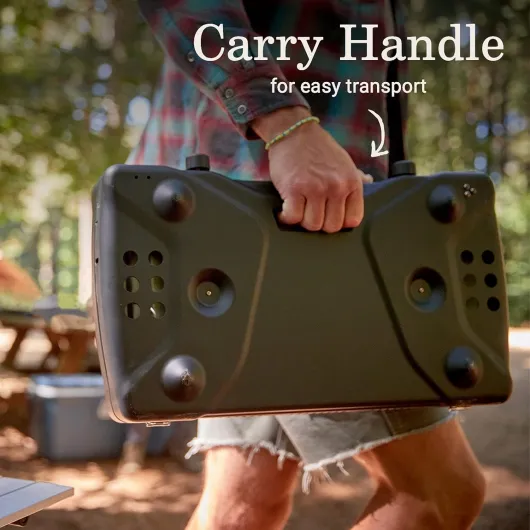
The only real usability annoyances are small: no non-slip feet, no carry handle padding, and no included storage bag. On slick picnic tables, the stove can move a bit when you push a pot around. I solved that with a cheap piece of rubber drawer liner under it. For carrying, the metal handle is fine for short distances, but if you’re walking a bit, a bag makes it more comfortable and keeps all the bits together. None of these are dealbreakers, but they’re things you notice after a few trips.
Performance: heats fast and simmers better than you’d expect
Performance-wise, this stove is pretty solid for camping use. With both burners wide open, it puts out enough heat to handle a big skillet and a pot at the same time without feeling underpowered. I’ve boiled water for coffee while frying bacon and eggs for three people, and I never felt like I was waiting forever. The 22,000 BTUs total seem realistic. It’s not commercial kitchen power, but for a camp setup or tailgate, it’s more than enough.
The thing that surprised me the most was the burner control. On a lot of cheaper stoves, you basically have two modes: off and rocket engine. On this one, the knobs actually give you a usable low setting. I managed to simmer chili without burning the bottom, and I kept a pot of rice just barely bubbling. You still have to babysit it a bit, but it’s much better than older Coleman models I’ve used, where everything scorched unless you kept lifting the pot.
Wind resistance is decent but not perfect. The built-in side wind guards and the lid do a good job in light to moderate wind. At the lake with about 5–10 mph breeze, the flame stayed steady and cooking times were normal. In stronger gusts, you’ll still lose some heat, especially around the edges of larger pans. I wouldn’t rely on it in very exposed, super windy conditions without trying to shield it a bit more, but for typical campsite use, it’s fine.
Fuel use seems in line with the specs: they claim about an hour on high from one 16 oz cylinder. In real life, I got roughly that if I ran one burner near max. With both burners at medium, I got a solid weekend of breakfasts and dinners out of a couple of 1 lb bottles. If you cook a lot or have multiple propane items, switching to a 5 or 20 lb tank with a hose is cheaper in the long run. Overall, the stove does what it’s supposed to do: it lights easily, heats quickly, simmers better than average, and handles normal camping wind without too much drama.
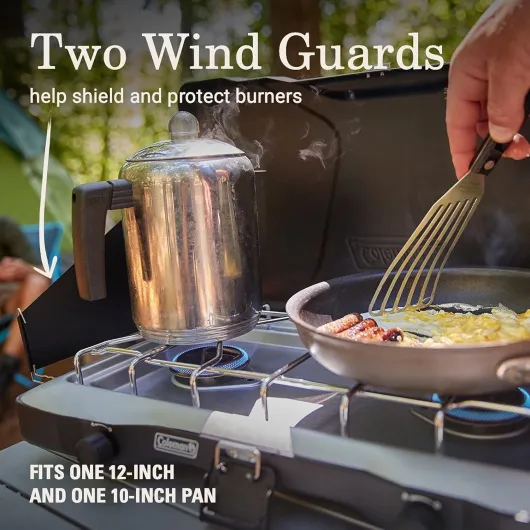
What you actually get with this stove
The Coleman Triton is a classic suitcase-style camping stove. Closed, it looks like a flat metal briefcase in matte black, with a simple latch on the front. The dimensions are roughly 15.9" long, 7.8" wide, and 24.8" high with the lid open (the 24.8" is basically with the lid up as a wind screen). Weight is about 5 pounds, so it’s light enough to carry in one hand but not something you’d take backpacking. This is for car camping, tailgating, or an emergency kitchen setup, not hiking.
Inside you’ve got two burners side by side. It fits a 12-inch pan and a 10-inch pan at the same time, which in real life means a big skillet on one side and a small pot on the other. That’s exactly how I used it: 12" pan for bacon and eggs, smaller pot for coffee water or pasta. There’s a chrome-plated removable grate that covers both burners, which lifts off easily for cleaning. No fancy accessories in the box apart from the stove itself and the grate. Despite what some listings say, mine did not include a separate griddle plate, so don’t count on that being there.
Power-wise, it’s rated for 22,000 BTUs total, so around 11,000 per burner if you crank both. That’s enough to boil a full pot of water in a reasonable time. In practice, I was able to get a medium pot to a rolling boil for pasta in about 8–10 minutes on a cool evening, which is fine for camping. You connect fuel via the standard Coleman-style regulator that screws into a 1 lb propane bottle; if you want to use a bigger tank, you’ll need to buy a separate hose adapter.
In terms of use cases, I’ve used it for: weekend car camping, cooking at the lake out of the back of the SUV, and as a backup stove during a short power outage. For all three, it worked as advertised. No big learning curve, no weird quirks. It’s a pretty straightforward tool: open, hook up gas, light, cook, wipe it down, close it. If you’re expecting a lot of bells and whistles, you’ll be disappointed, but if you just want a basic two-burner camp stove, what you see is what you get.
Pros
- Good heat output (22,000 BTUs) with surprisingly decent simmer control on both burners
- Easy setup and use, with effective wind guards for normal camping conditions
- Compact suitcase-style design that travels well and is straightforward to clean
Cons
- No built-in ignition, non-slip feet, or included carry bag, so you’ll likely buy a few extras
- Prone to small rust spots if not dried and stored properly, so it needs basic care
Conclusion
Editor's rating
After using the Coleman Triton 2-Burner Propane Stove on several trips and as a backup at home, my overall take is that it’s a no-nonsense, reliable camp stove that does exactly what most people need. It heats quickly, handles two decent-sized pans at once, and the burner control is better than a lot of stoves in this price range. The wind guards actually help in normal conditions, and the whole thing folds down into a compact, easy-to-store box. You do need to bring your own lighter and probably a non-slip mat or bag if you want a cleaner setup, but those are minor add-ons.
It’s not perfect. The metal isn’t super thick, it can start to show rust if you leave it wet or outside too long, and you don’t get extras like a built-in igniter or included carry case. But for the money, the balance of performance, simplicity, and reliability is good. I’d recommend this stove to car campers, people who tailgate, or anyone who wants a basic propane stove for power outages. If you’re a backpacker, this is too big. If you want top-tier build and lots of features, you might look at higher-priced models. For regular users who just want something that works and doesn’t feel cheap, this Coleman Triton is a solid choice.