
Summary
Editor's rating
Value for money: fair, but depends how hard you are on boots
Design: more trail shoe than classic boot
Comfort: strong point with a few caveats
Materials: synthetic focus with a Gore‑Tex liner
Durability: good for regular use, questionable for heavy abuse
Performance on trail: traction, support, and real-world waterproofing
What you actually get with these Salomon X Ultra 4 Mid GTX
Pros
- Very comfortable with minimal break-in, feels closer to a trail shoe than a stiff boot
- Good traction and support for day hikes and light backpacking on mixed terrain
- Effective waterproofing at the start, handles rain, puddles, and shallow streams well
Cons
- Waterproofing may weaken after several months of frequent wet use
- Breathability is limited; feet can get warm in hot weather
- Slippery laces and relatively snug fit with no wide option in many sizes

Specifications
View full product page →| Brand | Salomon |
Mid-height hikers that feel more like sneakers
I’ve been using the Salomon X Ultra 4 Mid Gore-Tex as my main hiking boots for a while now, mostly on mixed trails: rocky paths, muddy forest, a bit of snow, plus some rainy city walks. I’m not a thru‑hiker, but I do regular 6–12 mile hikes on weekends and some shorter walks after work. I bought them because I wanted something lighter than classic leather boots but still with ankle support and Gore‑Tex.
First impression out of the box: they look more like beefed‑up trail runners than old-school hiking boots. They’re pretty light in the hand, and on the feet they feel closer to running shoes than to stiff mountaineering boots. I wore them straight for a 5‑mile walk the first day without breaking them in, and I didn’t get any blisters, which is already a good sign for me because I usually have problems with new boots.
Over time, I’ve used them in rain, shallow streams, wet grass, and a couple of light snow days. I’ve also done a few rocky ascents where traction and ankle support actually matter. So I’ve had enough time to see both the good and the annoying parts: where the Gore‑Tex helps, where it starts to feel too warm, and how the sole and materials hold up after some miles.
Overall, I’d say they’re pretty solid mid-weight hiking boots that lean toward comfort and lightness rather than heavy-duty protection. They’re not perfect—waterproofing and breathability have their limits, and there are some small design details that bug me—but if you’re coming from bulky leather boots, they feel like a nice upgrade in comfort. If you expect something bombproof for years of abuse, you might want to manage your expectations.
Value for money: fair, but depends how hard you are on boots
Price-wise, the Salomon X Ultra 4 Mid GTX usually sits in the mid to upper range for hiking boots. You’re paying for the brand, the Gore‑Tex membrane, and the lighter, more modern design. Compared to cheaper non-Gore‑Tex hikers, you do get better initial waterproofing and a more technical feel. Compared to more expensive full-leather boots, you get less long-term durability but more comfort and lower weight.
For what I paid, I’d say the value is good but not mind-blowing. The key strengths are: very little break-in time, good traction, and solid comfort for day hikes and weekend trips. If you mostly hike in mixed conditions and don’t live in constant rain, you get a boot that feels nice on the foot and handles most normal situations. In that scenario, the price makes sense. It’s the kind of boot you’re happy to grab from the closet because you know your feet won’t suffer.
Where the value drops is if you expect long-term waterproofing and heavy-duty durability. If you’re out every week in wet, rocky terrain, you might wear out the membrane and outsole sooner than you’d like for the price. In that case, you might be better off with a heavier leather boot that costs a bit more upfront but lasts longer, or with cheaper boots that you accept you’ll replace more often. Also, the lack of a wide size option in many sizes could be a dealbreaker for some, which hurts the value if you have to buy and return multiple pairs.
Overall, I’d rate the value as solid for regular hikers who prioritize comfort and lightness over maximum lifespan. If you’re realistic about what you’re buying—a light, comfy, mid-cut Gore‑Tex hiker, not an indestructible work boot—then the price is reasonable. If you want something you can thrash for years without worrying, you might feel it’s a bit expensive for what it can endure.
Design: more trail shoe than classic boot
The design of the X Ultra 4 Mid GTX leans heavily toward aggressive trail shoe rather than traditional boot. The mid-cut collar gives some ankle coverage, but the overall structure is flexible. You can bend the boot with your hands; it’s not one of those stiff leather tanks. That’s good for walking comfort and bad if you want maximum protection with a heavy pack on scree all day. The outsole has fairly deep lugs with Salomon’s usual pattern, which bites well in dirt and light mud. On wet rock, grip is decent but not magical—you still have to watch your step.
The lacing system is one of the better thought-out parts. The lower eyelets pull the mid-foot in nicely, and the top hooks let you lock the ankle area separately. The downside is the laces themselves are pretty slippery. More than once, I’ve had to re-tie them because they loosened during the hike. Double knots are basically mandatory. I get why one reviewer complained about that; it’s a small detail but annoying when you’re stopping mid-trail to fix your boots.
Visually, the Black/Magnet/Pearl Blue colorway is pretty neutral with small color accents. It hides dirt well, which I like, because I don’t baby my hiking boots. After several muddy hikes and some rocky scrapes, they still look fine—just dusty. The toe cap has taken a few hits against rocks and roots and hasn’t peeled or split yet, so that part of the design seems solid. The heel area is also well-shaped for me, holding the heel in place without rubbing.
The main design trade-off is support vs. flexibility. If you’re used to old-school leather boots, these will feel soft and almost like high-top sneakers. For day hikes or lighter backpacking, I think that’s a good thing—you get more natural movement and less fatigue. But if you plan to carry a heavy pack over rough terrain for days, you might want something stiffer and more supportive. So the design is well-suited for modern, fast hiking, but not ideal if you’re doing hardcore mountaineering-style trips.
Comfort: strong point with a few caveats
Comfort is probably the main reason to buy these. Out of the box, I went straight to a 5‑mile mixed-terrain walk with no hot spots. Over the next weeks, I did several 8–10 mile hikes, and still no blisters. That’s rare for me; I usually need a break-in period with stiffer boots. The mid-cut gives enough ankle coverage without feeling like a cast. You can move your ankle naturally on uneven ground, which helps with balance and reduces fatigue on long days.
The fit for me (average width, high-ish instep) is snug but not painful. The toe box is just big enough—I agree with the reviewer who said that. If you like a very roomy toe area, you might find it a bit tight, especially with thick socks. Heel lock is good; my heel doesn’t slide when going uphill or downhill. Underfoot cushioning is decent, not super plush. It’s firm enough for rocky trails so you don’t feel every stone, but if you’re used to trail runners with big foam midsoles, this will feel a bit harder.
Breathability is where Gore‑Tex shows its limits. On cool or mild days, it’s fine. On hotter hikes, my feet get warm and a bit sweaty, especially if I’m pushing the pace. One user mentioned it’s “a little less cool/breathable than I like,” and I’m on the same page. You get the waterproofing, but you pay for it in ventilation. In winter, they’re comfortable with medium-weight wool socks. In real cold, your toes can still get chilly, like another reviewer said, but honestly, I haven’t found non-insulated boots that keep feet toasty all day in freezing temps either.
Overall, comfort is good for day hikes and light backpacking. If you have very wide feet or need a lot of extra arch support from thick insoles, you might have issues with the internal volume. But for average feet, they strike a nice balance of support, flexibility, and cushioning. Not luxurious, but definitely comfortable enough to wear all day without thinking too much about your feet.
Materials: synthetic focus with a Gore‑Tex liner
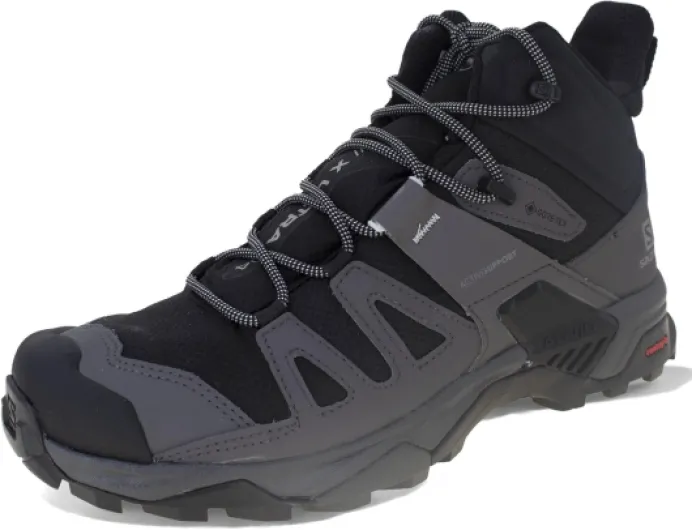
Material-wise, this boot is mostly synthetic fabric with some leather overlays, plus a rubber outsole and a Gore‑Tex membrane inside. The upper fabric feels tough enough to handle branches and rocks without tearing, but it’s not heavy-duty like thick full-grain leather. That’s the trade-off: you gain lightness and faster drying, but you give up some long-term toughness and that classic leather boot feel.
The Gore‑Tex liner does its job at the beginning: water stays out in typical conditions like wet grass, shallow puddles, and short stream crossings. I’ve stepped into water up to just below the laces and stayed dry. Several other users report the same. But there’s also feedback that waterproofing fades after a few months, and I’ve noticed that once you start to really flex the forefoot a lot and grind through mud and grit, the membrane’s performance feels less reliable. It’s not like a hole appears, but after a full day in constant wet conditions, you start to feel dampness, especially at the forefoot crease.
The sole is standard Salomon rubber. It’s not the softest compound on the market, but it strikes a decent balance between grip and durability. After around 70–80 miles, my lugs are worn a bit on the heel edges but still very usable. This lines up with what another user said: they had around 10 miles with no early wear; I’d say even with more distance, the outsole holds up okay. It’s not indestructible, but it’s not getting chewed up instantly either.
Inside, the fabric lining around the ankle and tongue is smooth and hasn’t frayed for me yet. The stock insole is basic EVA foam, which is fine for casual use but a bit underwhelming for longer hikes. I tried swapping to a more supportive insole, but that reduced the internal volume too much for my high-ish instep. So, materials are good enough for regular hiking, but if you’re rough on gear or hike in constant wet conditions, don’t expect them to feel new for years. They’re more in the “solid mid-range” category than in the bombproof premium tier.
Durability: good for regular use, questionable for heavy abuse
In terms of durability, I’d put these in the “pretty solid but not bombproof” category. After around 70–80 miles of mixed use (rocky trails, mud, a bit of snow, plus some urban walking), the upper is holding up well. No tearing, no major stitching issues, and the toe cap hasn’t started peeling. The midsole still feels stable and hasn’t collapsed. The outsole lugs show some wear on the heel edges, but nothing alarming. For normal hiking, that’s acceptable.
Where durability becomes a question mark is the long-term waterproofing. As one reviewer said, the waterproofing didn’t last six months for them. I haven’t had a full failure yet, but I can feel that in very wet conditions, the boots don’t feel as dry as they did when new. It’s more like a slow dampness than an obvious leak. For occasional rain and wet grass, they’re still fine; for regular use in streams and heavy mud, I wouldn’t fully trust them after several months. This seems to be a common pattern with many Gore‑Tex hiking boots, not just Salomon, but it’s worth noting.
The inner lining and padding around the ankle are still intact and haven’t compressed too much. No seams are coming apart so far. The eyelets and lace hooks are metal and haven’t bent or rusted. The only wear annoyance is the laces themselves; they haven’t broken, but because they’re slick, I’m already thinking about replacing them with a grippier pair, which is a cheap fix.
If you’re hiking every weekend on moderate trails, I’d expect these to last a decent amount of time—probably a couple of seasons of regular use before they start to feel tired or less waterproof. If you’re a guide or a thru-hiker pounding out big miles in rough terrain and constant wet, you’ll probably chew through them faster and might want something more robust. So durability is good for casual and regular hikers, but not at the level of heavier full-leather boots built for many years of abuse.
Performance on trail: traction, support, and real-world waterproofing
On the trail, these boots perform well for light to moderate hiking. Traction on dirt, gravel, and forest paths is solid. The lugs dig into soft ground enough to keep you from sliding, and on dry rock they feel secure. In mud, they do okay, but like any boot, if it’s thick sticky mud, you’ll still end up with big clumps under your feet. On wet rock, grip is acceptable but not confidence-boosting; I slow down a bit in those sections. In snow, they pair nicely with microspikes or snowshoes, which matches what one reviewer mentioned about using them with crampons and snowshoes.
Support-wise, for a mid-cut lightweight boot, they’re decent. The ankle collar gives you some stability, and the chassis underfoot has enough structure to keep your foot from folding over on sidehills. I’ve carried a moderate pack (around 20–25 lbs) on rocky trails and felt supported enough. I wouldn’t choose these for multi-day trips with a very heavy pack on rough, technical terrain; there are stiffer boots better suited for that. But for day hikes and weekend trips, they’re fine.
Waterproofing is a mixed bag. In the first months, they handle rain, wet grass, and shallow stream crossings really well. I’ve stood in ankle-deep water briefly and stayed dry. However, there’s a user review that mentions the waterproofing failing in under six months, and I can see how that could happen if you’re often in very wet conditions. Once the outer fabric gets saturated and the membrane has been flexed thousands of times, small leaks or damp spots can show up, especially around the forefoot crease. So I’d say: good waterproofing at first, but don’t expect miracles long-term if you abuse them in constant water.
For pace, they feel light on the foot, closer to trail runners than old-school boots. That makes them nice if you like to move fast and cover miles. If you mostly walk easy trails and occasionally step into puddles, performance is more than enough. If your hikes are more like swamp crossings or long slogs in heavy rain, you may eventually be disappointed by how long the waterproofing lasts.
What you actually get with these Salomon X Ultra 4 Mid GTX
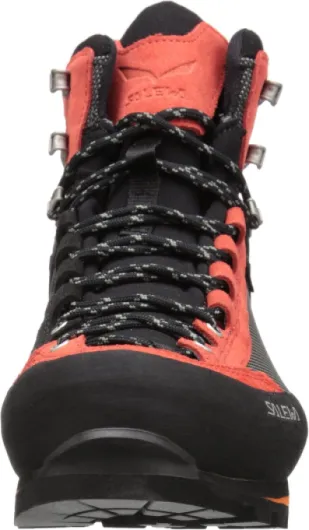
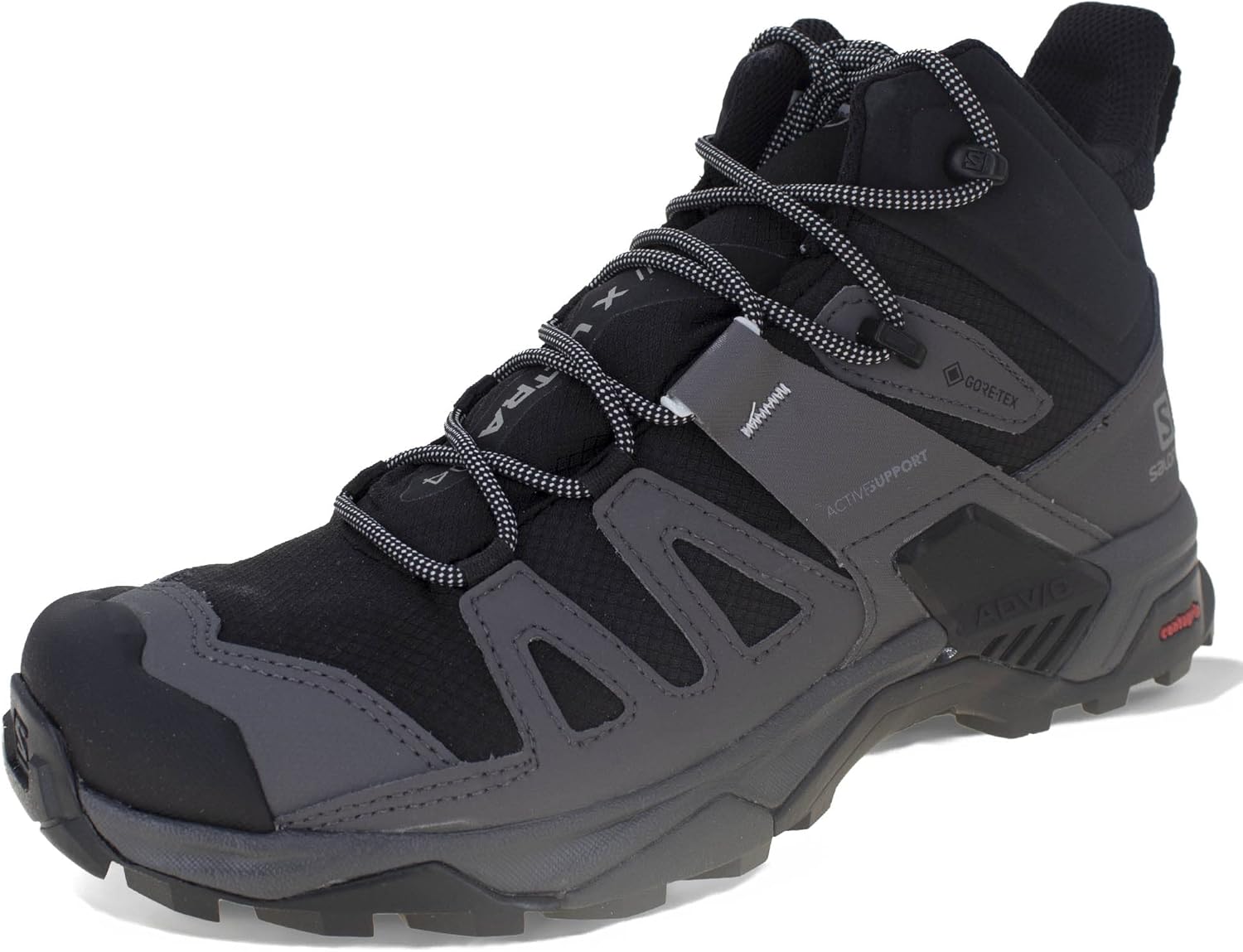
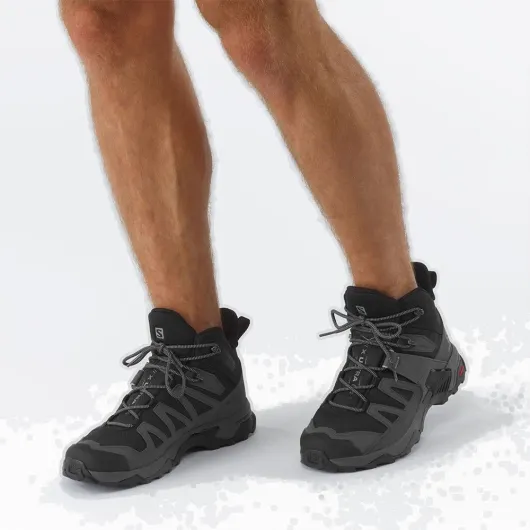
This specific version is the men’s mid-cut X Ultra 4 with Gore‑Tex, in the Black/Magnet/Pearl Blue color, size 12. So mid-height around the ankle, not a low shoe. The style is pretty typical Salomon: technical look, angular lines, and a mix of synthetic and leather panels. It’s not flashy, but it definitely looks like outdoor gear, not casual sneakers. If you wear them in town, people can tell you’re either coming from a hike or trying hard to look like it.
On paper, it’s a synthetic upper with some leather, rubber sole, and a Gore‑Tex membrane inside. The boot is marketed as waterproof, breathable, and relatively light. There’s a real heel counter, toe bumper, and a lacing system that locks the mid-foot pretty well. There’s no wide version in many sizes, which is worth noting if you have wide feet. I have medium-width feet and a slightly high instep, and they felt snug but not painful once the laces were adjusted.
Out of the box, you get: the boots, basic paper stuffing, and that’s it. No extra insoles, no spare laces, no care instructions beyond the usual tag. The insole is pretty standard foam, nothing special. I usually replace stock insoles, but here the volume inside the boot is not huge, so thick aftermarket insoles can make them feel cramped, especially if your instep is high. That matches what one reviewer mentioned about not being able to fit a thicker cushion.
In practice, I’d say the presentation is functional but nothing fancy. It’s clearly built to be used, not admired. The sizing felt true to size for me in length. If you’re between sizes or plan to wear thicker socks, I’d lean half a size up. Just keep in mind there’s no real wide option, so if your feet are like paddles, you might struggle a bit with the fit around the forefoot.
Pros
- Very comfortable with minimal break-in, feels closer to a trail shoe than a stiff boot
- Good traction and support for day hikes and light backpacking on mixed terrain
- Effective waterproofing at the start, handles rain, puddles, and shallow streams well
Cons
- Waterproofing may weaken after several months of frequent wet use
- Breathability is limited; feet can get warm in hot weather
- Slippery laces and relatively snug fit with no wide option in many sizes
Conclusion
Editor's rating
For me, the Salomon X Ultra 4 Mid Gore‑Tex is a comfortable, light, and capable hiking boot that works best for regular day hikes, weekend backpacking, and mixed-weather use. The big positives are how little break-in they need, how they feel more like supportive trail shoes than clunky boots, and their solid traction on most typical terrains. If you’re used to heavy leather boots, these feel like a relief on longer days. They’re also versatile enough to handle a bit of everything: dirt trails, rocky paths, mud, some snow, and rainy walks.
On the downside, waterproofing and long-term durability are not bulletproof. The Gore‑Tex works well at first, but if you’re often in wet conditions or streams, don’t be surprised if performance drops after several months. Breathability is also just okay; your feet can get warm in hot weather. The laces are annoyingly slippery, and the fit is on the snug side, with no wide option for many sizes, so wide-footed hikers might struggle.
I’d recommend these boots to hikers who want something light, comfy, and reasonably protective for 3‑season use, mainly on trails and moderate terrain, and who take care of their gear. They’re a good choice if you’re doing 5–15 mile hikes, some light backpacking, and occasional wet conditions. If you’re a heavy-duty user, carry big loads, or live in constant rain and mud, I’d look at stiffer, more robust leather boots instead, even if they’re heavier and need more break-in.