
Summary
Editor's rating
Value for money: good tool if you accept the old-school quirks
Small, tough, and a bit stuck in the past
Battery life and power: AA simplicity that just works
Durability and outdoor use: built to be abused
Navigation performance: solid tracking, dated tech
What the eTrex 22x actually offers in real life
Pros
- Very good battery life on two standard AA batteries with easy spares
- Rugged, waterproof design that handles rain, drops, and rough use
- Reliable GPS + GLONASS tracking with preloaded TopoActive maps for hiking and cycling
Cons
- Small 2.2" screen and slow, dated interface compared to modern devices
- Mini-USB port and clunky map/route management through older Garmin software

Specifications
View full product page →| Brand | Garmin |
A basic but reliable GPS when your phone has no signal
I picked up the Garmin eTrex 22x after one too many hikes where my phone GPS freaked out as soon as I lost cell service or got under thick trees. I didn’t want a smartwatch, and I didn’t need a super high-end mapping unit, just something small I could toss in the pack and trust when I’m off the grid. The eTrex line has been around forever, so I went for this 22x model to see if the old-school style still makes sense in 2025.
First impression: this thing feels like a tool, not a gadget. No touch screen, no fancy animations, just a small color screen and a bunch of buttons. If you’re used to phones and modern Garmins, it feels a bit dated. But once I actually used it on trail, I kind of understood why people keep buying these. It’s simple, it locks onto satellites quickly enough, and it just keeps running on AA batteries without drama.
I’ve used it on a mix of forest hikes, some basic off-trail exploring, and a bit of driving and kayaking with it strapped in place. It’s not perfect. The interface is clunky by today’s standards, the screen is small, and setting it up with maps and routes takes a bit of patience. But when you’re in the woods with no bars, the eTrex 22x does what it’s supposed to do: tells you where you are, where you were, and how to get back.
If you’re expecting a modern, connected device with phone integration and slick menus, you’ll probably be annoyed. If you want a solid little brick that runs forever on AA batteries and doesn’t care about rain, cold, or getting tossed in a pack, this thing still makes sense. That’s basically how I’d sum it up after using it: old-school, slightly annoying at times, but trustworthy.
Value for money: good tool if you accept the old-school quirks
In terms of price, the eTrex 22x usually sits under the $200 mark. For that, you’re getting a rugged handheld GPS with preloaded topo maps, long battery life, and proven hardware. You’re not paying for cutting-edge features, fancy screens, or deep smartphone integration. So the value really depends on what you expect from it and what you compare it to.
Compared to using just a smartphone with offline maps, this is more money up front, but you gain reliability, battery independence, and durability. Your phone is still there for photos and backup, but the eTrex can take the beating and run on AAs while your phone stays in airplane mode. For people who hike a lot in remote areas, that peace of mind is worth something. On the other hand, if you mainly do short day hikes on well-marked trails with decent cell coverage, your phone plus a good app might be enough, and the eTrex will feel like overkill.
Against other Garmin handhelds, the 22x is kind of the budget, no-frills option. You don’t get multi-band GNSS, bigger screens, or deep Bluetooth features you see on newer models. But you also don’t pay those higher prices. If you’re okay with a smaller screen and slower interface, the 22x gives you the core functions at a lower cost. If you’re already spending serious money on gear and want something more modern and connected, you might be happier saving up for a higher-end Garmin.
Overall, I’d call the value pretty solid but not mind-blowing. You’re paying for a proven, slightly outdated design that still works well. If your priority is a simple, tough GPS that you can trust off-grid, the price makes sense. If you want something slick, fast, and integrated with your phone, this will feel like you spent money on old tech.
Small, tough, and a bit stuck in the past
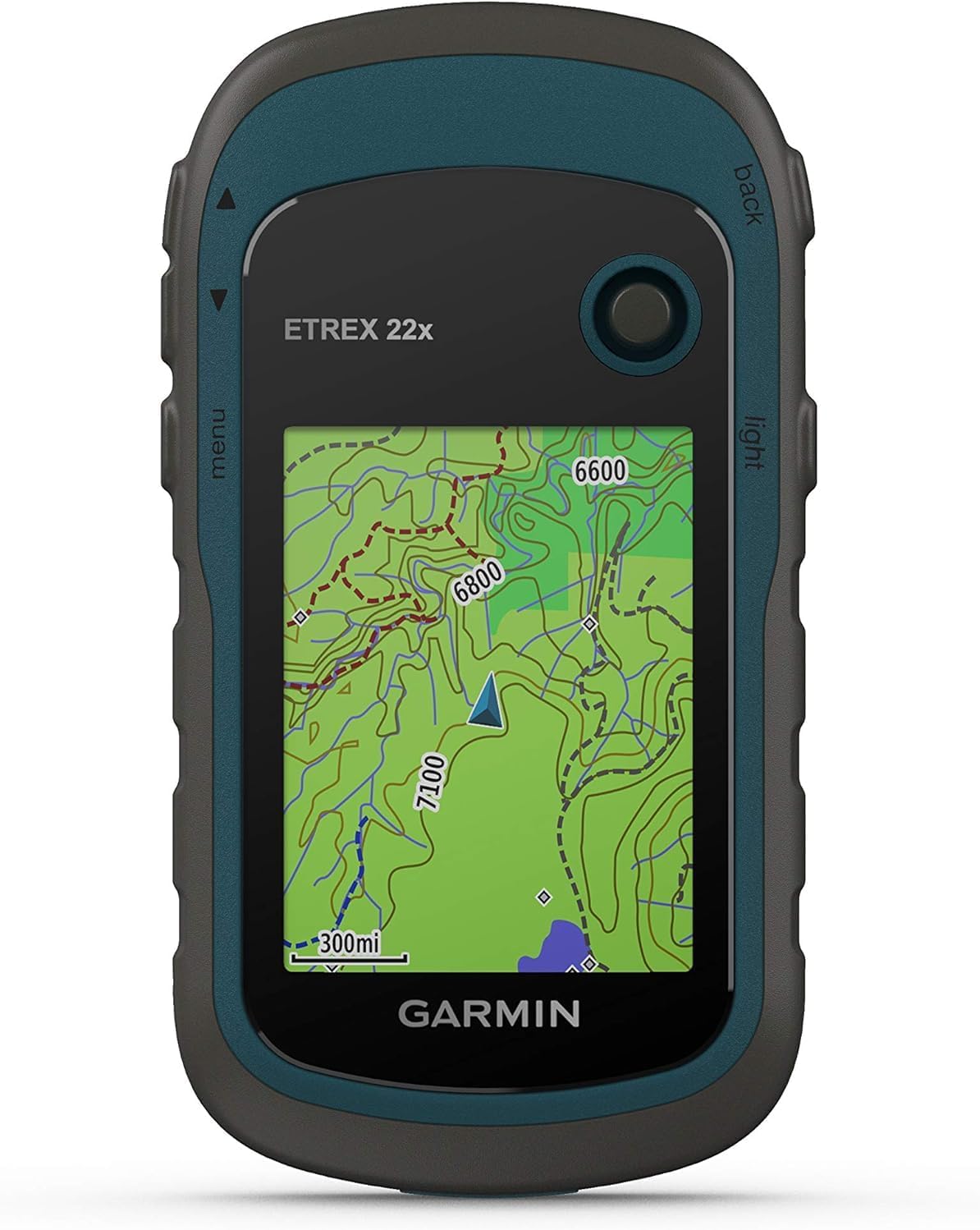
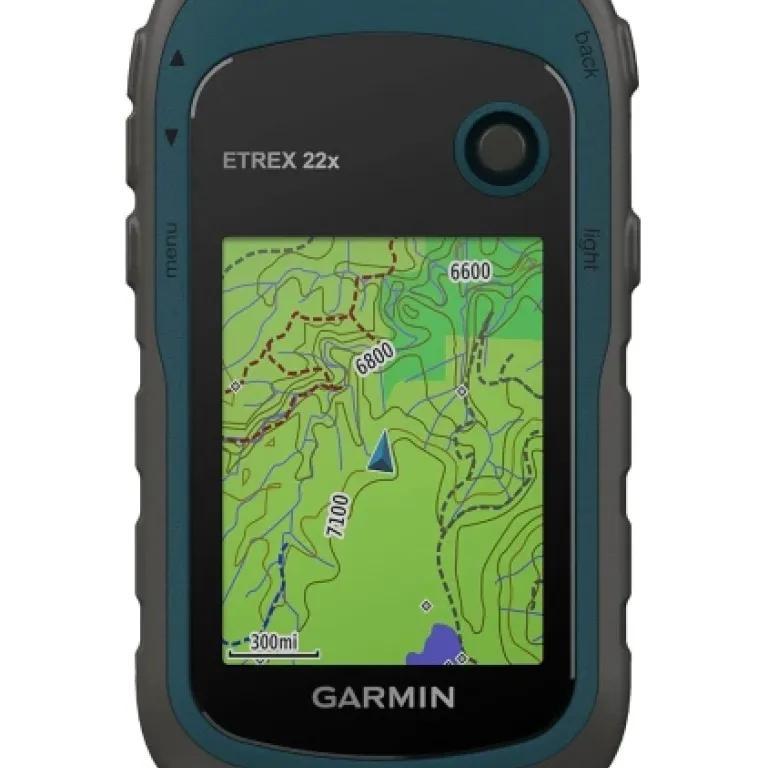
Physically, the eTrex 22x is exactly what you’d expect from an old-school Garmin handheld. It’s small (about 4 inches tall, 2.1 inches wide), light at around 5 oz, and shaped to sit nicely in one hand. The shell is black with a navy front, rubberized around the sides for grip. It’s clearly built to be tossed into a backpack, clipped on a strap, or mounted on a bike or ATV without babying it.
The main thing that stands out in use is the button layout and joystick. On the right side you’ve got a little thumb stick that acts like a mini joystick plus button. Then there are a handful of physical buttons around the sides for back, menu, power/backlight, etc. Coming from touchscreens, it feels slow at first, but once you learn the pattern, it’s actually usable with gloves and in rain, which is kind of the point. I’ve used it with light gloves on a cold morning and didn’t struggle much, which I can’t say for my phone.
The weak point design-wise is the screen size and port choice. The 2.2" screen is small, and while the resolution (240 x 320) is fine for text, it feels cramped for maps. You do a lot of panning and zooming with the joystick, which is not exactly fast. Also, Garmin is still using a mini-USB port hidden under a rubber flap. It’s sturdy enough, but mini-USB is dated. I had to dig around to find an extra cable, and if you lose the included one, you’re not grabbing a random USB-C off your desk to replace it.
Overall, the design is functional but clearly from an older era. It’s tough, it fits well in the hand, and the mounting rail on the back works with a bunch of Garmin mounts and tethers. But if you’re used to big bright touchscreens and modern connectors, this will feel like stepping backward. Whether that bothers you depends on what you care about more: rugged reliability or modern convenience.
Battery life and power: AA simplicity that just works
The battery setup on the eTrex 22x is one of its main strengths. It runs on two standard AA batteries, and Garmin claims up to 25 hours in GPS mode. In real life, that number is actually pretty believable if you’re not blasting the backlight at 100% all day. I ran it on decent NiMH rechargeables on a couple of full days of hiking and still had enough juice left at the end to feel comfortable skipping a change.
What I really like is the flexibility. You can tell the device what battery type you’re using (alkaline, lithium, NiMH), and it adjusts the battery gauge so it’s not lying to you. For longer trips, I just throw a couple of spare AA pairs in my pack, and that’s it. No proprietary charger, no power bank unless I feel like bringing one, and if something goes wrong I can buy AA batteries almost anywhere. Compared to built-in batteries that slowly degrade over years, this is straightforward and easy to manage.
The trade-off is you don’t get fancy power features. There’s no built-in charging for rechargeables – you have to charge your NiMH cells in a separate charger. Also, no USB-C quick charging or anything like that because it doesn’t charge at all over USB; that port is just for data. So if you’re coming from a world of plugging everything in at night, this is a bit different. You’re swapping batteries, not charging the device itself.
Overall, though, for a hiking GPS, I think this battery approach makes sense. Long runtime, predictable behavior, and easy to carry backups. If you’re doing multi-day trips, being able to just pack a small bag of AAs is very convenient. It’s not modern, but in this case, old-school is actually pretty practical.
Durability and outdoor use: built to be abused
On the toughness side, the eTrex 22x feels like a brick in a good way. It’s rated IPX7, so it can handle being splashed, rained on, and even dunked for a short time. I used it in light rain and damp conditions, and it never flinched. The buttons still worked fine when wet, and the screen didn’t freak out like a touch screen does when it gets water on it. I wouldn’t go deep diving with it, but for hiking, kayaking, and general outdoor stuff, it feels very safe.
The casing itself is hard plastic with rubberized edges, and it takes knocks well. I’ve dropped it a couple of times from waist height onto dirt and rock, and it just ended up with minor scuffs. The screen is recessed a bit, which helps protect it if it lands face-down. It’s not scratch-proof, but after tossing it in a pack with other gear, I didn’t end up with any serious damage – just normal light marks you’d expect on a field tool.
One small but useful detail is the mounting rail and tether options. There’s a standard Garmin rail on the back, so you can clip it to bike mounts, car mounts, or use a dedicated tether. I ran a simple cord through it and attached it to my pack strap; that way, even if it slipped out of my hand or the holder, it wasn’t going anywhere. For rough terrain or thick brush, that’s reassuring.
Long-term, based on how similar this is to older eTrex models that have lasted people for years, I’d expect this to hold up very well as long as you don’t destroy the rubber seals or abuse the USB flap. The only wear point I can see being an issue after many years is the rubber around the buttons, but that’s more of a decade-scale problem. In short: it’s not pretty, but it feels like something you can rely on for a long time without babying it.
Navigation performance: solid tracking, dated tech
Out on the trail, the eTrex 22x behaves like a steady workhorse. It uses both GPS and GLONASS, which helps in tougher environments, but it’s still a single-band receiver. That means you don’t get the extra precision of newer multi-band units, but for normal hiking and off-road use it’s generally fine. I tested it in mixed forest cover, some ravines, and open fields, and it kept a lock most of the time without big jumps in position.
Track recording is straightforward. You turn it on, toss it in a pocket or clip it to your pack, and it quietly logs your route. When I compared recorded tracks to my phone (when I had service) and to known trail lines from online maps, the eTrex line was usually slightly smoother and less jumpy. Average error felt in the 3–10 meter range in typical woods, which is normal for this kind of unit. It’s not survey-grade, but it’s plenty for finding your way back or following a path.
The downside is speed and interface lag. Redrawing maps when you pan or zoom is slower than modern devices. You move the joystick, it thinks for a second, then the map refreshes. It’s not unusable, but if you’re used to a smartphone, it feels clunky. Same story when loading bigger map areas off a microSD card – it works, just not quickly. Routing on roads and trails from the preloaded TopoActive maps is functional, but again, not fast. You tap through a few menus, wait for it to calculate, and then follow simple turn prompts.
Where it shines is reliability and consistency. It doesn’t crash, it doesn’t overheat, and it doesn’t care if you’ve got cell coverage. Once you learn the menus, marking waypoints, following a track, or navigating back to your starting point is pretty straightforward. So performance-wise: it’s not modern or snappy, but for the basic job of “tell me where I am and help me get back,” it does the job reliably.
What the eTrex 22x actually offers in real life
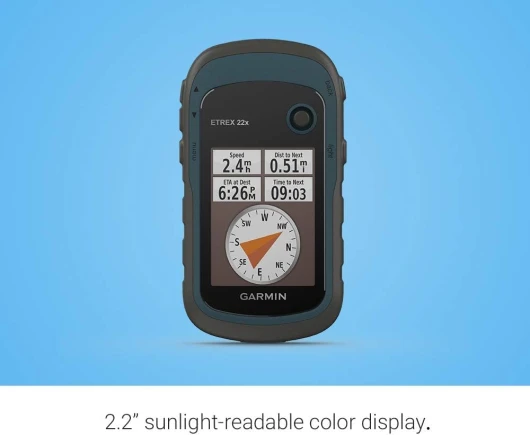
The eTrex 22x is a compact handheld GPS with a 2.2" color screen, preloaded TopoActive maps, and support for GPS + GLONASS satellites. On paper, that sounds fairly standard, but in practice it’s a very stripped-down, purpose-built device. You get the unit itself, a USB cable (mini-USB, not modern), and some paperwork. No fancy mount, no case, no batteries in my box – you’re on your own for AA cells and accessories.
The main features that matter in real use are pretty simple: preloaded topo maps, track recording, waypoints, and basic navigation (follow a track, go to a waypoint, see distance and direction). It’s rated for about 25 hours on two AA batteries in GPS mode. I ran it on NiMH rechargeables and got close to that with the backlight set reasonably low. You can add more maps via the 8 GB internal memory and a microSD card, but be ready to spend time downloading and managing them through Garmin’s software, which isn’t exactly plug-and-play.
In terms of satellite performance, it locks on in a couple of minutes from cold start and faster once it’s warmed up and has a clear sky. Under trees, it still held a signal well enough for hiking, and accuracy was usually within a few meters when I checked against known points or my phone in good conditions. It’s not multi-band or cutting-edge, but for hiking, geocaching, and basic off-road navigation, it’s good enough and consistent.
So in practice, what you’re buying here is a simple, rugged, button-based GPS with decent maps and long battery life. No Wi‑Fi, no smartphone sync (despite the Bluetooth mention in some specs, you don’t get the kind of connected features newer units have), and no touch screen. If you’re okay with that and just want reliable location and a breadcrumb trail, it does the job. If you expect modern connectivity and easy map updates, you’ll probably find it a bit tedious.
Pros
- Very good battery life on two standard AA batteries with easy spares
- Rugged, waterproof design that handles rain, drops, and rough use
- Reliable GPS + GLONASS tracking with preloaded TopoActive maps for hiking and cycling
Cons
- Small 2.2" screen and slow, dated interface compared to modern devices
- Mini-USB port and clunky map/route management through older Garmin software
Conclusion
Editor's rating
The Garmin eTrex 22x is basically a modern-ish take on an old-school handheld GPS. It’s small, tough, runs forever on AA batteries, and focuses on one job: showing you where you are and helping you stay on track when your phone isn’t reliable. The preloaded TopoActive maps, GPS + GLONASS support, and solid track recording make it a dependable tool for hiking, camping, and general outdoor use. It feels like something you can throw in your pack and forget about until you actually need it.
On the flip side, it’s clearly behind the times in some areas. The 2.2" screen is small, the interface is slow compared to phones and newer Garmins, and the mini-USB port plus clunky map management feel dated. There’s no real modern Bluetooth integration the way many people expect today. If you like slick UIs and easy syncing with your phone, you’ll probably be annoyed. But if you care more about reliability, battery flexibility, and durability than about tech flash, it still makes a lot of sense.
I’d recommend the eTrex 22x to hikers, hunters, and outdoorsy folks who want a basic, trustworthy GPS that doesn’t depend on cell service and doesn’t mind getting beat up. It’s also a good backup navigation tool for off-road drivers and boaters. People who should skip it: anyone who wants a big bright screen, touch controls, deep smartphone integration, or very high-precision multi-band GNSS. For them, a higher-end Garmin or just a good phone + app combo will fit better. For what it is – a rugged, no-nonsense handheld GPS – the eTrex 22x gets the job done.