
Summary
Editor's rating
Value: good if you specifically want minimalist boots, otherwise there are safer bets
Design: minimalist idea, slightly aggressive heel area
Comfort: rough break-in, then pretty good if you like minimal shoes
Materials: tough enough, but not luxury
Durability: solid so far, but thin sole has its limits
Performance: great ground feel and stealth, limited protection
What you actually get with the Mini-Mil TR105
Pros
- Very lightweight for an 8-inch tactical boot, reduces fatigue over long days
- Low drop and wide toe box give a natural, minimalist feel with good ground feedback
- Vibram Tarsus outsole offers decent grip and flexibility while staying uniform-compliant
Cons
- Harsh break-in with significant heel/Achilles rubbing for many users
- Thin sole means you feel rocks and rough ground more, less protection under heavy loads
- Not waterproof and leather shows water stains easily

Specifications
View full product page →| Brand | TACTICAL RESEARCH TR |
Minimalist combat boots that actually feel like sneakers? Kind of.
I grabbed the TACTICAL RESEARCH Mini-Mil TR105 because I wanted something closer to a barefoot boot than the usual bricks we get issued. My feet were getting tired of thick soles, heavy leather, and that feeling of walking on wooden blocks all day. On paper, these looked perfect: low drop, wide toe box, Vibram sole, and still compliant with uniform regs. So I went in with decent expectations, but not dreaming of miracles.
First impression straight out of the box: they’re light. Like, noticeably lighter than standard issue or most commercial tactical boots I’ve worn. You pick them up and it feels more like a trail runner with an 8-inch upper than a real duty boot. The build doesn’t scream luxury, but the stitching and materials look solid enough for field use. No fancy finish, just functional.
Once I laced them up, I immediately felt two things: the ground under my feet, and pressure around the heel/Achilles. If you’re used to cushioned boots, the thin sole is a bit of a shock. Not bad, just different. But the heel and back-of-ankle area? That’s where the pain party starts. After a couple hours the rubbing was real, especially on inclines or stairs.
After a few weeks, though, my opinion changed quite a bit. The boots softened up, the heel irritation calmed down, and the minimalist feel started to make sense. They’re not perfect and there are some design quirks that bug me, but if you know what you’re getting into, they can be a pretty solid option. Just don’t expect to throw them on day one and ruck 10 miles without some suffering.
Value: good if you specifically want minimalist boots, otherwise there are safer bets
In terms of value, I’d put these in the “good but niche” category. Price-wise, they sit below some of the big-name premium tactical boots but above the bargain stuff. You’re paying for the lightweight build, Vibram sole, and minimalist design more than for plush comfort or fancy features. If that’s exactly what you’re looking for – a low-drop, wide-toe, uniform-compliant boot – then the price makes sense and feels fair.
Where the value gets tricky is if you’re just a regular user who wants a comfortable all-around duty or work boot. For the same money, you can get more cushioned, out-of-the-box comfortable options from other brands that don’t need a brutal break-in or force you to deal with heel rubbing. Those boots will be heavier and less “barefoot”, but a lot of people don’t care about that. So for the average guy who just wants something comfy and durable, this might feel like a compromise instead of a deal.
For more specific use cases – ground hunting, light rucking, patrols, range days, or anyone into minimalist footwear – the value looks better. The combo of low drop, wide toe box, and real ground feel is rare in a regulation-looking boot. You’d normally have to hack something together or accept a non-compliant shoe. If that’s you, paying a bit more for this specific design makes sense, even with the downsides.
So overall, I’d say the value is pretty solid if you know what you’re buying and not that impressive if you just randomly grab them expecting a comfy, generic tactical boot. There’s better for the price in terms of comfort and protection, but not many direct competitors for this exact minimalist niche that still passes uniform rules.
Design: minimalist idea, slightly aggressive heel area
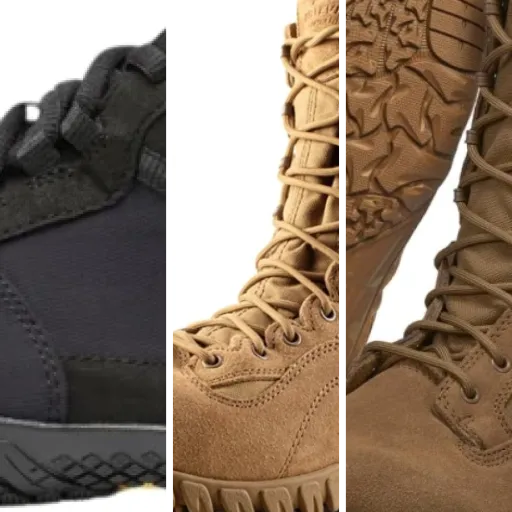
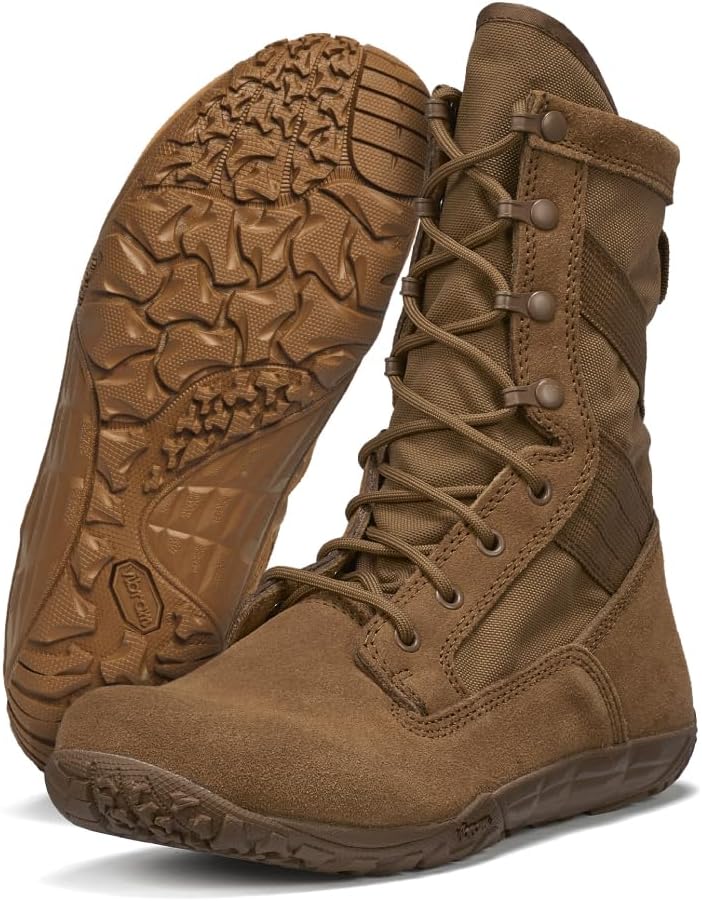
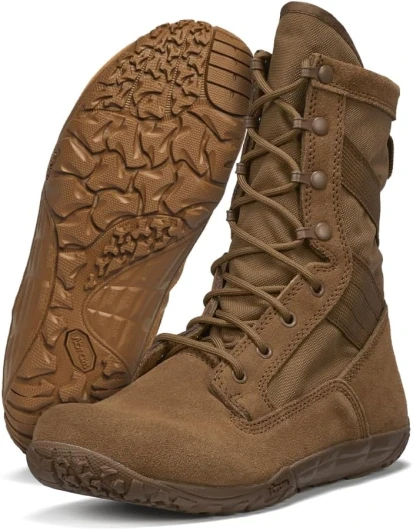
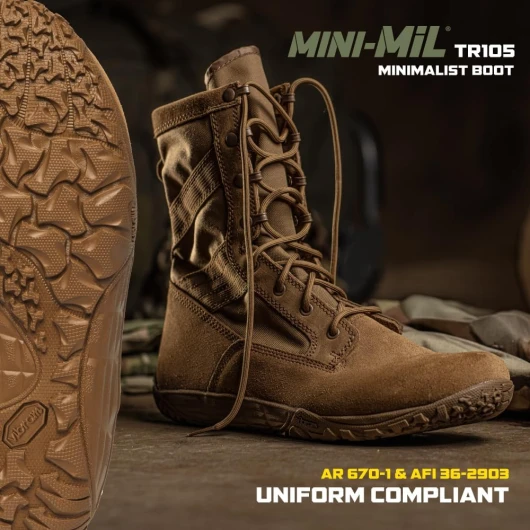
Design-wise, you can tell they tried to merge a barefoot shoe mindset with a regulation combat boot silhouette. The 8-inch height, lace pattern, and coyote color all look standard issue from a distance. Up close, you notice the slimmer sole and the way the upper flexes more compared to a typical stiff military boot. The profile is clean, not flashy, no giant logos or weird patterns – which I like for work use.
The main design win for me is the wide toe box. I hate boots that squeeze my toes together, especially on long days. With these, my toes actually have room to spread out when I walk or run. After a couple of long range days, my forefoot felt less cramped than with most boots. If you’re into barefoot shoes or Altra-style running shoes, this will feel familiar in a good way.
Where the design stumbles is the heel and Achilles area. There’s a layered construction at the back that gives structure and support, but it creates a stiff edge that digs into the back of the ankle when the boots are tightly laced. On me, it felt like a plastic or stiff insert was pushing into the bone. First few days, I got legit hot spots and almost blister-level irritation. I’m not the only one either – a lot of people mention the same heel rub. It does get better as the boot breaks in, but out of the box it’s rough.
Lacing is straightforward, no speed hooks, just regular eyelets. You can play with lacing tension to reduce heel pressure, but then you lose some ankle lock, which kind of defeats the purpose of an 8-inch boot if you’re doing uneven terrain. So the design is a trade-off: good forefoot freedom and flexibility, questionable comfort around the heel. If they rounded or padded that area a bit better, the design would make a lot more sense for long days and rucks.
Comfort: rough break-in, then pretty good if you like minimal shoes
Comfort on these boots is a bit of a roller coaster. First week: not fun. I wore them for a couple of 8–10 hour days right away, and the back of my ankles and Achilles got chewed up. The stiff heel area rubbed every step, especially going uphill or climbing stairs. I had to switch to double socks – thin liner sock plus a normal boot sock – just to make them bearable. With single socks, I was on the edge of blisters by midday.
After about 2–3 weeks of on-and-off use, they started to calm down. The leather and the heel structure softened slightly, and the rubbing dropped a lot. Once broken in, I could wear them with normal boot socks without thinking about my ankles all the time. So, yeah, the break-in period is very real. If you buy these, plan ahead: don’t throw them on for a long ruck or a multi-day field exercise straight out of the box unless you enjoy taping your heels.
Now, if you’re used to regular cushioned boots, the thin sole and low drop will feel weird at first. You feel rocks, roots, and small bumps way more. For me, after a few days, this actually felt nice: my stride felt more natural, and my feet didn’t feel like they were fighting a big heel every step. But it does demand stronger feet and calves. If you jump into these from thick, high-heel boots and start running or rucking hard, your calves and Achilles will complain. This is not a plug-and-play comfort boot for everyone.
Once I got past the initial phase, comfort was pretty solid for what it is: light, flexible, and roomy in the toes. Standing for long periods is fine, walking is good, running short distances feels natural. For long rucks on rocky terrain with heavy weight, I’d still pick something with more cushion. So I’d say comfort is very dependent on your expectations: if you want a barefoot-style combat boot and you’re ready for a tough break-in, you’ll probably like them. If you just want a plush, out-of-the-box comfy duty boot, this is not it.
Materials: tough enough, but not luxury
The upper is a mix of cattlehide leather and 1000D Cordura nylon, which is pretty standard for modern military boots. The leather sections feel thick enough to take abuse, and the Cordura panels help with breathability and flexibility. After dragging them through dirt, light mud, and some rocky trails, the fabric didn’t fray and the leather only showed cosmetic scuffs. Stitching is double and triple in the usual stress zones, and I didn’t see any loose threads out of the box or after a few weeks.
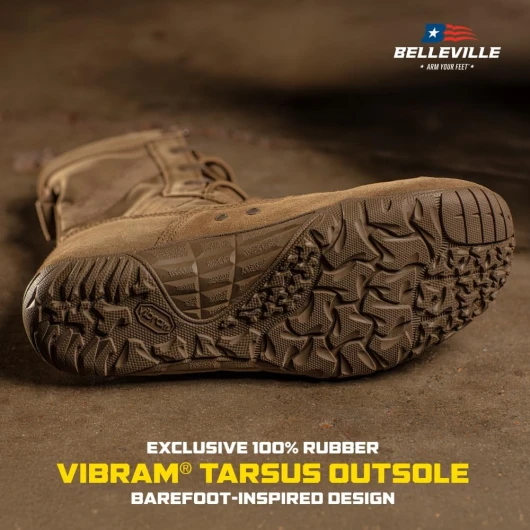
The outsole is a 100% rubber Vibram Tarsus with micro lugs. It’s not a chunky mountaineering sole; it’s thinner and more flexible. Rubber feels grippy on concrete, rocks, and dry dirt. On wet smooth surfaces, it’s decent – not magic, but I didn’t feel like I was skating. In mud, the small lugs fill up faster than a big lug sole, but they also shed debris reasonably well once you’re back on drier ground. You’re trading deep mud performance for ground feel and quiet movement.
Inside, the single-density molded insert is basic but functional. It adds a bit of cushion without killing the minimalist vibe. If you have sensitive feet or are used to a lot of padding, you might want to swap in a better insole, but that kind of ruins the low-drop, ground-feel point of this boot. The lining is nothing fancy, just standard fabric, but it breathes okay for hot-weather use. No waterproof membrane, which is good for breathability but bad if you stand in wet grass or puddles – you’ll get wet fast.
One thing that bugged me: the leather shows water stains easily. A bit of rain or splash and you get marks that don’t just fade away when dry. Functionally it doesn’t matter much, but if you care about your boots looking clean for garrison, that’s annoying. I’d strongly suggest treating them with a waterproofing spray or wax before serious use. Overall, the materials feel practical and durable enough, but they don’t feel premium or soft. It’s more “rugged work gear” than anything else, which fits the price point.
Durability: solid so far, but thin sole has its limits
On the durability side, after a few weeks of regular use (range days, some light hiking, daily wear), the boots are holding up well. The stitching hasn’t popped anywhere, and I checked the high-stress zones like around the toe flex, heel, and eyelets. No loose threads, no separation between leather and sole. That’s a good sign, especially for something this light. The upper leather has a few scuffs and creases, which is normal, and the Cordura panels still look almost new.
The Vibram sole shows some wear on the outer heel and forefoot, but nothing alarming. Because the sole is thinner than a standard boot, I expect it to wear out faster if you’re doing a ton of miles on concrete or asphalt. This isn’t some huge lug, long-distance pavement stomper. For mixed use – dirt, field, training, and some city – I’d expect a reasonable lifespan, but not multi-year abuse like some heavier boots. If you’re hard on footwear and live on rough surfaces, long-term durability will probably be just “okay” rather than great.
One concern is that internal heel structure that causes the rubbing. Since it feels like a stiff plastic piece, I don’t see it breaking down quickly. That’s both good and bad: good for long-term support, bad if that shape happens to hit your ankle bone the wrong way. On my pair, it softened enough to stop hurting, but I can see how some people might end up with a permanent hot spot if their anatomy and that plastic piece just don’t match. That’s more of a design durability issue than a material failure.
Overall, I’d call durability pretty solid for the weight class. It’s not indestructible, but it’s not flimsy either. If you treat them as lightweight, hot-weather, movement-focused boots and not as your only pair for years of daily abuse on concrete, they should hold up fine. If you want a boot you can beat to death on every surface for years, you might want something heavier and more traditional.
Performance: great ground feel and stealth, limited protection
Performance-wise, these boots shine in mobility and ground feel, and are weaker when it comes to protection and long-haul comfort under heavy load. On dirt trails, forest floor, and mixed terrain, I felt very connected to the ground. You can feel small branches and rocks through the sole before you fully commit your weight, which helps you move quietly. For hunting, stalking, or any kind of field movement where noise matters, that’s a real plus. Compared to traditional chunky boots, I was noticeably quieter and more precise with my steps.
Traction from the Vibram Tarsus sole is good but not aggressive. On dry dirt, gravel, and rock, grip is reliable. On wet concrete or wet rocks, it holds up pretty well, though you still have to be careful like with any boot. In mud or clay, the micro-lugs don’t bite as deep as a big lug sole, but they also don’t cake up as badly once you’re out of the worst of it. For most normal field, range, or light hiking use, the traction is enough. I wouldn’t pick these for steep, loose, alpine-style terrain with a heavy pack.
The light weight really helps with fatigue. After full days on my feet, my legs felt less beat up compared to heavier boots. But there’s a trade-off: because the sole is thin and there’s not a lot of cushioning, stepping on a big sharp rock still hurts. It’s not like bare feet, but you definitely notice it. If you’re carrying a lot of weight or doing long rucks on rocky fire roads, that constant impact will add up. I’d call these good for up to moderate distances and loads, but not my first choice for long-distance rucking with 60+ lbs.
For heat management, they do well. The leather and Cordura combo breathes decently in hot weather. My feet got warm, but not swampy, and they dried reasonably fast after sweating. Just remember: they are not waterproof. Dewy grass or shallow puddles can soak them and your socks. So performance is very solid for light, fast, stealthy movement in warm conditions, and more limited when you need serious protection, insulation, or load-bearing support.
What you actually get with the Mini-Mil TR105
On paper, the TR105 is a minimalist, 8-inch, AR 670-1 / AFI 36-2903 compliant boot in coyote brown, built for people who want that “barefoot” style but still need to look like they belong in a formation. It has a 2 mm heel-to-toe drop (almost flat), a wide toe box, a thin Vibram Tarsus outsole, and weighs about 16 oz per boot. That’s noticeably lighter than most traditional combat boots which usually sit closer to 25–30 oz per boot.
The brand pushes a few main points: minimal sole with ground feel, low drop, extra wide toe box, and breathable leather + Cordura upper. There’s also a removable single-density insert, which is just a basic foam insole with a bit of structure – nothing fancy, but it helps take some sting out of rocks and hard surfaces. The outsole has small lugs instead of big aggressive ones, so it’s more about quiet grip and flexibility than deep mud traction.
In practice, what that means is this boot sits in a weird middle ground between a running shoe and a standard duty boot. You feel much more of the terrain than with normal tactical boots. If you step on a big rock, you know it. When you move quietly over leaves, roots, or gravel, you also feel more in control of your foot placement. That’s good for hunting, patrolling, or range days where you’re moving a lot but not hauling 80 pounds of kit over sharp scree all day.
Big caveat: sizing runs small. The brand even says to go half a size up from your running shoe. I did that, and it was the right call. If you go true-to-size and have wider feet or like thicker socks, you’re probably going to hate life for the first few days. Overall, the presentation is very “function first”. No fancy packaging, no premium feel. It’s basically: here’s a light boot that bends, grips, and fits in uniform rules. Take it or leave it.
Pros
- Very lightweight for an 8-inch tactical boot, reduces fatigue over long days
- Low drop and wide toe box give a natural, minimalist feel with good ground feedback
- Vibram Tarsus outsole offers decent grip and flexibility while staying uniform-compliant
Cons
- Harsh break-in with significant heel/Achilles rubbing for many users
- Thin sole means you feel rocks and rough ground more, less protection under heavy loads
- Not waterproof and leather shows water stains easily
Conclusion
Editor's rating
After wearing the TACTICAL RESEARCH Mini-Mil TR105 for a while, my take is simple: they’re good minimalist military-style boots with a painful break-in and a few quirks. Once they soften up, they feel light, flexible, and natural underfoot, especially if you’re already used to barefoot or low-drop shoes. The wide toe box and thin Vibram sole make moving quietly and precisely much easier than in standard clunky combat boots.
On the downside, the heel/Achilles area is badly behaved out of the box. Expect rubbing, hot spots, and probably double socks or moleskin for the first couple of weeks. Protection and cushioning are limited, so if you do heavy rucks with big loads on rocky ground, you’ll feel it. They’re also not waterproof, and the leather shows water stains pretty fast, so they’re clearly aimed at hot, mostly dry environments.
I’d recommend these to people who: like minimalist footwear, want ground feel and quiet movement, need something that still looks regulation, and are willing to push through a rough break-in. If you just want a comfy, forgiving duty boot you can wear all day from day one, or if you depend on maximum cushioning and protection, I’d skip these and look at more traditional options.