
Summary
Editor's rating
Value for money: worth it if you know what you’re buying
Design: more trail shoe than classic boot
Comfort: great out of the box, with a few quirks
Materials: technical mix with some compromises
Durability and waterproofing: good for the weight, but not bulletproof
Performance on the trail: grip and stability are the main strengths
What you actually get with these Salomon boots
Pros
- Light and agile for a mid-height Gore-Tex hiking boot
- Very good grip on wet and mixed terrain thanks to the Contagrip outsole
- Comfortable out of the box with minimal break-in and decent ankle support
Cons
- Waterproofing may weaken after several months of heavy use
- Durability is decent but not on the level of heavier full-leather boots

Specifications
View full product page →| Brand | Salomon |
Light hikers with trail-runner DNA
I’ve been using the Salomon X Ultra 4 Mid Gore-Tex (men’s, size 11.5, Black/Magnet/Pearl Blue) for a mix of day hikes, wet city walks, and a couple of long weekends in the mountains. I usually bounce between Keens and Merrells, so I had a pretty clear idea of what I wanted: something lighter than a classic leather boot, but still with enough ankle support and real waterproofing. On paper, these tick all those boxes.
Out of the box, they felt more like chunky trail-running shoes than heavy boots. That’s the first thing that hit me. They’re not brick-heavy, and you notice it right away on the first longer walk. I did a 10 km mixed trail the first day (probably not smart with new boots), and my legs didn’t feel as cooked as they usually do with full leather boots. No hot spots, no blisters, which is already a good sign.
But they’re not perfect. After a few wet hikes and some daily use, a couple of weak points showed up, especially around waterproofing over time and how the sole wears. I’m not saying they fall apart quickly, but they’re not indestructible either. They’re more like performance shoes that trade a bit of long-term toughness for comfort and low weight.
So if you’re expecting a boot you’ll keep for 5–7 years of heavy abuse, that’s probably not what this is. If you want something light, with good grip and decent support that you can actually walk fast in, then they start to make sense. I’ll go into the details, but overall I’d say they do the job well, with a few trade-offs you need to be okay with.
Value for money: worth it if you know what you’re buying
Price-wise, the X Ultra 4 Mid GTX sits in the same zone as other big-name Gore-Tex hiking boots from Keen, Merrell, etc. So you’re not getting a budget boot here; you’re paying for the brand and the tech. The question is whether what you get matches the price. For me, it’s good value if you actually use the strengths of the boot: light weight, strong grip, and out-of-the-box comfort. If you just want something to walk the dog on flat sidewalks, it’s probably overkill.
Compared to similar boots I’ve had, these feel lighter and more agile than most Keens and Merrells, especially on longer hikes. Support is good enough for day hikes and light backpacking, and the grip in wet conditions is better than average. If you hike regularly and like to move fast, that combination is worth paying for. You’re basically buying a boot that feels like a trail shoe with extra protection, and that’s not something cheaper, no-name boots usually do well.
On the downside, the potential waterproofing drop-off after some months and the medium-long durability mean you’re not buying a decade-long investment. If you’re rough on boots and expect them to last several years of daily abuse, the cost per year might not look so good. Also, the stock insole is weak for this price range. At this level, I’d expect something a bit better. If you end up buying aftermarket insoles, that’s extra cost on top.
Overall, I’d say the value is solid but not mind-blowing. If you want a light, grippy, comfortable boot for regular hiking and you’re okay with the idea that it might not last forever, the price makes sense. If your priority is pure longevity and bombproof waterproofing over many seasons, you might be better off putting your money into a heavier leather boot instead.
Design: more trail shoe than classic boot
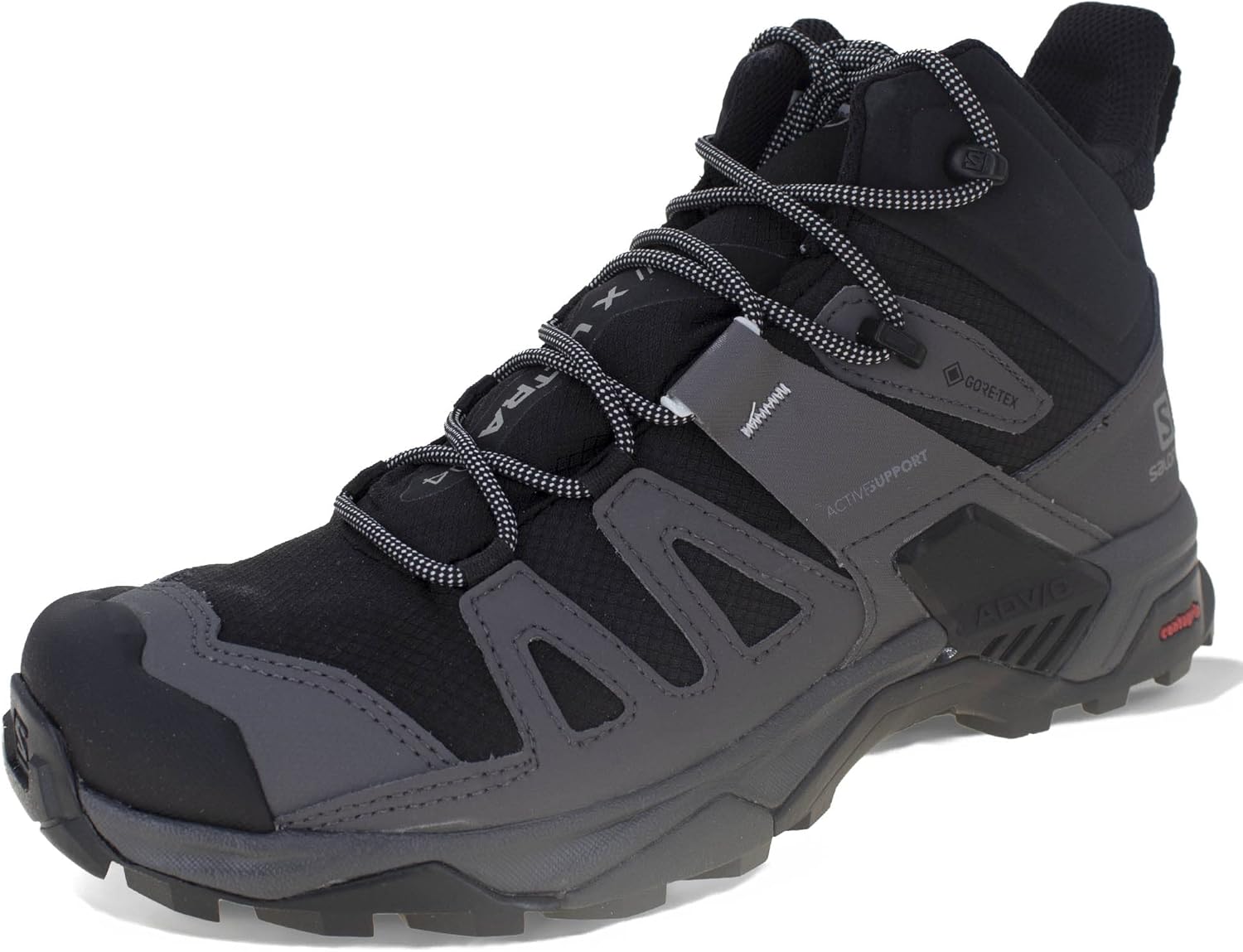
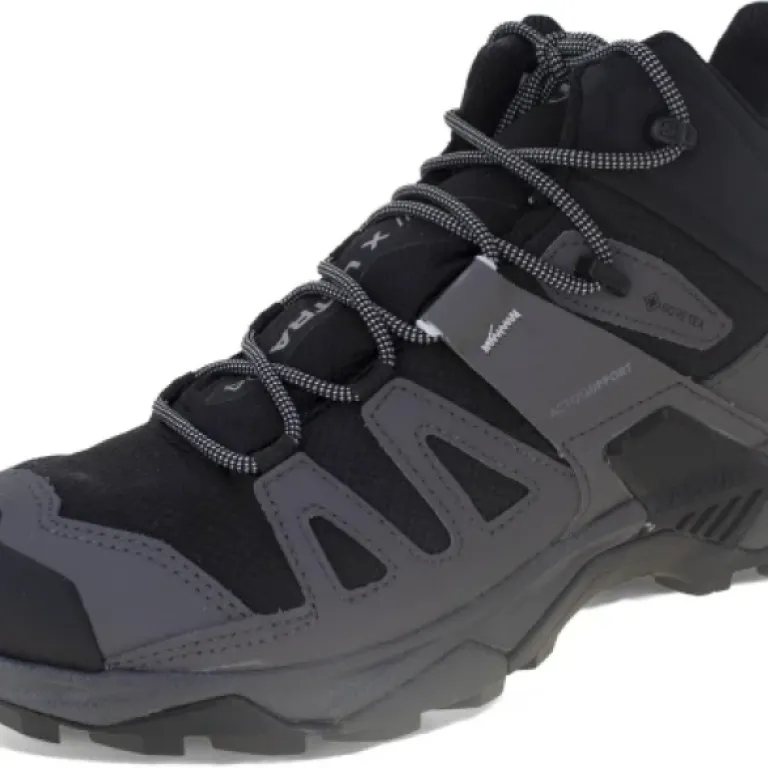
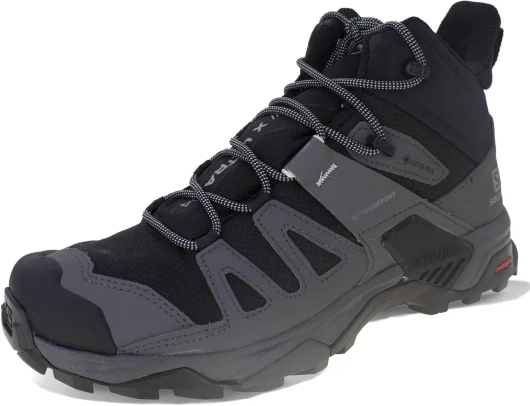
Design-wise, the X Ultra 4 Mid GTX looks like a bulked-up trail shoe with a collar, and that’s basically what it is. The Black/Magnet/Pearl Blue color is pretty neutral. It’s mostly dark, with some small blue touches that don’t scream for attention. You can wear them around town without looking like you’re about to cross the Alps, which I appreciate. They pass as normal outdoor shoes rather than big clunky boots.
The shape is quite streamlined: slightly pointed toe, medium-width forefoot, and a fairly pronounced heel. The mid-cut collar gives you ankle coverage without going too high. If you’re used to traditional leather boots that feel like braces around your ankles, this will feel much lighter and more flexible. The lacing system is simple: standard laces, no quick-lace gimmicks, with a couple of hooks at the top. One downside: the laces are a bit slippery, and they tend to loosen if you don’t double knot them or really crank them down.
Functionally, the design is focused on stability and grip. You get that visible “chassis” piece wrapping the heel area, which does help lock the rear of your foot. On sidehills and rocky paths, you feel that the heel doesn’t roll as much as it would in a pure running shoe. The outsole has fairly aggressive lugs, not mountaineering-level but enough for wet dirt, mud, and loose gravel. The toe bumper is decent, and I’ve kicked a few rocks without ending up swearing at the boot.
Overall, the design is practical: light, modern, somewhat sporty. The trade-off is that it doesn’t feel like an old-school leather boot that will mold to your foot for ten years. It’s more of a precise, technical tool that’s great when it fits your foot and use case, but it’s not the kind of thing you’ll be re-soling in a decade. I liked the look and how discreet it is, but if you’re into classic all-leather aesthetics, this will feel a bit too synthetic and technical.
Comfort: great out of the box, with a few quirks
Comfort was honestly one of the strong points for me. There was basically no break-in period. I did a 10 km hike the first day and then a 15 km mixed trail the same week, and I didn’t get any blisters or serious hotspots. That’s rare for me with mid boots. The padding around the ankle is well placed, and the tongue doesn’t dig into the front of your ankle, which can be a problem with stiffer boots. Right away, they feel more like supportive trail shoes than rigid hikers.
The fit is on the medium side. The toe box is just wide enough for me, but if you like very roomy toes, you might find it a bit tight. I sized up to 11.5 (I’m usually 10.5–11), and I’d recommend doing the same, especially if you use thicker socks or want some space for downhill descents so your toes don’t smash into the front. The heel hold is good: no big heel lift even on steep climbs, which helps avoid blisters on the back of the foot.
Underfoot, the cushioning is firm but comfortable over a full day. I’ve worn them for 20,000-step days in town and on trails, and my feet were tired but not destroyed. Arch support is decent; you can feel that there is some structure, not just flat foam. The downside is the stock insole: it’s thin and doesn’t add much. I tried swapping in a more cushioned insole, but that made the instep too tight, so I went back to the original. If you have high arches or a thick orthotic, you might struggle with volume in the boot.
One thing to keep in mind: because of the Gore-Tex and the mid height, they’re not the coolest boots. On warm days, my feet definitely got sweaty. It’s manageable, but if you mostly hike in hot weather, I’d think twice about any Gore-Tex boot. For cooler or wet conditions, though, the comfort is very solid. Overall, I’d say comfort is a strong point, as long as you size up a bit and don’t expect the airy feel of a mesh running shoe.
Materials: technical mix with some compromises
The upper is a mix of PU-coated leather and synthetic fabric, with a Gore-Tex membrane inside. In practice, that means you get a structure that’s lighter than full-grain leather but stiffer than a pure mesh trail shoe. The PU coating helps with water resistance and durability in high-wear areas, especially around the toe and sides. The fabric panels keep the weight down and give the boot some flex. It’s a pretty standard modern hiking boot recipe, nothing fancy, but it gets the job done.
The midsole feels like EVA foam or something close to it, with that typical Salomon balance: not super plush, but not rock-hard either. There’s enough cushioning to handle long days on trail without your feet feeling completely beat up, but if you’re used to very soft running shoes, this will feel firmer. I personally prefer this firmer feel for hiking because it gives more control on uneven terrain. Underneath, the Contagrip MA outsole is the highlight: the rubber compound grips well on wet rock and slick surfaces. I tested them on wet pavement, wet roots, and damp rocks, and traction was pretty solid.
On the inside, the lining is standard synthetic with the Gore-Tex membrane sandwiched in. It doesn’t feel luxurious, just functional. Breathability is okay for a Gore-Tex boot, but you do feel the heat on warm days. That’s just how waterproof membranes are. If you hike in hot, dry climates, this kind of boot will always feel warmer than a non-membrane shoe. The stock insole is thin and pretty basic. It’s fine if you have neutral feet and don’t care much, but if you usually upgrade insoles, you’ll probably do the same here. The only catch: if your instep is high, thicker insoles can make the boot feel cramped.
So, materials overall: technical, light, and efficient, but clearly geared toward performance, not long-term indestructibility. You get good grip, decent upper durability for the weight, and reliable structure around the heel. On the downside, the synthetic-heavy build and PU coating don’t age as nicely as leather. They crease, scuff, and visually look “used” faster, even if the boot is still structurally fine. I’m okay with that trade-off for the weight and grip, but if you want a boot that ages gracefully, this isn’t it.
Durability and waterproofing: good for the weight, but not bulletproof
Durability is where you start to see the trade-offs of a light, synthetic-heavy boot. After a few months of mixed use (trails, city, wet days), my pair is holding up decently: no seams blown, no sole peeling, and the structure is still solid. The outsole shows some wear at the front lugs and a bit at the heel, which matches what one Amazon reviewer said. It’s not catastrophic, but you can tell these aren’t designed to last forever if you hammer them every day. Compared to Keens that die in six months for some people, these seem to do better, but I wouldn’t expect years and years of hard use.
The upper material has a few scuffs and creases, especially on the PU-coated leather parts, but nothing that affects function. The fabric panels haven’t torn, even after brushing against rocks and branches. For a boot this light, I’d call the upper durability pretty solid, but again, if you’re a roofer or use them as daily work boots on harsh surfaces, don’t expect miracles. As hiking boots used mainly for outdoor trips and occasional daily wear, they should last a couple of seasons at least, depending on how abusive you are.
Waterproofing is a mixed bag. At the beginning, the Gore-Tex works very well. I’ve stood in ankle-deep puddles and walked through wet grass and light streams without getting my feet wet. That lines up with a lot of reviews saying they’re solidly waterproof at first. The issue is how long that lasts. Some users report the waterproofing starting to fail in under six months with regular use, which doesn’t surprise me. Membranes can break down, and stitching and flex points are always weak spots.
In my case, after a few months, they’re still waterproof, but I baby my gear more than some people. If you’re constantly bending, kneeling, and soaking them, expect the membrane to give up sooner or later. Once that happens, you end up with a boot that’s warm, not very breathable, and not fully waterproof anymore, which is annoying. So: durability overall is decent for a light boot, but if you want a long-term tank or rely heavily on waterproofing for years, this might not be the best choice.
Performance on the trail: grip and stability are the main strengths
On actual trails, the X Ultra 4 Mid GTX behaves more like a sturdy trail runner than a classic boot, and that’s mostly a good thing. The first thing you notice is how light and agile they feel compared to heavy leather boots. You can walk fast, change direction quickly, and they don’t feel like they’re dragging your legs down. On climbs and descents, that lighter feel really helps, especially over long distances. I did several 10–15 km hikes with a moderate pack, and I never felt like the boots were the limiting factor.
Grip is where these shine. The Contagrip outsole bites well into wet dirt, gravel, and even wet rock. I tested them on muddy forest trails and slick roots after rain, and I felt pretty confident. Obviously, nothing grips on greasy clay, but compared to other boots I own, these are on the better side. One Amazon reviewer mentioned being on roofs and still having good grip; I can see that. On wet pavement and smooth surfaces, they’re better than a lot of hiking boots I’ve used, which usually feel sketchy in those conditions.
Stability is good for a light boot. The chassis around the heel keeps your rearfoot from rolling too much, which I noticed on sidehills and uneven rocky sections. Ankle support is there, but don’t expect the locked-in feeling of a heavy mountaineering boot. It’s more like “extra insurance” compared to a low-cut shoe. For day hikes and light backpacking, that level of support is enough for me. If you have weak ankles or carry very heavy loads, you might want something beefier.
One thing to be aware of: because they’re lighter and less stiff, you do feel rocks and roots a bit more than in big boots. The protection is still fine, but if you stomp hard on sharp stones all day, you’ll feel some pressure underfoot. For me, the trade-off in agility and reduced fatigue is worth it. Overall, performance-wise, I’d say they’re very solid for fast hiking, wet conditions, and mixed terrain, as long as you stay within that intended use and don’t expect mountaineering-level protection.
What you actually get with these Salomon boots
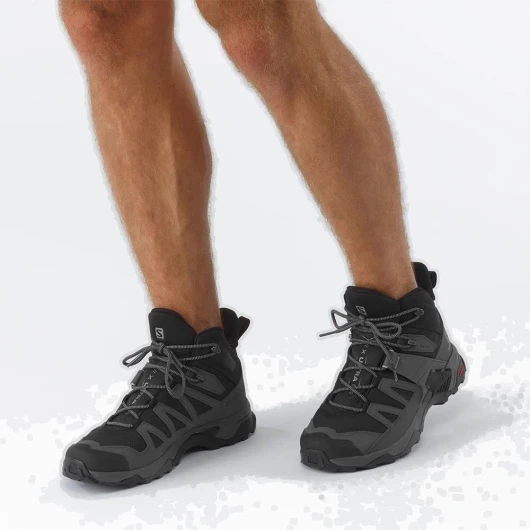
The pair I tested is the mid-height X Ultra 4 GTX, men’s 11.5, in the Black/Magnet/Pearl Blue color. So not the low-cut shoe version, and not a big full-leather trekking boot either. It’s that in-between category: higher than a sneaker, lighter than a classic backpacking boot. Salomon sells it as a hiking boot with trail-running agility, and that description is actually pretty accurate in practice.
In terms of basic specs: it’s Gore-Tex lined, rubber sole with Salomon’s Contagrip MA, lace-up closure, with PU-coated leather mixed with synthetic fabric on the upper. Made overseas like most big brands now. The boot doesn’t feel cheap in hand, but it clearly leans toward the “technical sports shoe” side more than the “rugged work boot” side. You see panels, overlays, and a sort of plastic chassis piece around the heel that’s supposed to help with stability.
Out of the box, my size 11.5 felt true to size compared to my Salomon trail runners, but compared to other brands, it runs a bit short. I usually wear 10.5–11 in most shoes; going 11.5 here felt right, especially if you use thicker hiking socks. The toe box is not super wide, but not a torture device either. If you have very wide feet, you might find it a bit snug, but for my average-to-slightly-wide feet, it was fine once laced properly.
In terms of positioning, I’d place this boot for people who do a lot of day hikes, fast hiking, and maybe light backpacking with a moderate pack. It’s not what I’d pick for a heavy multi-week trek with 25+ kg on your back, but for 1–3 day trips with a normal load and lots of mixed terrain, the boot matches that use pretty well. The important thing is to see it as a fast, light hiker, not as a tank.
Pros
- Light and agile for a mid-height Gore-Tex hiking boot
- Very good grip on wet and mixed terrain thanks to the Contagrip outsole
- Comfortable out of the box with minimal break-in and decent ankle support
Cons
- Waterproofing may weaken after several months of heavy use
- Durability is decent but not on the level of heavier full-leather boots
Conclusion
Editor's rating
The Salomon X Ultra 4 Mid Gore-Tex is a solid choice if you want a hiking boot that feels closer to a trail-running shoe than a heavy leather tank. The main strengths are clear: light weight, very good grip on wet and mixed terrain, and comfort right out of the box with almost no break-in. For day hikes, fast hiking, and light backpacking, they handle climbs, descents, and technical sections without feeling clumsy. If you’re used to heavy boots, you’ll probably enjoy how much less tired your legs feel at the end of the day.
But there are trade-offs. This isn’t a lifelong boot. The outsole and upper hold up fine for a light hiker, but they’re not built like work boots. Waterproofing is strong at the start, but several users report it fading after months of hard use, which is something to keep in mind if you live in a very wet area. The fit is medium, slightly on the narrow side, and the stock insole is basic for the price. If you have wide feet, high arches, or expect years of daily abuse, you might want something more robust and possibly non-membrane.
In short, I’d recommend these to hikers who prioritize lightness, grip, and immediate comfort and who mainly do day hikes or short trips with moderate loads. If you’re a roofer, a full-time field worker, or a long-distance backpacker with heavy packs, I’d look at heavier leather options instead. For the right user, though, these boots get the job done well and feel good doing it, as long as you’re realistic about their lifespan.