
Summary
Editor's rating
Is it worth the price compared to other safety shoes?
Grey/Orange look and real-world practicality
Comfort: depends heavily on your foot shape
Foam, rubber and composite toe: what they’re really made of
Holding up better than cheap safety sneakers (so far)
Grip, protection and day-to-day use on the job
What you actually get out of the box
Pros
- Lightweight composite toe and athletic feel compared to classic steel-toe boots
- Good slip resistance and full ASTM safety ratings (toe, puncture, EH, SR)
- Upper and outsole feel more durable than many cheaper safety sneakers
Cons
- Fit runs a bit snug; can be uncomfortable for wider feet
- Low ankle height offers limited ankle support compared to real boots

Specifications
View full product page →| Brand | New Balance |
Safety shoes that don’t feel like bricks… mostly
I’ve been wearing the New Balance Men's Composite Toe Speedware Industrial Boot in 10.5 Grey/Orange for a couple of weeks on a mix of warehouse floor, light outdoor work, and a lot of walking between buildings. I usually rotate between classic leather work boots and cheaper safety sneakers (Skechers and some no-name brand), so I had a pretty clear idea of what I wanted: toe protection, grip on dusty concrete, and something that doesn’t destroy my feet by lunch.
In practice, these feel a lot more like athletic sneakers with a safety upgrade than like traditional work boots. The composite toe keeps the weight down, and the overall profile is closer to a trail runner. If you’re used to heavy steel-toe leather boots, you’ll notice the difference right away the first time you walk a flight of stairs or do a long shift on your feet.
That said, they’re not perfect. Comfort is going to depend a lot on your foot shape. I’ve seen reviews where people say they’re the best safety shoes they’ve worn, and others saying they’re miserable even after trying multiple insoles. After my own use, I’d say they land somewhere in the middle: pretty solid if your foot matches the fit, frustrating if it doesn’t.
So this review is just me, using them like any normal guy at work would. No marketing talk. I’ll walk through how they look, how they feel after a full shift, and if I think they’re worth the money compared to other safety sneakers I’ve trashed in under a year.
Is it worth the price compared to other safety shoes?
Price-wise, the Speedware sits in that middle-to-upper range for safety sneakers. You can definitely find cheaper options from big box stores, and you can also find more expensive leather work boots. So the real question is: do you get enough out of these to justify paying more than for a budget pair? For me, the answer leans toward yes, but with a couple of conditions.
On the plus side, you get a proper set of safety features: composite toe, puncture resistance, slip resistance, and electrical hazard protection, all with recognized ASTM standards. You also get a shoe that feels lighter and more agile than a steel-toe boot, with better durability than the really cheap safety sneakers I’ve burned through before. If these last a year of regular use without the sole peeling or the upper blowing out, they’ll be good value for money compared to having to replace a cheaper pair every 4–6 months.
On the downside, the fit won’t work for everyone. If you have wide or tricky feet and end up needing to size up, try wide, and swap insoles, the total cost creeps up. And if they end up being uncomfortable like that 1-star review mentioned, then they’re obviously bad value for you personally. This is one of those shoes where I’d strongly suggest trying them on and walking around a bit before committing, or at least buying from somewhere with an easy return policy.
Overall, I’d rate the value as pretty solid if they fit your feet well. You’re paying for a decent balance of protection, comfort, and durability in a lighter package. There are cheaper options, but many of those cut corners on materials or soles. If you’re on your feet all day and want something that feels closer to a sneaker than a boot, the price makes sense.
Grey/Orange look and real-world practicality
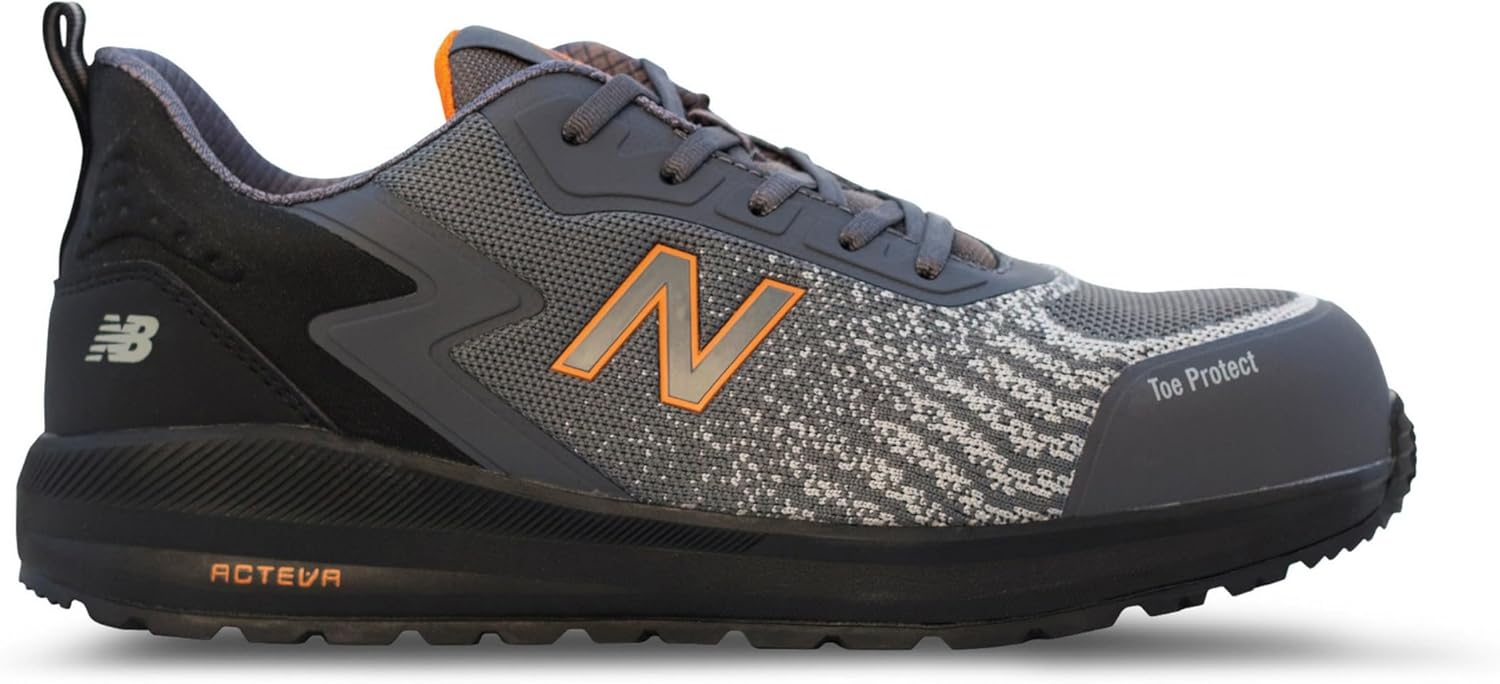
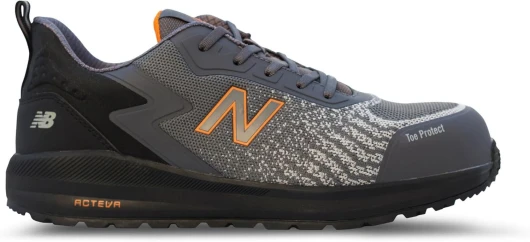
The Grey/Orange colorway is pretty straightforward: mostly dark grey with orange accents that make it look more like a trail running shoe than something you’d wear on a construction site. Personally, I like that. It doesn’t scream “work boot,” so if you go grab a coffee after work, you don’t feel like you’re clomping around in big brown leather bricks. The orange hits are visible enough that they don’t just look like plain sneakers either, which is handy if your workplace likes gear that’s easy to spot.
From a practical angle, the design is mostly closed-up synthetic material with some structured areas instead of big open mesh panels. That matters if you work around metal shavings, wood chips, or general debris. Compared to my older safety sneakers, I had fewer moments of something sharp working its way through the mesh and poking my socks. The “debris-free” pitch sounds like marketing, but on dusty floors and around cut-offs, I did notice less junk ending up inside.
The profile is low around the ankle. You get just enough height to cover the ankle bone, but not enough to really brace your ankle if you twist it on uneven ground. If you work on flat warehouse or factory floors, that’s fine. If you’re on uneven job sites, ladders, or rough terrain all day, this design is more about mobility and lightness than serious support. Think running shoe with a little extra structure at the heel, not a boot you’d wear for framing a house in mud.
One thing worth noting: the toe area looks a bit bulky from the outside because of the composite cap, but inside it doesn’t feel as cramped as some steel toes I’ve worn. Visually, they’re not stylish in a fashion sense, but they look modern and functional. I’d call the design practical and work-ready, not pretty, and that’s fine by me for something I’m going to beat up at work.
Comfort: depends heavily on your foot shape
Comfort is where opinions are clearly split, and I get why. For me, after about three days of break-in, they felt pretty good for a safety shoe, but not like a running shoe. Underfoot, the NB Comfort Insole plus the Acteva foam midsole give a medium-firm feel. On an 8–10 hour shift on concrete, my heels and arches felt supported enough, and I didn’t get that burning sensation I sometimes get with completely flat work boots. The cushioning is there, just not super soft.
The fit in 10.5 for me was true to size lengthwise, but a bit snug in width. I have slightly wider-than-average feet, not full wide, and the first day my forefoot felt a little squeezed by the end of the shift. After a few days, the upper loosened a bit and became more comfortable. If you have really wide feet, I’d seriously look for a wide version or size up half a size. One negative review saying they were the most uncomfortable safety shoes and never broke in doesn’t surprise me if that person has a wider or higher-volume foot.
Around the ankle and heel, the padding is decent without being bulky. I didn’t get hot spots or rubbing, even when I was going up and down stairs a lot. The shoe holds the heel in place fairly well; I didn’t feel my foot sliding forward into the toe cap, which is a big deal with composite toes. Toe room is okay, not generous but not painful. If you like a roomy toe box, these might feel a bit tight unless you size up.
Breathability is average. They’re not sauna-level hot, but they’re not airy mesh runners either. On hot days, my feet felt warm but not soaked in sweat. If I compare them to my old leather steel-toe boots, these are definitely cooler. Compared to very open mesh safety sneakers, they’re a bit warmer but keep out more debris. Overall, comfort is good if your foot matches the last, but I wouldn’t call them universally comfortable. Try them and be ready to swap insoles if you need extra arch support or more cushioning.
Foam, rubber and composite toe: what they’re really made of
The upper feels like a mix of synthetic leather-style panels and tougher fabric, stitched and bonded in a way that keeps gaps to a minimum. There’s no big soft mesh area like you see on cheap sneakers, which is good for durability. After two weeks of daily wear, including kneeling, flexing on ladders, and scraping against pallets, the upper still looked decent. No peeling, no obvious tearing, just the usual scuff marks you’d expect.
The midsole is New Balance’s Acteva foam, which is their fancy name for a lightweight performance foam. In practice, it’s firmer than a typical running shoe but softer than a classic work boot midsole. When you press your thumb into it, there’s some give, but it springs back instead of staying squished. On hard concrete floors, that foam takes some of the sting out of long walks, but it’s not super plush. If you like a soft, bouncy feel, this is more on the medium-firm side.
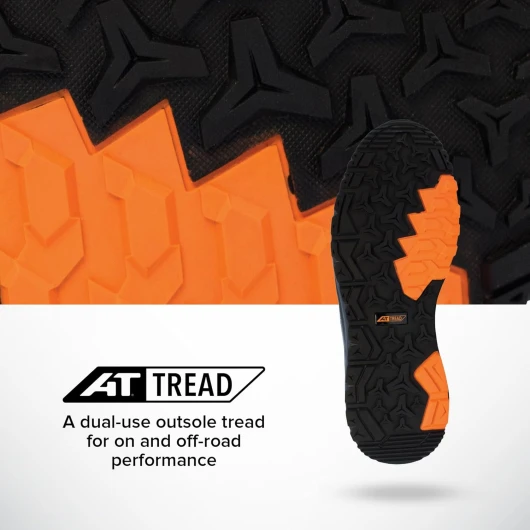
The outsole is rubber with a mixed tread pattern: part trail-style lugs, part flatter running-style sections. The rubber itself feels reasonably dense, not that soft rubber that shreds in a month. Another user mentioned their Skechers safety sneakers started peeling fast; I had a similar experience with a different brand. On these, after a couple of weeks, the edges of the lugs were a bit smoothed out in high-contact areas, but no chunks missing or peeling yet. That’s a good sign for long-term durability.
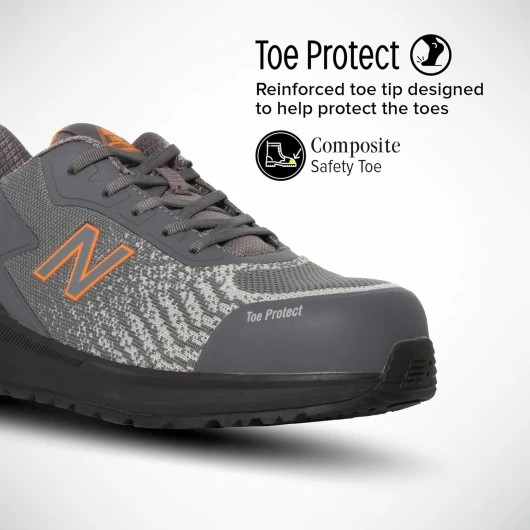
The composite toe and anti-perforation midsole are the real safety materials here. The toe cap doesn’t conduct cold like steel, and it’s noticeably lighter. The anti-perforation layer underfoot adds a bit of stiffness, which you can feel when you try to bend the shoe. It doesn’t turn it into a board, but there’s clearly an extra plate in there. Overall, the materials feel like they’re built for real work, not just for looks. Not premium luxury, just solid and functional.
Holding up better than cheap safety sneakers (so far)
Durability is always the big question with safety sneakers. I’ve had pairs where the outsole started peeling within a month and the whole shoe was trash in under six months. With these Speedware, after two weeks of daily use, I’m not seeing any early failure signs. Obviously that’s not a full-year test, but you can usually tell pretty fast if something is going to fall apart.
The upper is holding up well against scuffs and bending. The synthetic overlays don’t show cracking yet, and the stitching looks tight. I dragged my toes a few times moving pallets, and while you can see marks, the material didn’t tear or separate. The toe bumper area seems tough enough to handle regular knocks without blowing out.
The outsole is where I was most suspicious, because of past experience with other brands. Here, the rubber is still firmly bonded, no peeling at the heel or toe edges, and the lugs are just slightly worn where I strike the ground the most. That’s normal wear, nothing dramatic. Compared to the user who said their Skechers peeled in a month, I’d say this feels more reliable. The midsole foam hasn’t compressed in a weird way yet either; the shoes still feel supportive and not squashed.
Inside, the insole is starting to show some imprint of my foot, but it’s not flattened or torn. If you wear them hard every day, I’d expect to replace the insole at some point, which is pretty standard. Overall, they feel more durable than budget safety sneakers and closer to what I’d expect from a mid-range work shoe. Time will tell, but nothing so far makes me think they’re going to self-destruct quickly.
Grip, protection and day-to-day use on the job
On the job, the slip resistance is one of the better points. The outsole pattern with mixed lugs grips well on dusty concrete, painted floors, and slightly wet areas. I tested them on a smooth warehouse floor with some dust and small spills, and they felt more planted than my old safety sneakers. I’m not saying you’re glued to the ground, but I had fewer “whoa” moments when hitting a slick patch. The ASTM SR rating seems earned, not just printed on the box.
The composite toe and anti-perforation midsole do what they’re supposed to. I kicked into pallets, bumped metal edges, and dropped a couple of smaller items on my toes, and nothing got through. You still feel the impact a bit, but that’s normal. The big plus of composite is weight and less temperature transfer; in colder areas of the warehouse, my toes didn’t feel like ice blocks the way they do in steel-toe boots. The puncture-resistant midsole adds a bit of stiffness, but I didn’t feel it limiting my movement much. I climbed ladders, crouched, and walked a lot without feeling like my feet were fighting the shoe.
Stability is decent for a low-cut shoe. The heel counter is firm, so your heel doesn’t roll around, and the base feels wide enough. Still, it’s not a high-ankle boot, so if you step in a pothole or on a rock, you don’t have that extra leather wrapping your ankle. For flat floors and light outdoor use, I had no issue. For rough construction sites all day, I’d personally still pick a higher boot.
One thing I appreciated is that they feel relatively light and agile. Doing quick turns, walking fast between areas, or going up stairs feels more like wearing a trail shoe than a clunky boot. If your work is a mix of walking, standing, and occasional lifting rather than heavy excavation or framing, this style makes sense. Overall, performance is solid: good grip, proper protection, and enough mobility to not feel weighed down during a full shift.
What you actually get out of the box
Out of the box, the Speedware looks and feels more like a chunky running shoe than a boot. The "boot" word in the name is a bit misleading. The shaft height is ankle level, so don’t expect any serious ankle support like a 6-inch leather work boot. In my size 10.5, each shoe felt noticeably lighter than my steel-toe boots and roughly in the same range as my old Skechers safety sneakers, maybe slightly more solid in the hand.
New Balance pushes a lot of tech terms: composite toe, anti-perforation midsole, Acteva foam, NB Comfort Insole, debris-free upper. In practice, that means you get a sneaker-style shoe with a reinforced toe, a firm but cushioned midsole, and an upper that doesn’t have a lot of open mesh where dust and metal shavings can get in. On my job, I deal with fine dust and small debris, and I did notice less junk ending up inside the shoe compared to my older mesh-heavy safety sneakers.
The pair I tested meets ASTM F2413-18 (M/I/C, EH/PR) and ASTM F3445-21 SR, which covers impact/compression, electrical hazard, puncture resistance, and slip resistance. That’s all the usual stuff most workplaces ask for. I had no issues getting them approved by safety at work; they tick the boxes on paper. If your job requires steel toe specifically, these won’t pass, but most places accept composite as long as it meets the standard.
Overall, from a presentation standpoint, it’s a work sneaker with legit safety certifications, not a classic boot. If you go in expecting that, what you pull out of the box matches the promise. If you’re picturing a rugged leather boot, you’ll probably be surprised by how sporty they look and feel.
Pros
- Lightweight composite toe and athletic feel compared to classic steel-toe boots
- Good slip resistance and full ASTM safety ratings (toe, puncture, EH, SR)
- Upper and outsole feel more durable than many cheaper safety sneakers
Cons
- Fit runs a bit snug; can be uncomfortable for wider feet
- Low ankle height offers limited ankle support compared to real boots
Conclusion
Editor's rating
After wearing the New Balance Men's Composite Toe Speedware Industrial Boot (10.5 Grey/Orange) on real shifts, I’d sum it up like this: it’s a work sneaker with legit safety features that suits people who want something lighter than a traditional boot and are mostly on flat surfaces. The composite toe, puncture-resistant midsole, and slip-resistant outsole do their job, and the overall feel is more athletic than clunky. Durability looks better than the cheaper safety sneakers I’ve had, especially around the outsole and upper bonding.
Where it can go wrong is comfort for certain foot shapes. If your feet are wide or very sensitive, you might find them tight or too firm, especially if you expect running-shoe softness. For me, after a short break-in, they were comfortable enough for full days on concrete, but they’re not miracle shoes. They’re practical, not magic. I’d recommend them for warehouse workers, light industrial, technicians, and anyone walking a lot who wants a lighter shoe with full safety ratings. If you work on rough sites, need serious ankle support, or have very wide feet, I’d look at a higher-cut boot or a different last.
In short: good protection, decent comfort, and solid durability for the price, as long as the fit works for you. Try them, walk around, and if they feel right, they’ll probably serve you well at work.