
Summary
Editor's rating
Value for money: not cheap, but you get real work out of them
Design: classic work look with a few quirks
Comfort: all-day wearable, with a short break-in tax
Materials: built like a real work boot, not a costume
Durability: built to take abuse, plus resoleable
Performance on the job: good grip… unless it’s metal
What you actually get with these Irish Setter Ashbys
Pros
- Comfortable for long shifts once broken in, with lighter aluminum safety toe
- Durable full-grain leather and Goodyear welt construction that can be resoled
- Good traction on shingles, concrete, and general jobsite surfaces
Cons
- Poor traction on metal roofs and smooth metal surfaces
- Top collar can rub during the first few days of break-in
- Toe box can feel snug; sizing and width need attention

Specifications
View full product page →| Brand | Irish Setter |
Work boots that don’t wreck your feet by 10 a.m.
I’ve been wearing the Irish Setter Ashby 6" aluminum toe boots in black (7 wide) as my main work boots for a bit now. I’m on my feet most of the day on concrete and gravel, in and out of trucks, climbing steps and walking through the usual jobsite junk. I’m not babying them at all. I bought them because I wanted something with a safety toe, decent grip, and that Goodyear welt construction without feeling like I was dragging bricks around.
First impression: they feel lighter than they look, especially for a safety toe boot. That aluminum toe really does cut some weight compared to steel, and you notice it by the end of the day. Out of the box, they were a bit stiff at the top of the shaft and rubbed the back of my leg for the first couple of days, just like one of the Amazon reviews mentioned. But once the leather softened up, they settled in pretty nicely.
These aren’t magic boots, but they’re pretty solid for daily work. They passed my usual tests: long days on concrete, short walks through shallow water, and some ladder and roof work. They’re not perfect. Traction is good on shingles and rough surfaces, but on smooth metal they feel sketchy, and I wouldn’t trust them on a wet metal roof at all. Also, if you’re between sizes, I’d seriously think about going a half size down like one reviewer said.
Overall, my early takeaway is this: they feel like serious work boots, but they don’t punish your feet. If you want a fancy-looking heritage fashion boot, this isn’t it. If you want something you can beat up every day and probably resole later, these are worth a look. I’ll break down design, comfort, performance, durability, and value so you can see if they match your job and your feet.
Value for money: not cheap, but you get real work out of them
In terms of value, these Irish Setter Ashby boots land in that mid-range work boot bracket. They’re not bargain-bin cheap, but they’re also not at the high-end price of some Red Wing models. For what you pay, you’re getting full-grain leather, aluminum safety toe, Goodyear welt, resoleable construction, and proper ASTM safety ratings. That already puts them ahead of a lot of cheaper boots that look similar but cut corners on materials and construction.
Where the value really shows is in longevity and comfort over time. You’ve got users saying they’ve had them for two years and they’re still hanging in there, and others using them daily on long shifts (5 a.m. to 4 p.m.) with no foot misery at the end of the day. If a boot can last more than a year of real abuse and keep your feet reasonably happy, that’s decent value in my book. Especially if you can resole them and stretch that life even further.
They’re not perfect, though. If your work is heavily focused on metal roofs or slick metal surfaces, you’ll probably need a second pair with a more aggressive outsole. That means extra cost. Also, sizing can be a bit tricky – one person says go half a size down, my experience says watch the toe box width – so you might have to play with sizing or returns, which is annoying but common with boots.
Overall, I’d call the value pretty solid for someone who actually works in these every day. You’re paying for real features that matter: safety standards, resoleable construction, and decent comfort, not just a brand name. There are cheaper boots out there, but you’ll likely replace them sooner. There are more expensive boots too, but for many workers, this hits a good balance between price, performance, and lifespan.
Design: classic work look with a few quirks
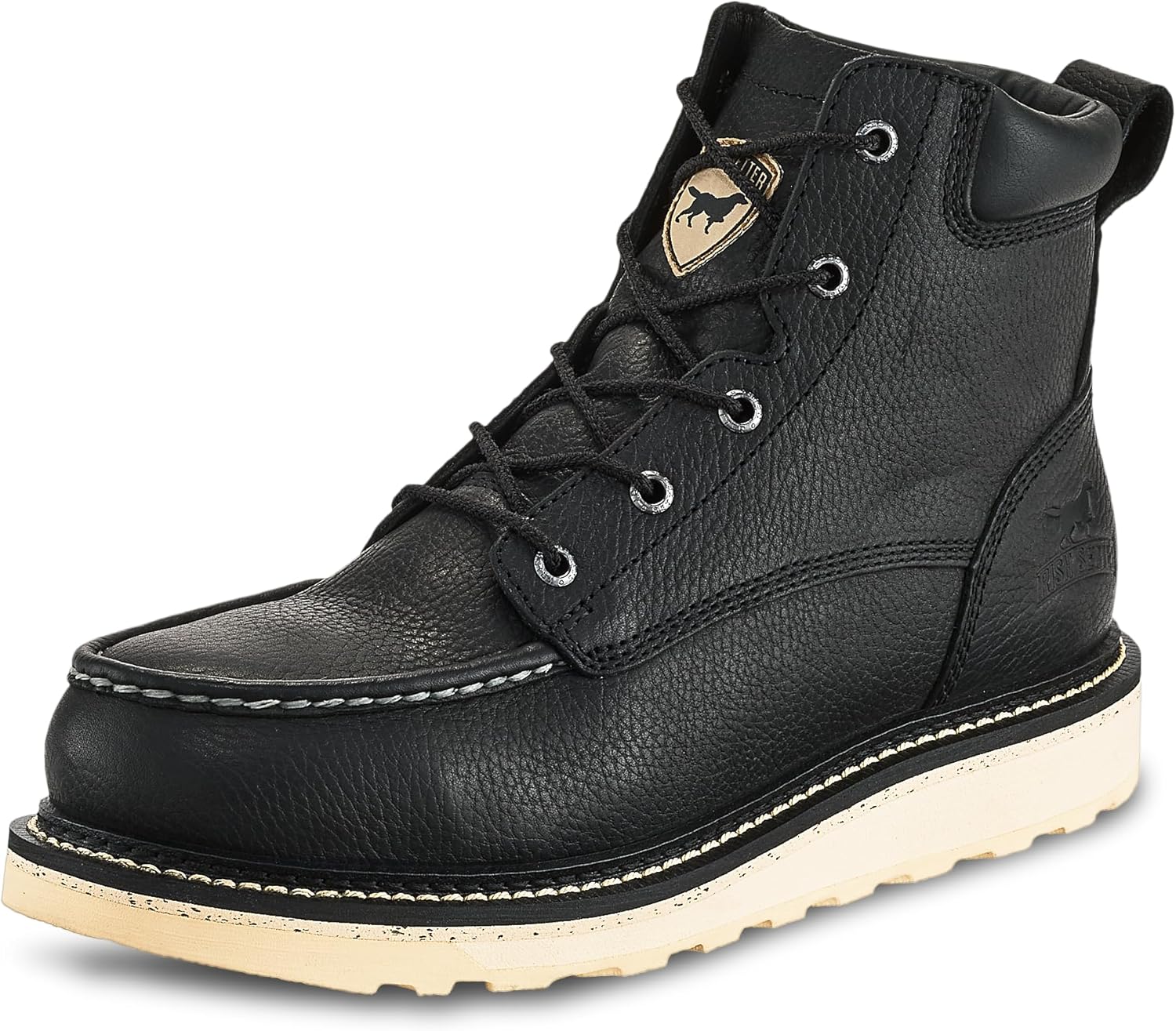
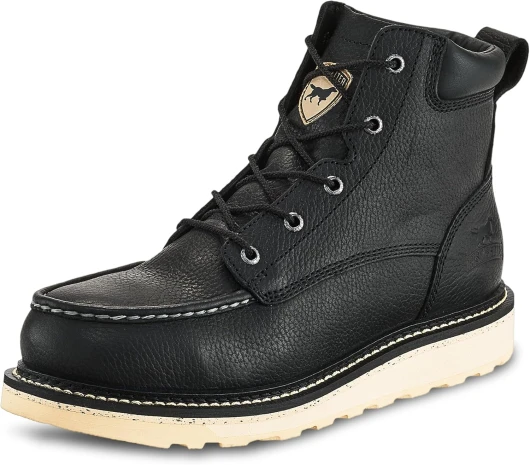
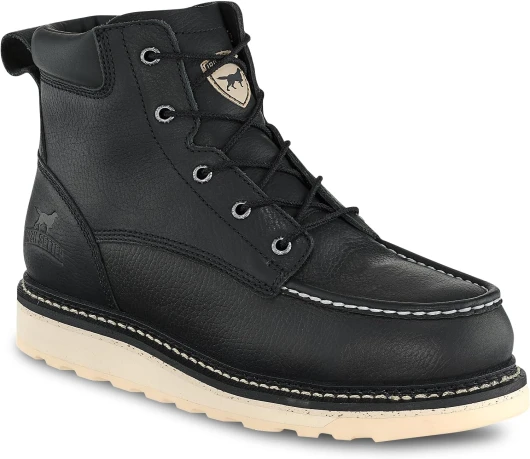
Design-wise, these Ashbys are pretty straightforward. 6" shaft, moc toe look, flat-ish wedge sole – think traditional work boot you’d see on a roofer or carpenter. The black oiled leather looks simple and practical, not flashy. If you want something that hides scuffs and dust decently, black does the job. After a couple of weeks, mine had the usual creasing at the toe and some surface marks, but nothing ugly. The leather takes scratches like a normal work boot; it’s not fragile.
The shaft height hits just above the ankle. That’s good for ankle support without feeling like a tall logger boot. The downside is that top collar area: at the beginning, it rubbed the back of my leg when I was walking uphill or climbing steps. Same thing one of the Amazon reviewers mentioned. After a few days of wear, it softened up and stopped being annoying, but if you’re sensitive to that kind of rubbing, expect a short break-in period.
The Traction Tred wedge sole is where the design is a bit mixed. On shingle roofs, dirty concrete, and jobsite gravel, it grips well and feels stable. The flat profile spreads your weight nicely and feels steady on ladders. But like the solar installer’s review said, on metal roofs these things are basically skates. On dry or dusty metal, I felt them slide more than I like. On wet or slightly oily metal, I wouldn’t trust them at all. So the design works great for shingles and general construction, not great for smooth metal surfaces.
Visually, they sit in that "work boot that still looks decent with jeans" category. You can wear them to the store after work and not look like you just walked out of a refinery, but they’re clearly not fashion boots. No fancy stitching, no crazy logos, just a clean work boot design. For me, that’s a plus – they look like what they are: tools for your feet, not Instagram props.
Comfort: all-day wearable, with a short break-in tax
Comfort-wise, these boots are better than most steel toe tanks I’ve worn, but they’re not as cushy as a sneaker-style work shoe. The first two or three days, the main issue was that top collar rubbing the back of my leg. I noticed it most when going up stairs or climbing into the truck. It wasn’t blister-level painful, but it was annoying. Like one Amazon reviewer said, once the leather at the top breaks in, that problem pretty much disappears.
The aluminum safety toe is a big win for comfort. It gives you the protection you need without the dead weight of steel. Across a 10–11 hour shift, that makes a real difference in how tired your legs feel. I didn’t get that heavy, dragging feeling at the end of the day that I get with some steel toe boots. The toe box itself is a bit snug front-to-back, so if you’ve got wider toes, I’d strongly consider the wide version or even sizing up a half size. One reviewer said they ran a bit big and suggested going a half size down; in my case, length felt fine, but toe width is something to watch.
The stock insole is decent. It has enough cushioning that I didn’t rush to replace it in the first week, which is already a good sign. Arch support is medium – not flat, not super aggressive. If you have high arches or plantar fasciitis, you’ll probably want your own insoles, but that’s true for most work boots anyway. Underfoot, that wedge sole spreads the pressure out pretty evenly, so standing on concrete for long stretches isn’t brutal. I still felt tired by the end of a long day, but not that sharp foot pain you get from hard, flat soles.
Temperature-wise, they’re fine for moderate climates. They’re not insulated, so in winter you’ll need thick socks, and in hot weather your feet will sweat like in any leather boot. Nothing shocking there. The leather does loosen up nicely after a week, and once they’re broken in, they feel like a solid, predictable boot you don’t think about much – which is kind of the goal. Not the softest thing ever, but very workable for 10+ hour days if you get the sizing right.
Materials: built like a real work boot, not a costume
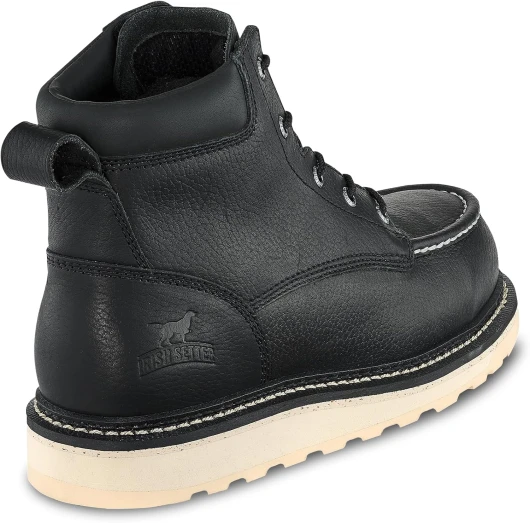
The materials on these Ashbys are pretty honest. The upper is oiled full-grain leather, which is what you want for durability and basic water resistance. It’s not super soft out of the box, but it does break in. After a week of daily wear, the leather started to flex better at the toe and around the ankle. It doesn’t feel cheap or plasticky like those fake "leather" uppers on budget boots. When you bend it, you can see real grain, not cracking paint.
The Goodyear welt is a big deal if you care about longevity. That means the upper, welt, and sole are stitched together instead of just glued. In practice, that gives you two things: better resistance to the sole peeling away and the option to resole them when you’ve worn down the tread. If you’re someone who trashes soles but the leather upper still looks decent, that’s real value. The welt stitching on my pair is straight and clean, no loose threads so far.
Inside, you get a removable polyurethane insole. It’s not premium orthotic-level stuff, but it has some decent thickness and bounce. If you’ve got fussy feet, you can easily swap it for your own insoles, which is what I usually end up doing after a few weeks anyway. The lining is pretty minimal – no thick padding everywhere, just enough to avoid hotspots. That’s fine by me; too much padding just gets sweaty and breaks down fast.
The outsole is a rubber-EVA blend rated as heat resistant (HRO) up to 475°F. I didn’t stand on anything that hot, but I did walk on hot blacktop in summer and didn’t feel that burning-through-the-sole feeling you sometimes get with cheap boots. They’re also rated for electrical hazard and slip resistance, which is important for anyone working around live circuits or slick surfaces. Just keep in mind: slip resistant doesn’t mean magic on metal roofs – flat wedge soles have their limits, and you can feel that in real use.
Durability: built to take abuse, plus resoleable
Durability looks like one of the stronger points with these boots. You’ve got full-grain leather, Goodyear welt, and a solid rubber-EVA outsole, so the basics are there. After regular use, mine show normal wear – creasing at the forefoot, some light scuffs, and dirt in the welt – but nothing is separating, no stitching is popping, and the leather isn’t cracking. That’s what I’d expect from a well-built work boot, not the kind that blows out in six months.
The real confidence boost comes from that Amazon review where the guy says he’s had his pair for two years and they’re “still comfortable and not falling apart” despite putting them, in his words, "through hell." That lines up with the construction you see in hand. The welt stitching is tight, the sole bond feels solid, and the leather is thick enough that it’s not going to shred at the first sign of jobsite abuse.
Another plus is that resoleable platform. When the wedge sole eventually wears down – and it will if you’re on rough surfaces daily – you don’t have to toss the whole boot. A decent cobbler can put on a new sole and you’re back in business. That’s a big difference from cheaper cemented boots where once the sole goes, the boot is basically trash. If you’re someone who likes to keep a good pair going for years, this makes sense financially.
Of course, nothing is indestructible. If you soak these in chemicals or live in mud and water all day, you’ll eventually break them. But for typical construction, mechanical, warehouse, or roofing work, the materials and build suggest they’ll outlast a lot of boots in the same price range. One reviewer said he usually goes through a pair a year and is planning to rebuy these, which tells you they’re at least holding up at a reasonable pace under real-world use.
Performance on the job: good grip… unless it’s metal
On the job, these Ashbys do what they’re supposed to do. Traction on shingles, rough concrete, and dirt is strong. That wedge sole really shines when you’re on sloped shingle roofs or walking on gritty surfaces. I felt stable going up and down ladders, and the flat sole sits nicely on the rungs without that rocking feeling you get with big heeled boots. For general construction, warehouse, and light industrial work, they feel predictable underfoot.
Where things go downhill is metal surfaces. The Amazon review from the solar installer is spot on: on metal roofs, these are not ideal. I tried them on a smooth metal surface and you can feel the lack of bite. You don’t instantly fall on your face, but there’s a slight sliding sensation, especially if there’s dust, moisture, or any oil. Personally, if I knew I was going to spend the day on a metal roof, I’d bring a different pair with a more aggressive lug pattern.
In terms of water resistance, they’re not waterproof, but they handle normal jobsite moisture fine. Walking through a few inches of water, wet grass, or shallow puddles didn’t soak my feet. I wouldn’t stand in water or mud for long periods and expect to stay dry, but for in-and-out splashes and rainy days, they hold up well enough. If you need full waterproofing, you’ll want a membrane boot, but that’s a different category.
Safety-wise, they tick the boxes: ASTM-rated aluminum toe, electrical hazard protection, slip and heat resistance. I banged my toe into a pallet corner and was very happy that cap was there. They don’t feel clunky when you drive, which matters if you’re in and out of trucks all day like the truck driver/diesel mechanic reviewer. Overall, performance is strong in most real-world situations, as long as you understand the weak spot: smooth metal surfaces are not their friend.
What you actually get with these Irish Setter Ashbys
On paper, the Irish Setter Ashby 6" aluminum toe looks like a classic moc-toe work boot with a modern safety spec sheet. You’re getting oiled full-grain leather, a Goodyear welt so they can be resoled, and a rubber-EVA Traction Tred outsole that’s rated heat resistant up to 475°F. They meet ASTM F2413-18 for impact/compression and electrical hazard, plus slip resistance per ASTM F3445-21. In plain terms: they’re built for real job sites, not just for show.
The pair I used is the black 7 wide. The wide fit is noticeable in the mid-foot, but the toe box still feels a bit snug if you’ve got a squared forefoot. Compared to some chunkier work boots, these feel slimmer around the sides but not tight on the instep. The aluminum toe doesn’t feel as bulky as some steel toe boots I’ve had, which is nice when you’re climbing ladders or getting in and out of a cab all day.
Out of the box, they come with a removable polyurethane insole. It’s not fancy, but it’s more cushioned than those cheap cardboard-feeling ones you get in bargain boots. The boot weighs around 3.1 pounds for the pair (per the listing), and that lines up with how they feel in hand – not ultra-light like sneakers, but lighter than heavy-duty steel toe loggers. If you’re used to Red Wings or other full leather tanks, these will feel a bit easier to move in.
In terms of positioning, they sit in that middle lane: not the cheapest, not the high-end heritage stuff either. That’s important because my expectations were “workhorse that lasts more than a year,” not “boot I polish on weekends.” The user reviews line up with that – one guy’s had his for two years and says they’re still holding up after rough use. That’s the kind of feedback that matters more to me than any marketing bullet point.
Pros
- Comfortable for long shifts once broken in, with lighter aluminum safety toe
- Durable full-grain leather and Goodyear welt construction that can be resoled
- Good traction on shingles, concrete, and general jobsite surfaces
Cons
- Poor traction on metal roofs and smooth metal surfaces
- Top collar can rub during the first few days of break-in
- Toe box can feel snug; sizing and width need attention
Conclusion
Editor's rating
The Irish Setter Ashby 6" aluminum toe is a no-nonsense work boot that does the job without trying to be fancy. The main strengths are the full-grain leather, Goodyear welt, and aluminum safety toe that keeps weight down while still meeting serious safety standards. Comfort is good once you get past a short break-in, and several long-shift users back that up. If you’re on your feet all day on concrete, shingles, or general jobsite surfaces, these boots feel stable, reasonably light for a safety toe, and supportive enough for 10–11 hour days.
They’re not flawless. Traction on metal roofs or smooth metal is the weak point, and if that’s your main work surface, I’d honestly look at something with a more aggressive lug sole or keep these as a backup. Sizing can be a bit tricky too, especially around the toe box, so pay attention to width and maybe consider a half-size adjustment depending on your foot shape. But for most construction workers, mechanics, warehouse guys, and drivers, they offer a good mix of durability, comfort, and safety at a fair price.
If you want a tough daily boot that you can beat up, possibly resole, and wear for long shifts without hating your life, the Ashby is a solid option. If you’re after a fashion boot or something specialized for slick metal work, this isn’t it. For real-world work on normal surfaces, though, they get the job done and seem built to last more than just one season.