
Summary
Editor's rating
Value: lots of liters for not much money, if you accept the compromises
Design: lots of space and straps, but very obviously a budget build
Comfort: okay up to ~25 lb, then you start to feel the shortcuts
Materials: light and decent for the price, but not made for abuse
Durability: fine for casual use, questionable for heavy, frequent loads
Performance on the trail: big volume, decent water protection, limited load handling
What this 80L Bseash pack actually offers on paper
Pros
- Very large 80L capacity in a relatively lightweight 3 lb package
- Includes rain cover and separate shoe/dirty laundry compartment
- Good price for the amount of space and features you get
Cons
- No internal frame and thin padding make heavy loads uncomfortable
- Stitching and materials feel budget and may not handle frequent, heavy use
- Zippers and buckles are basic and need to be treated with care when the pack is fully stuffed

Specifications
View full product page →| Brand | Bseash |
A massive 80L pack that doesn’t kill your wallet (or your back… most of the time)
I took this Bseash 80L army green backpack on a few weekend trips and a 4‑day camping loop to see what it was really worth. On paper, it looks great: 80L capacity, only about 3 lb, rain cover included, and a very low price compared to the big brands. It targets people who want volume and light weight without spending Osprey money. That’s exactly why I grabbed it: I wanted a cheap big pack for occasional use, not a hardcore thru‑hiking setup.
Once loaded, I pushed it close to the stated 33 lb limit: tent, sleeping bag, mat, clothes, food, stove, and some random gear strapped outside. So I didn’t baby it; I used it like most casual campers would. I walked with it for several hours a day, on trails, in buses, and tossed it on the ground more than once. I also got lucky with one proper rain shower to test the rain cover and the “waterproof” claim.
Overall, my feeling is that this backpack is good value if you know its limits. It’s big, light, and the layout is practical, but you clearly feel that it’s a budget pack. The stitching, padding, and overall finish are not at the same level as more expensive hiking brands. It’s fine for a few days of hiking or travel, but I wouldn’t trust it for a month‑long trek with heavy loads.
If you’re expecting a comfortable, bombproof pack for serious backpacking, you’ll probably be disappointed. If you just need a large, cheap backpack for occasional camping, island hopping, or trips where you can’t drag a suitcase, then it starts to make sense. The key is to stay realistic: it’s decent, not premium, and you have to respect the weight limit and treat it with a bit of care.
Value: lots of liters for not much money, if you accept the compromises
From a value for money perspective, this Bseash 80L is hard to beat if your budget is tight. You’re getting a very large capacity, a rain cover, separate shoe compartment, hydration sleeve, and a bunch of straps and pockets for much less than what big outdoor brands charge. For someone who goes camping a few times a year or needs a big backpack instead of a suitcase for a specific trip, it’s a pretty solid deal. You’re paying for volume and basic functionality, not for premium materials or advanced ergonomics.
Compared to a pack like the Osprey Atmos 65L, which one Amazon reviewer mentioned, the difference is clear: the Osprey costs several times more, but the comfort, frame, and durability are in a different league. If you’re an experienced hiker or you know you’ll carry 30+ lb often, the extra money for a better pack is worth it. But if you’re a student, traveler, or casual camper who just wants a big bag for a two‑week trip to the islands or the mountains, this Bseash makes financial sense.
The key is to be honest about how you’ll use it. If you load it within its limits, don’t throw it around, and use it mainly for moderate hikes and travel, you get good value. The people who are unhappy usually expect it to behave like a high‑end trekking pack, which it isn’t. I see it more as a budget workhorse: a bit rough around the edges, not super comfy, but it gets the job done without emptying your wallet.
So overall, in terms of value, I’d rate it as good. Not a bargain miracle, not trash either. It hits a nice middle ground for people who need a big backpack and are ready to accept some compromises on comfort and long‑term durability. If that’s your profile, you’ll probably be satisfied with what you get for the price.
Design: lots of space and straps, but very obviously a budget build
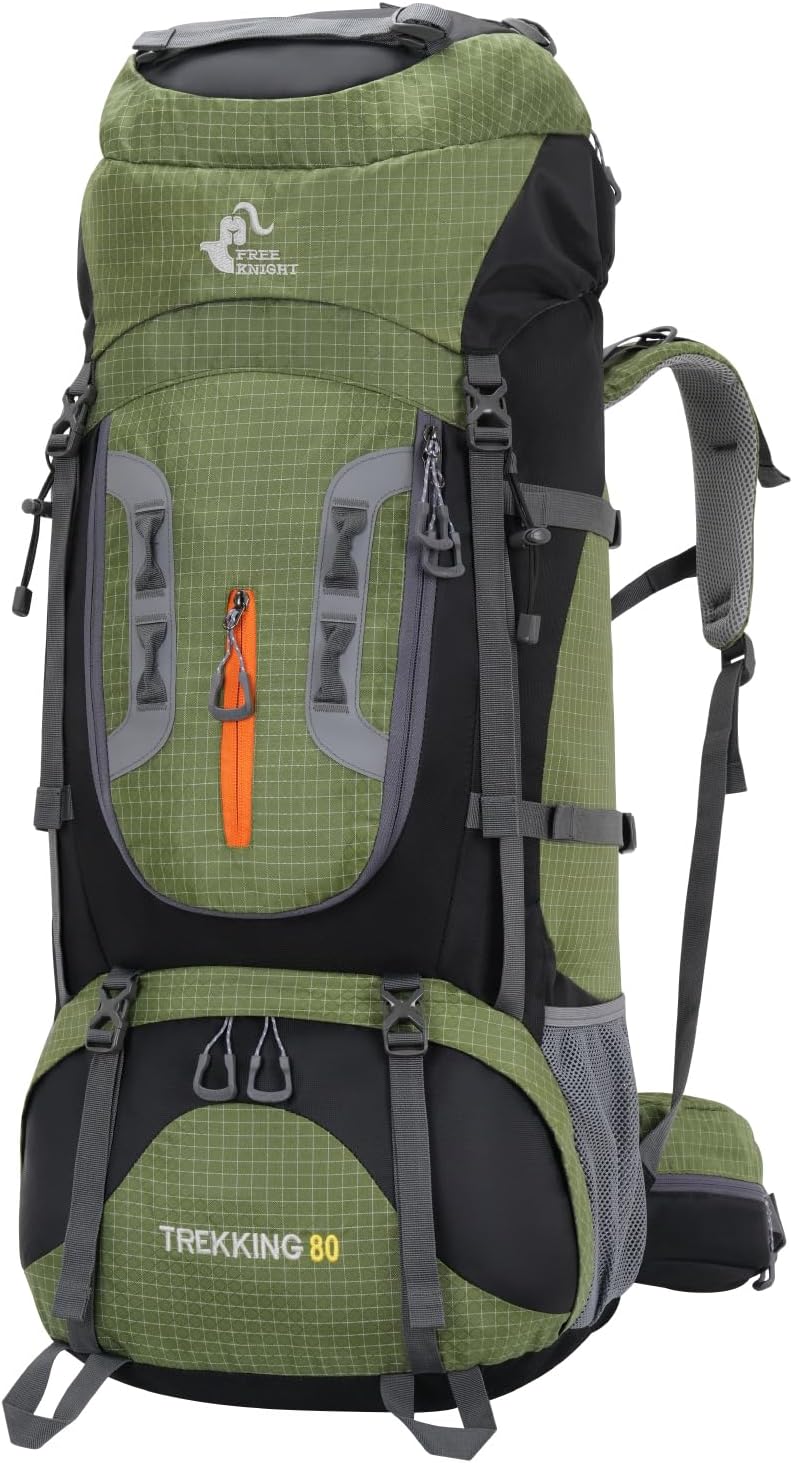
From a design point of view, the main thing you notice is the size. This thing is tall and can swallow a lot of gear. The army green color looks fine in real life, more muted than flashy. It doesn’t scream “tourist”, which I like when I’m moving through airports or buses. Visually, it looks like a classic trekking backpack, with lots of straps, buckles, and pockets hanging around. Nothing fancy, but functional enough. If you’ve used big‑name packs, you’ll immediately see the difference in how clean (or not) the lines and stitching are, but for the price bracket it’s acceptable.
The compartment layout is actually pretty practical. The separate bottom compartment for shoes or a dirty laundry bag is handy; I used it for my trail runners and later for smelly socks and underwear. The main top compartment is huge and uses a drawstring closure under a lid, which is standard. That lid has extra pockets for quick‑access stuff like snacks, headlamp, and documents. On the sides, you have two elastic pockets that hold 1L bottles without issues. There are also compression straps you can use to secure trekking poles or a rolled mat.
Where the design feels more “cheap” is in the small details: some straps are a bit thin, the plastic buckles feel basic, and the internal organization is very simple. Don’t expect fancy internal dividers or hidden pockets. It’s more like a big sack with a few add‑ons. The hydration sleeve inside holds a bladder, but there’s no dedicated, reinforced routing for the hose; you just run it out near the top. It works, but it’s not super polished.
In use, I appreciated the number of attachment points, but I also noticed that if you really load up the outside with a sleeping bag, mat, and other gear, the pack starts to feel a bit unbalanced because there’s no frame. So the design invites you to hang things everywhere, but the structure doesn’t fully follow. Overall, design is practical and generous in volume, but clearly tuned more for casual campers and travelers than for serious mountaineers who need precise load control.
Comfort: okay up to ~25 lb, then you start to feel the shortcuts
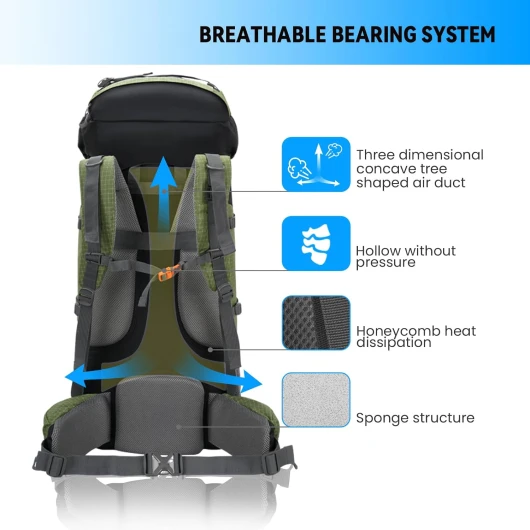
Comfort is where the Bseash 80L really shows its limits. The brand advertises ergonomic shoulder straps and back support, but without a frame, there’s only so much it can do. The S‑shaped shoulder straps are padded and the mesh is breathable, but the padding is relatively thin. On 1‑2 hour hikes with around 20–22 lb, I was fine. The load felt reasonably balanced, and the hip belt helped take some weight off the shoulders. I did sweat on the back, but nothing unusual for a big pack.
When I pushed closer to the claimed 33 lb max, things changed. After 3–4 hours of walking, I started to feel pressure points on my shoulders and lower back. Because there’s no internal frame, if you don’t pack very carefully, hard items like a cooking pot or food bag can poke through the back panel a bit. I had to repack once to move a metal pot away from my spine. With a framed pack, the structure usually takes care of that. Here, you really have to use clothes or a sleeping bag as a cushion against the back.
The hip belt and chest strap help, but they’re basic. The hip belt has some padding, but it doesn’t wrap and hug your hips like on higher‑end trekking packs. It still shifts a bit when you walk. For shorter distances or lighter loads, it’s acceptable, but I wouldn’t choose this for multi‑week treks or thru‑hiking. One Amazon reviewer said they switched to an Osprey Atmos for that reason, and I completely get it. This pack just isn’t in the same league for long‑term comfort.
If you’re using it for weekend camping, travel between hostels, or carrying gear from car to campsite, it’s totally usable. You just have to keep your expectations in check: it’s comfortable enough, not more. If you’re sensitive to shoulder or back pain, or you know you’ll regularly carry over 30 lb for several hours, I’d look for something with a proper frame and thicker padding, even if it costs more. For the occasional user on a budget, the comfort is “decent but nothing more.”
Materials: light and decent for the price, but not made for abuse
The backpack uses ripstop polyester/nylon fabric that is advertised as water‑resistant and tear‑resistant. In hand, the material feels fairly thin but not flimsy. It’s in line with other budget hiking packs I’ve tried. After dragging it around for a few trips, including putting it down on rocks and dirt, I didn’t get any big tears, just some light scuff marks on the bottom. So for occasional use, the fabric itself is okay. I wouldn’t trust it for sharp rocks or constant bushwhacking, but for trails, buses, and campsites, it holds up.
The zippers and buckles are where you really feel the cost savings. The zippers work, but they’re not super smooth like YKK ones, and I had a few moments where I had to wiggle them a bit when the pack was stuffed full. No zipper failure so far, but I’m aware I need to be gentle, especially on the shoe compartment when it’s overpacked. The plastic buckles don’t feel very strong; they haven’t snapped on me, but I wouldn’t crank the straps as hard as I do on higher‑end packs.
The padding and mesh on the back and shoulder straps are covered with a breathable fabric. The foam inside is on the thinner side, which you really feel after a few hours of hiking. It’s okay for light to moderate loads, but when you reach that 30+ lb zone, it becomes less comfortable and you start feeling hard spots. Also, there’s no internal frame, no metal stays, nothing. So the material structure of the back panel is basically just layered fabric and foam. That’s the biggest difference vs more expensive packs.
Stitching is a mixed bag. On my unit, critical points like shoulder strap attachment and hip belt are double‑stitched, but you can see some slightly uneven lines and loose threads here and there. I haven’t had tearing yet, but one Amazon review mentioned stitching failure under load, and I’m not surprised. If you keep the weight near or under the recommended 33 lb and don’t drag it by one strap only, it should be fine. If you overload it and throw it around, it will probably give up sooner than a premium pack. So materials are good enough for budget use, but you clearly get what you pay for.
Durability: fine for casual use, questionable for heavy, frequent loads
After a few trips, the overall structure of the pack is still intact: no ripped fabric, no broken buckles, and the zippers still function. That’s a good sign for short‑term durability. The bottom has a few scuff marks from being dropped on gravel and dirt, but nothing that goes through the material. The rain cover also survived being stretched tightly over a very full load without tearing. So for occasional use—say a few trips a year—it looks like it will hold up reasonably well if you’re not brutal with it.
Where I’m more cautious is long‑term durability under heavier loads. The stitching on some stress points doesn’t inspire huge confidence. I noticed slight stretching at the base of one shoulder strap when I lifted the fully loaded pack by just that strap. I stopped doing that and started lifting it from the top handle plus one strap. This matches what one Amazon reviewer said: the pack tore under load, likely due to stitching. I haven’t had that happen, but I can see how it could if you overload it or mishandle it regularly.
The fabric itself seems fairly resistant to small snags, but I wouldn’t run it through thorny bushes or drag it over rocks. This is more of a trail, bus, and campsite backpack, not a canyon or climbing pack. The lack of a frame also means the pack can deform over time if you constantly pack it lopsided. It’s not catastrophic, but after a while, it may not sit as nicely as on day one.
So in terms of durability, I’d say: good enough for light to medium, occasional use, not ideal for people who live out of their backpack for months. If you plan to use it twice a year for camping weekends or a couple of weeks of travel, it should survive that without much drama. If you want to use it as your main pack for a gap year or a thru‑hike, I’d invest in something sturdier. There’s better on the market for heavy use, but at a higher price.
Performance on the trail: big volume, decent water protection, limited load handling
In real use, the biggest strength of this Bseash 80L is simply how much stuff it can carry in terms of volume. For a 3–4 day trip, I had no trouble fitting everything inside without it feeling like it would explode. Tent on the outside, sleeping bag at the bottom, clothes in the middle, food on top, and still space for extras. The many straps let you attach a mat, hammock, or tripod easily. I liked that I could organize dirty shoes separately and keep my clothes clean in the main compartment.
On the weather side, the water resistance is decent. The outer fabric handled light drizzle and splashes without soaking through immediately. During a heavier rain, I pulled out the included rain cover from the bottom pocket and wrapped the whole pack. That cover fits well and did its job; my gear stayed dry, including the top of the pack where water usually seeps in. I wouldn’t call the backpack itself waterproof, but with the cover, it’s clearly fine for normal rainy days. Just don’t expect it to handle a full day of heavy rain without the cover.
The main weakness in performance is load management. The brand says max 33 lb, and I’d actually aim for a bit less if you want to stay comfortable and avoid stressing the seams. When I pushed near that limit, I felt some minor creaking in the stitching around the shoulder area when lifting the pack by one strap. Nothing tore on mine, but combined with Amazon reviews mentioning tears, I’d take that limit seriously. The pack can swallow more volume than it can safely carry in weight, if that makes sense.
For travel use, like bus and plane trips, it’s pretty handy. It’s within the size range many airlines accept as checked luggage, and being lightweight means you can pack more stuff before hitting airline weight limits. I used it on a bus trip where rolling luggage would have been a pain, and it was a good compromise. So performance is solid for light to moderate loads and mixed travel/hiking use, but it’s not a heavy‑duty workhorse for fully loaded expeditions.
What this 80L Bseash pack actually offers on paper
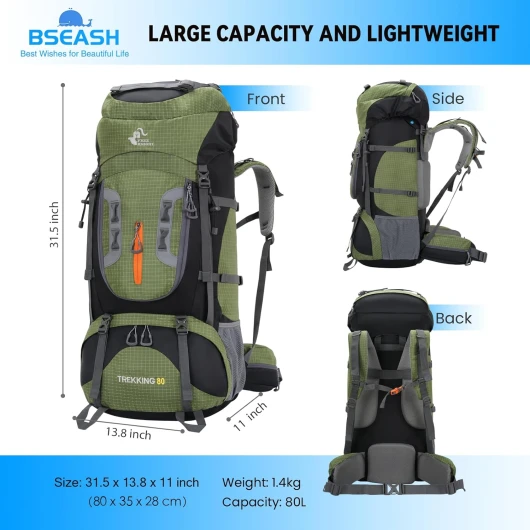
The Bseash 80L is advertised as a lightweight, water‑resistant hiking and camping backpack with a built‑in rain cover. The total capacity is 80 liters, which is huge for something that weighs only about 1.36 kg (just under 3 lb). The dimensions are roughly 80 x 35 x 28 cm (31.5 x 13.8 x 11 inches), so it’s tall and narrow, typical for trekking packs. The brand says the maximum load it should carry is around 33 lb (about 15 kg), which is not that high for an 80L bag, and that detail matters in real use.
In terms of features, you get a big main compartment with drawstring closure, an inner sleeve for a water bladder, two side pockets for bottles, a separate shoe compartment at the bottom, and several smaller pockets and straps. There are supposedly 8 adjustable straps to tighten the load or hang stuff like a sleeping bag, mat, or tripod. At the bottom there’s a zippered pocket that hides the rain cover, which wraps around the whole pack when needed.
The material is a ripstop polyester/nylon mix, advertised as water‑resistant and tear‑resistant. There’s no internal or external frame, which is important: it’s basically a soft pack with some padding, not a structured expedition backpack. The shoulder straps are S‑shaped and padded, and the back panel uses breathable mesh with foam. There’s a basic hip belt and chest strap, but nothing too advanced like you see on higher‑end trekking models.
So on paper, the positioning is clear: it’s a large‑volume, low‑cost backpack for adults, unisex, aimed at camping, climbing, and travel rather than hardcore long‑distance trekking. The Amazon rating hovers around 4/5 with mixed comments: some people happy with the capacity and light weight, others complaining about stitching and comfort when loaded. After using it, I’d say the listing is mostly honest, but the “80L trekking beast” image is a bit optimistic for what you actually get.
Pros
- Very large 80L capacity in a relatively lightweight 3 lb package
- Includes rain cover and separate shoe/dirty laundry compartment
- Good price for the amount of space and features you get
Cons
- No internal frame and thin padding make heavy loads uncomfortable
- Stitching and materials feel budget and may not handle frequent, heavy use
- Zippers and buckles are basic and need to be treated with care when the pack is fully stuffed
Conclusion
Editor's rating
After using the Bseash 80L backpack on several trips, my take is pretty simple: it’s a large, budget‑friendly pack that works well for light to moderate use, but it’s not built for heavy loads or hardcore trekking. The big advantages are the massive capacity, low weight, and practical features like the separate shoe compartment and included rain cover. For weekend camping, hostel‑to‑hostel travel, or situations where a suitcase is a pain, it does the job and lets you carry a lot of stuff without spending much.
On the flip side, the lack of a frame, the thin padding, and the average stitching mean it has clear limits. Comfort drops once you get near 30+ lb, and you need to be careful with how you pack and handle it if you want it to last. If you’re planning a long trek, a thru‑hike, or you know you’re rough on your gear, I’d skip this and go for a sturdier, more comfortable pack from a more technical brand.
So, who is it for? People on a budget who need a big, occasional‑use backpack for 3–4 day trips, travel, or camping and are okay with “decent but not amazing” comfort and durability. Who should avoid it? Serious hikers, heavy packers, and anyone expecting premium comfort and bombproof build. If you keep your expectations realistic and respect the weight limit, it’s good value for money and a practical option.