Summary
Editor's rating
Is it worth the money compared to cheaper glues?
Design and ease of use: simple but thought through
What’s in it and what it sticks to
How the repair holds up over time and in bad conditions
What you actually get in the tube
Does it actually hold your soles on?
Pros
- Holds leather and rubber soles together very well if surfaces are clean and dry
- Thin, non-foaming formula with a narrow nozzle makes precise application easier
- One small tube is enough for several repairs, so cost per repair is reasonable
Cons
- Price feels high compared to generic super glue tubes
- Requires proper prep and curing time; quick, lazy fixes don’t last very long

Specifications
View full product page →| Brand | Boot-Fix |
Can this tiny tube really save your boots?
I bought this Boot-Fix shoe glue because a pair of leather boots I like a lot started to peel at the toe and along the sidewall. The upper was still in good shape, the sole still had grip, but the bond between them was opening up. Classic situation: you don’t want to bin them, the cobbler is either expensive or far away, so you try to fix it yourself. That’s exactly the kind of problem this glue claims to solve.
First impression when you open the package: the tube looks small for the price. It’s 20 grams, so roughly the size of a slightly bigger super glue tube. I honestly thought, “I’m going to finish this on one pair.” In practice, like a lot of other users say, you don’t need much. A thin bead goes a long way, and it flows enough to spread into the joint, so I ended up using maybe a quarter of the tube for a fairly big repair on both boots.
I used it on leather uppers with a rubber sole, which is more or less its main purpose. I also tried a quick test on an old pair of trainers where the heel was starting to peel. That second test was less careful, more of a “let’s see what happens if I rush it”. The difference between a properly prepared repair and a lazy one is clear: with good prep it holds really well, with bad prep it’s a temporary fix at best.
Overall, my first takeaway: it’s basically a specialized super glue for shoes. It behaves like cyanoacrylate (which it is), but it stays a bit more flexible and doesn’t foam or expand like Gorilla Glue. If you expect it to magically resurrect totally dead shoes, you’ll be disappointed. If your shoes still have life left and you’re willing to clean and dry everything properly, it does the job better than the usual cheap super glue tubes.
Is it worth the money compared to cheaper glues?
On price, Boot-Fix sits above the random super glue tubes you find in supermarkets and around the level of more specialized products like Shoe Goo or Gorilla Glue. At first glance, paying that much for a 20 g tube feels steep. But you have to compare it to the alternatives: a proper resoling at a cobbler often costs as much as or more than a new pair of mid-range shoes, and if you just chuck the boots, you’re wasting all the money you already put into them.
In my case, this glue basically saved a pair of boots that would have cost several times the price of the tube to replace. Even if they only last another season or two thanks to the repair, that’s already good value. The fact that I still have more than half the tube left means I can fix at least one or two more pairs in the future. So taken as a “per repair” cost, it’s actually quite reasonable.
Compared to Shoe Goo, which I’ve used before, the main difference is that Boot-Fix is thinner and sets faster. Shoe Goo is more like a thick paste; it can build up worn areas but takes ages to cure and stays a bit gummy for a while. Boot-Fix is not as good for rebuilding missing chunks, but for bonding surfaces that should already match, it’s quicker and cleaner. Gorilla Glue, on the other hand, expands and can make a mess if you’re not careful. I’ve had it push the sole away slightly as it foamed, which isn’t ideal. Boot-Fix doesn’t do that.
So in terms of value, I’d say it’s not cheap, but it pays for itself if you use it to save even one decent pair of shoes or boots. If you only have one pair of cheap trainers and they’re already wrecked, it’s probably overkill. But if you own leather boots, hiking shoes, work boots or anything you actually care about, spending a bit more on a glue that’s designed for this job makes sense.
Design and ease of use: simple but thought through
Design-wise, this is not a fancy object, but some little details matter. The tube is flexible enough that you can control the flow easily with one hand, which is important when the other hand is holding the shoe open. The nozzle is long and narrow, so you can reach into the gap between the upper and the sole rather than just smearing glue on the outside. That makes a big difference compared to short, stubby nozzles you get on cheap super glues.
The viscosity is what I’d call medium: it’s runnier than gel super glue but thicker than water. In practice, that means it will run into tight joints if you gently squeeze, but it doesn’t instantly flood everywhere. You still have to be careful, though. When I did the toe area of my boot, a bit of glue oozed out along the welt, and where it hit the exposed leather it dried slightly whitish. It’s not dramatic, but if you’re picky about looks, you’ll want to wipe any excess immediately.
Another design point is the working time. They market it as “instant bond”, and yes, it grabs quite fast, but if you just press for 10 seconds and walk off, you’re pushing your luck. In my case, I held pressure by hand for about a minute per section, then let the boots sit overnight. Other users say the same: ignore the idea that you can glue and wear in five minutes if you want a long-lasting repair. I’d say you have around 20–30 seconds to adjust things before it starts to set, then it locks in pretty firmly.
Overall, the design is practical for actual shoe repair. It’s not perfect – a slightly longer nozzle or a needle tip would be handy for very deep splits – but for most sole separations and sidewall lifts, it’s easy enough to work with. If you’ve ever used any super glue before, you’ll get used to this in minutes.
What’s in it and what it sticks to
This glue is basically a cyanoacrylate formula (super glue family), tweaked to stay a bit more flexible once cured. That’s important for shoes, because the sole flexes constantly. Standard super glue can go brittle and crack under that movement, especially in cold weather. Here, the bond doesn’t feel rubbery, but it’s not glass-hard either. When I bend the sole where I glued it, it creaks a bit the first few times but doesn’t snap or peel.
In terms of compatible materials, I tried it on:
- Leather upper + rubber sole (main repair)
- Rubber sole to foam midsole (old trainers test)
- A quick side test on a small leather patch to see if it stains
On leather-to-rubber, it grabs very well, as long as both surfaces are fully dry and properly cleaned. I followed the same kind of prep as one of the Amazon reviewers: warm, dry room for a day, then brushed off dirt and wiped with a bit of isopropyl alcohol. After that, the bond feels solid, and after a few muddy walks, nothing has started to lift again.
On the trainer heel (rubber to foam), it held, but not as strongly. Foam is always tricky; it soaks up some glue and doesn’t give a perfect surface. I’d call that repair “good enough to extend the life of beaters”, but I wouldn’t rely on it for heavy sports. On the leather test patch, a small drop that I wiped quickly left no visible mark, but when it cured in place and I peeled it off, it did remove a tiny bit of finish. So you still need to be careful on visible leather.
So material-wise, it’s clearly optimized for rubber and leather shoe components, which is exactly what it claims. For plastics, foams or random household repairs, it might work, but I wouldn’t buy it specifically for that when standard super glue is cheaper.
How the repair holds up over time and in bad conditions
Durability-wise, my experience lines up with what many reviewers describe. After the repair, I put the boots through what I’d call normal abuse: daily walks on pavement, a couple of long muddy hikes, and some wet grass and shallow puddles. We’re talking several dozen kilometers over a few weeks. The glued areas haven’t budged. No fresh gaps, no crackling noise, and no visible lifting at the edges. The bond seems to handle bending and torsion fine.
The glue is advertised as resistant to heat, cold and moisture. I haven’t tested extreme temperatures, but I did wear the boots in fairly cold, damp weather and then left them to dry naturally. No sign of the bond weakening after they dried. One of the big problems with some other glues (like Gorilla Glue) is that they expand and create a foamy joint that can break down or let water seep in. Here, the joint is thin and compact, so there’s less space for water to sit.
Another point is how the leftover glue in the tube ages. So far, after opening it and using it a couple of times over more than a month, it’s still liquid and usable. The tip can crust a bit, but you can poke it clear or trim the end. That may not sound like much, but with many cheap super glues you get one use and then the tube is done. This one seems to stay functional longer, which matters for durability in the sense of “I can use the same tube for multiple repairs over the year”.
To be clear, this doesn’t turn old, tired shoes into new ones. If the sole rubber is crumbling or the midsole is rotten, the glue will hold the pieces together, but the shoe itself may still fail elsewhere. I’d say it’s best for boots and shoes that are still structurally sound but have one or two separation issues. In that scenario, the durability is good enough that you genuinely extend the life of the footwear rather than just limping along for a week.
What you actually get in the tube
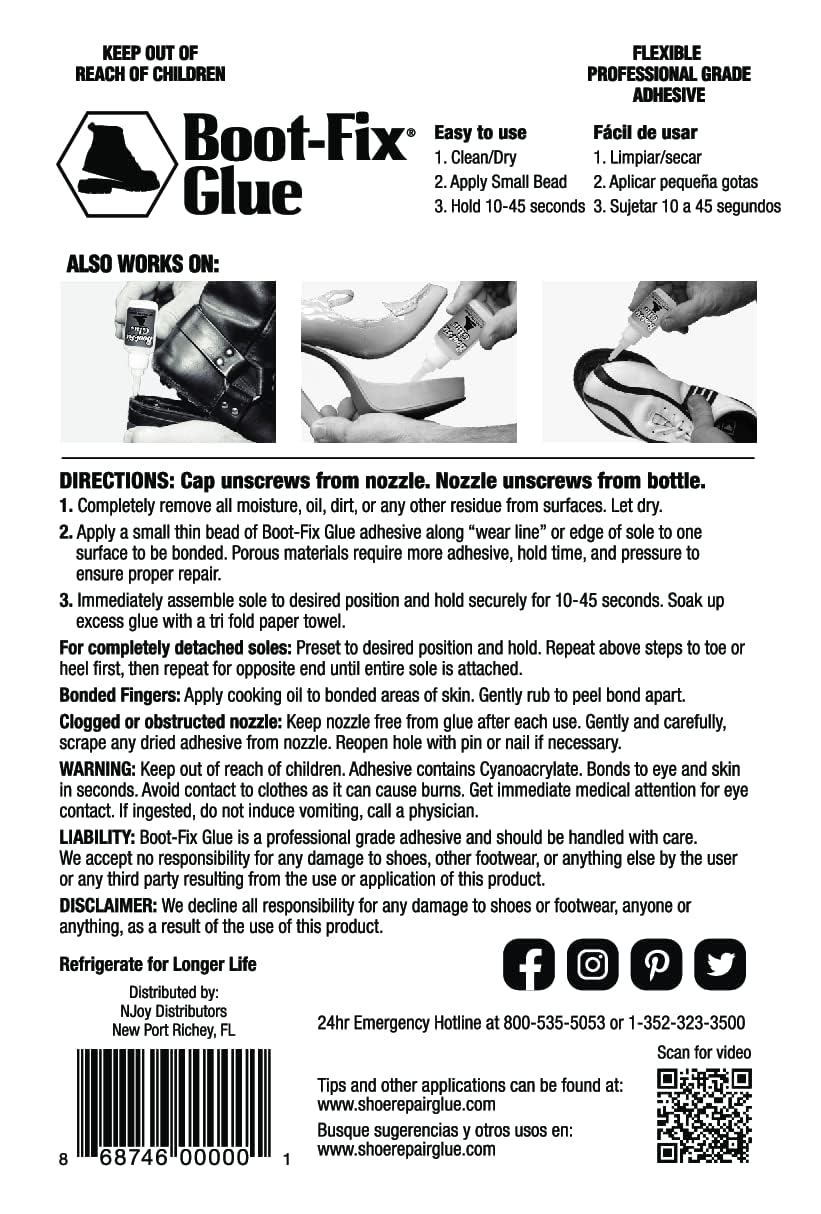
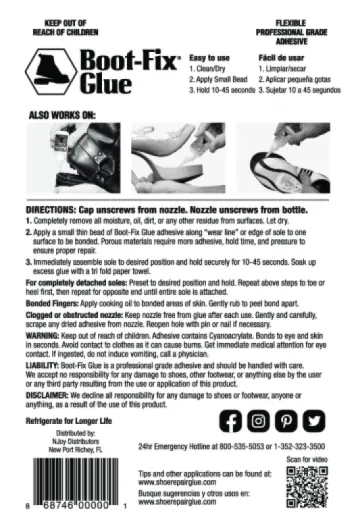
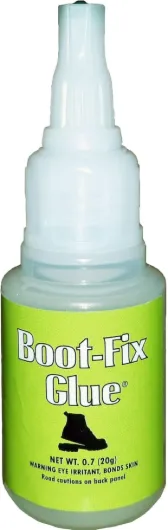
On the presentation side, it’s very basic: a small white tube, simple label, and a narrow nozzle. No fancy box or accessories. Honestly that’s fine for what it is, but don’t expect a full “shoe repair kit” with brushes, clamps or anything like that. It’s literally just the glue. The description on the packaging is clear enough: professional shoe repair glue, instant bond, flexible, works on leather and rubber. Nothing more, nothing less.
The tube size is 20 grams (about 0.7 fl oz), which sounds tiny but is actually enough for several repairs if you’re not heavy-handed. I did a full toe and sidewall re-bond on both boots and still have well over half left. The nozzle is pretty thin, which helps a lot to get the glue deep into the gap between sole and upper. You can squeeze it gently and run the tip along the opening, and it will seep inside without going everywhere.
One thing I pay attention to with this kind of product is how the cap behaves after first use. With many super glues, the cap fuses to the tube or the nozzle clogs solid. With this one, as long as you wipe the tip quickly with a bit of paper towel and close it properly, it stays usable. After a couple of weeks between uses, mine still opened without a fight and the glue flowed fine. So in terms of everyday practicality, it’s decent.
So, in short: simple packaging, functional nozzle, and the tube feels small but is more than enough for several pairs if you’re careful. If you expect lots of instructions and accessories, you’ll be underwhelmed. If you just want something you can pull out of a drawer and use straight away, it’s basically what you need.
Does it actually hold your soles on?
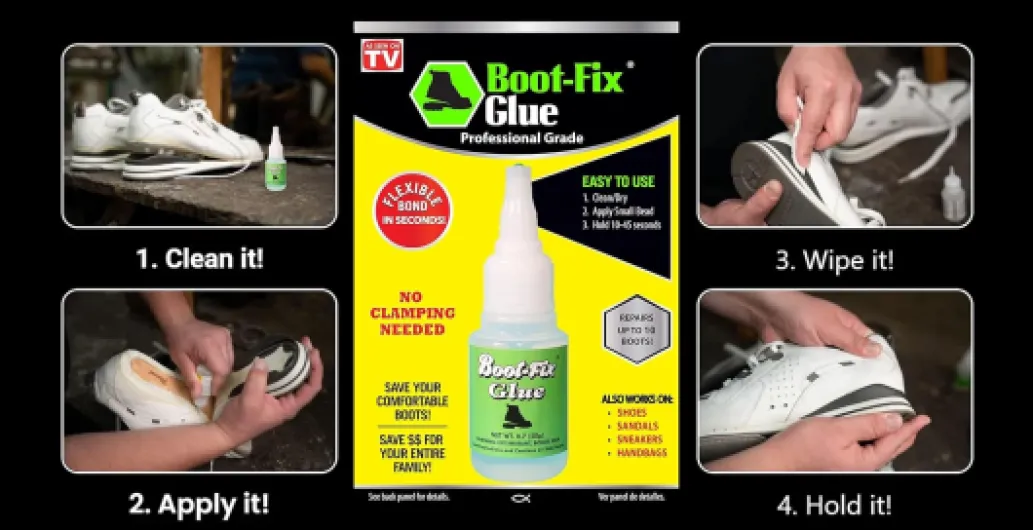
This is where it matters. I used Boot-Fix on a pair of leather boots where the toe of the sole had peeled back about 3–4 cm and the side rubber strip was lifting along roughly 10 cm. I cleaned everything, let it dry thoroughly, applied a thin bead of glue along the whole contact area (not just the edge), pressed firmly for about a minute, then left the boots in a warm room for 24 hours. After that, I wore them on several walks, including wet grass, mud and some pavement.
After a few weeks of normal use, the repair is still intact. No fresh gaps, no flapping at the toe, and the side strip is holding. When I flex the boot by hand, the glued area moves with the rest of the sole instead of feeling stiff and ready to crack. That matches a lot of the highly rated reviews: if you do the prep right and let it cure properly, it holds up well under real-world use. It’s not magic; it’s just a good, strong bond suited for this kind of stress.
On the flip side, when I did a lazier repair on an old pair of trainers (quick clean, slapped some glue, pressed for 20–30 seconds, wore them the next day), the heel started to lift again after a week of daily wear. Not as bad as before, but clearly not a long-term fix. That shows pretty clearly that the glue itself is strong, but it’s not going to compensate for bad surfaces or no curing time. If you treat it like tape, you’ll get tape-level results.
So in terms of pure effectiveness, I’d say it’s pretty solid for giving a second life to boots and shoes that are structurally fine but starting to separate. If your soles are worn flat, cracked, or the shoe is falling apart in multiple places, this will just delay the end, not reverse it. But for common sole separation issues, it does what it says, and better than generic super glue or foaming construction glues I’ve tried before.
Pros
- Holds leather and rubber soles together very well if surfaces are clean and dry
- Thin, non-foaming formula with a narrow nozzle makes precise application easier
- One small tube is enough for several repairs, so cost per repair is reasonable
Cons
- Price feels high compared to generic super glue tubes
- Requires proper prep and curing time; quick, lazy fixes don’t last very long
Conclusion
Editor's rating
Boot-Fix Shoe Glue is basically a no-nonsense, specialized super glue for footwear. It’s not flashy, the tube looks small, and it’s pricier than generic glue, but in actual use it does what most people want: it re-bonds soles and uppers reliably, as long as you do your part with cleaning and drying. On my leather boots with rubber soles, the repair has held up to real walking in wet and muddy conditions, not just a quick indoor test.
The big thing to understand is that the glue isn’t magic. If you slap it onto dirty, damp surfaces and expect miracles in five minutes, you’ll end up with a temporary fix at best. Used properly – thin bead, good surface prep, firm pressure, and at least overnight curing – it gives a strong, slightly flexible joint that feels solid and survives daily use. It’s better behaved than Gorilla Glue for this specific job and easier to work with than thick pastes like Shoe Goo when you just need to stick things back together rather than rebuild missing chunks.
I’d recommend it for people who have decent boots or shoes that are coming apart at the sole but still have life left in them: work boots, hiking boots, leather shoes, even old Docs. If your footwear is already worn flat, cracked, or falling apart in several places, this will only delay the inevitable and might not justify the cost. But if you want a realistic chance to save a pair you actually like without going to the cobbler, this glue is a pretty solid option.