
Summary
Editor's rating
Value: very decent for the price, with a few trade-offs
Design: practical trail look, nothing fancy, mostly focused on support
Comfort: good once broken in, but size and ankle feel matter
Materials: synthetic build that feels tough enough but not premium
Durability: feels tough at first, but some reports of early splitting
Waterproofing: good for rain, mud and wet grass
Performance on the trail: grip and waterproofing are the main strengths
What you actually get for your money
Pros
- Good waterproofing for rain, mud and wet grass – feet stay dry in normal conditions
- Strong grip with aggressive 7 mm lugs, works well on muddy and uneven terrain
- Comfortable once broken in, with solid ankle support and decent cushioning for long walks
Cons
- Synthetic upper may split or wear faster than premium leather boots, some reports of splitting after a few months
- Runs slightly small; half-size up is often needed, especially with thick socks

Specifications
View full product page →| Brand | XPETI |
Solid budget boots or future blisters? Here’s the deal
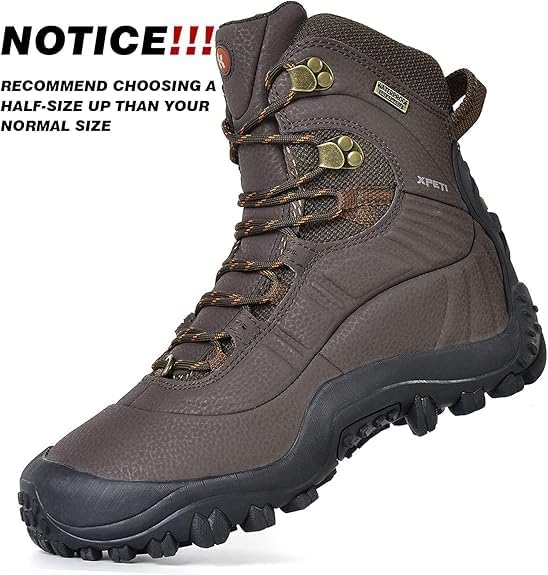
I've been using these XPETI Men's Waterproof Hiking Boots (size 10 UK, brown) as my main walking and light hiking boots for a few weeks. I’ve used them for dog walks twice a day, some muddy local trails, and a couple of longer 10–12 km hikes. I’m not sponsored, I paid for them myself, and I usually buy mid-range brands like Hi-Tec, Karrimor and occasionally spring for something pricier if my feet are suffering. So I went into these with fairly normal expectations: if they keep my feet dry, don’t hurt, and last a reasonable time, I’m happy.
Right away, the first thing that stood out was the ankle support and the weight. They feel more supportive than cheap supermarket boots, but they’re not heavy like old-school leather hiking boots. Out of the box, they felt a bit stiff around the ankle but not brick-hard. I wore them around the house for a day before going out properly, just to see if they rubbed. No major hot spots on day one, which is already a good sign for me because I usually get heel rub quickly.
Waterproofing was the other thing I wanted to test properly. The brand talks a lot about “waterproof mesh upper” and a membrane, which usually means they’re going after the same idea as Gore-Tex, but cheaper. In practice, I had them in wet grass, steady rain, and some shallow puddles. So far, my socks stayed dry. Obviously, I didn’t stand in a stream for ten minutes, but for normal wet UK-style walks, they did the job.
Overall, first impression: these are pretty solid for the price, but not perfect. You can feel they’re not a premium boot – the materials and finish are more “functional” than nice. But for dog walking, weekend hikes, and general bad weather use, they seem to hit a good balance between comfort, grip and cost. The real question will be how long they last, because a few Amazon reviews mention splits after a few months, and that’s something I’d keep in mind if you’re planning to hammer them every single day.
Value: very decent for the price, with a few trade-offs
When you look at the price of these XPETI boots compared to big-name hiking brands, they sit firmly in the budget to mid-range zone. For that money, you’re getting proper ankle support, decent cushioning, real grip, and effective waterproofing. In my view, that’s already good value, because a lot of cheaper boots either leak, hurt your feet, or feel like cardboard after a few long walks. These actually feel like proper hiking boots, not just fashion boots pretending to be outdoor gear.
The main trade-off for the lower price is long-term durability and brand reputation. With a more expensive brand, you often get better materials and sometimes better after-sales support. With XPETI, you’re gambling a bit more on how long they’ll last. That said, the Amazon rating of 4.3/5 over thousands of reviews suggests that most people are happy with what they get. Some even say they’re the best boots they’ve had at this price and are buying a second pair in another colour, which says a lot about perceived value.
For what I use them for – regular walks in bad weather, light hiking, and general outdoor messing around – I’d say they’re worth the money. If they last a solid year of regular use, I’d consider that fair at this price point. If they only lasted a few months under heavy daily use, that would be less good, but that’s also not really how they’re marketed; they’re sold as hiking and walking boots, not industrial work boots.
If your budget is tight and you want boots that keep your feet dry, have good grip, and are comfortable enough for long walks, these are a pretty solid option. If you’re more focused on long-term durability and don’t mind spending more, you might want to look at higher-end brands with leather uppers and more proven membranes. In short: value is strong if you’re realistic about what you’re buying and how you’ll use them.
Design: practical trail look, nothing fancy, mostly focused on support
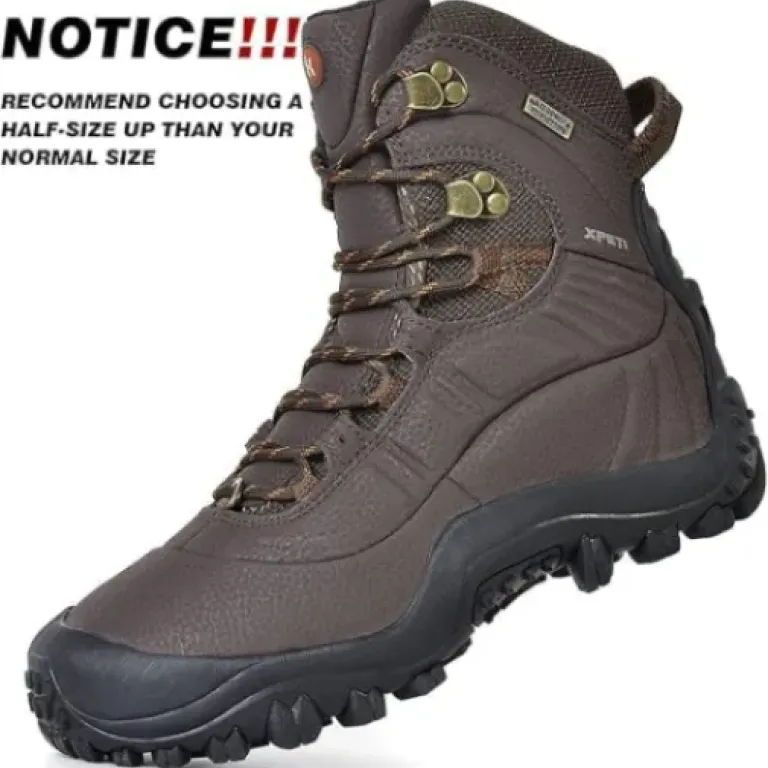
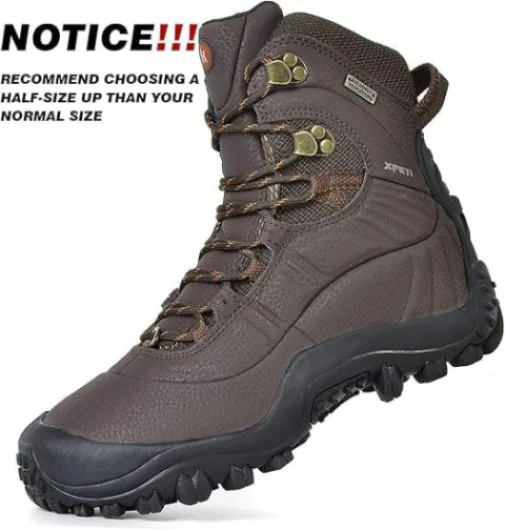
Design-wise, XPETI clearly focused on support and grip rather than making something stylish. The overall look is a standard brown hiking boot with synthetic overlays and a rubber toe cap. The toe cap is actually one of the things I appreciated: it gives you a bit of protection when you inevitably kick a rock or tree root, and it also helps the front of the boot resist scuffing. After a few weeks of use, the toe area had some marks but nothing serious – it still looked fine.
The outsole has aggressive 7 mm lugs that you can really see and feel. These are deeper than on a lot of casual walking shoes and more in line with proper trail footwear. The pattern is multi-directional, so you get grip going uphill and braking downhill. On muddy paths and wet grass, I never felt like I was skating around. You still need to be careful on smooth wet stone, but that’s normal. For general British-style trails with mud, roots and uneven ground, the design of the sole is a strong point.
The lacing system is basic but works: standard fabric loops and hooks higher up so you can get a tighter ankle lock. The lace-up closure lets you adjust the tightness over the top of the foot and around the ankle separately, which I like. Once you get them dialled in, your foot feels locked in without sliding forward on descents. The tongue is gusseted high enough to keep water and mud from instantly getting in, which is important when you step in deeper puddles or slush.
One thing to note: because of the thick ankle padding and molded TPU support, the boots feel quite structured around the ankle. This is good for stability, especially if you’ve had ankle issues or carry a backpack, but it might feel a bit restrictive at first if you’re coming from low trainers. After a few walks, I got used to it, but the first couple of outings I definitely noticed the boot “holding” my ankle more than I was used to. So from a design point of view, these lean more towards support and safety than freedom of movement, which suits hiking but maybe not casual city wear all day.
Comfort: good once broken in, but size and ankle feel matter
Comfort-wise, these XPETI boots ended up better than I expected for the price, but they’re not slippers out of the box. The first couple of walks, I really noticed the firm ankle support and the stiffness around the collar. It wasn’t painful, but you’re aware something is holding your ankle in place more than a trainer would. After three or four outings of 45–60 minutes each, the padding softened up a bit and they started feeling more natural. So I’d say there is a short break-in period, especially if you’re not used to higher boots.
The EVA midsole and foam insole give decent cushioning. I did a 10 km walk on mixed terrain (pavement, forest trail, some rocky bits) and my feet weren’t screaming at the end. The underfoot feel is on the firmer side compared to running shoes, but for a hiking boot that’s normal. You get enough protection from stones and roots without feeling every bump. If you’re planning longer hikes or you already know you need strong arch support, I’d swap the stock insole for something better – the boot has enough volume to allow that.
Breathability is okay but not perfect. These are waterproof boots with a membrane, so they will run warmer than non-waterproof shoes. On cool and wet days, they felt great. On a milder sunny day, my feet were definitely warmer than in my non-waterproof walking shoes, but still acceptable. I didn’t get any nasty rubbing or blisters, which for me is the main test. I wore standard hiking socks, not super thick ones, and that combination worked well. If you go for very thick socks, make sure you size up half a size as several users suggested.
Fit is slightly snug lengthwise but not cramped, and the width is moderate to slightly wide. My toes had enough room and I didn’t get that “toe smashing the front” feeling on descents, which is important. The lace-up system lets you adjust the midfoot and ankle tightness separately, so you can loosen the top if you feel too restricted. Overall, once broken in and sized correctly, comfort is a strong point for the money. Not luxurious, but clearly better than the really cheap no-name boots you see in discount shops.
Materials: synthetic build that feels tough enough but not premium
The boots are mostly synthetic with a rubber sole, EVA midsole, and mesh lining inside. If you’re expecting thick leather, that’s not what this is. The benefit of the synthetic upper is that it keeps the weight down and dries faster if you do end up getting them wet inside. The downside is you don’t get that long-term leather “molding to your foot” feel, and sometimes synthetics can crack or split earlier, which is exactly what a few Amazon reviewers reported after a few months.
The upper has a mix of tougher synthetic panels and areas of waterproof mesh. In hand, the material doesn’t feel cheap-flimsy, but it also doesn’t feel like top-end mountaineering gear either. It sits right in that middle “good enough” zone. The stitching on my pair was straight and clean, no loose threads out of the box. The joins between the sole and the upper looked well sealed, which is critical for waterproofing. That said, long-term durability is still a question mark – one reviewer mentioned the boots splitting after four months, so if you’re planning to use these every day for work on rough ground, I’d keep that in mind.
Inside, the mesh lining is comfortable and does a decent job of managing moisture. On longer walks, my feet got warm but not unbearably sweaty, and I didn’t feel like I was walking in a plastic bag. The insole is foam, removable, and pretty standard. It gives some cushioning but nothing special; if you have fussy feet or need extra arch support, I’d plan to swap it for a better insole. The EVA midsole under that is where most of the shock absorption comes from, and that part feels solid – landings feel cushioned enough even on harder tracks.
Overall, the materials are practical and in line with the price. You’re not getting premium leather or big-brand membranes, but you are getting a well-built synthetic boot that feels sturdy enough for regular walking and hiking. If you treat them reasonably and don’t abuse them like work boots on concrete and rubble every day, they should hold up fine. Just don’t expect them to last like a £200 pair from a high-end outdoor brand.
Durability: feels tough at first, but some reports of early splitting
Durability is the one area where I’m a bit cautious. In the short term, my pair feels sturdy enough. The sole is still in great shape after several weeks of use, the stitching is intact, and the upper hasn’t shown any obvious signs of damage beyond normal scuffing. The rubber toe cap helps a lot with preventing damage at the front – I’ve kicked a few rocks and roots and only got cosmetic marks.
However, looking at the broader feedback, there are a few warning signs. One Amazon reviewer mentioned they loved the boots – good support, comfortable, waterproof – but then updated their review saying the boots split about four months after purchase. That kind of split usually happens around the flex zone above the toes, especially on synthetic boots. Another person said they walked miles in their first pair before they eventually split, but still bought another pair because they liked them enough. That tells me that lifespan might be limited if you use them hard and often, but performance during that time is solid.
For my own use (regular dog walks, weekend hikes, not daily construction-site abuse), I’d expect these to last at least a good season, maybe more if I rotate them with another pair. If you’re planning to wear them every day for work on rough ground, I’d be less confident. The synthetic materials just don’t scream long-term tank-like durability the way good leather boots do. On the other hand, you’re also paying a fraction of what high-end leather boots cost, so there’s a trade-off.
So in simple terms: short to medium-term durability seems fine, but I wouldn’t buy these expecting them to be your only boot for years. If you accept that they might need replacing after a year or so of heavy use, the price still makes sense. If you want something to last for ages under daily punishment, you’ll probably need to spend more and go for stronger materials.
Waterproofing: good for rain, mud and wet grass
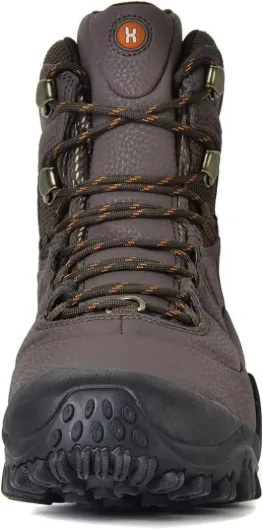
Since the big selling point here is that these are waterproof hiking boots, I paid attention to this more than anything else. Over several rainy days, I walked through soaked fields, muddy woodland paths, and plenty of wet grass that usually soaks your feet in normal trainers. With these XPETI boots, my feet stayed dry every time. The waterproof mesh upper and membrane seem to be doing their job, and the gusseted tongue helps stop water sneaking in through the laces as soon as you hit a puddle.
I also deliberately walked through some shallow puddles and sections of trail where water was sitting a couple of centimetres deep. As long as the water stayed below the top of the boot, I was fine. No obvious leaks, no damp socks afterward. That lines up with the Amazon reviews where people mention dog walking three times a day in rain and mud with dry feet. So for typical UK winter and autumn conditions – rain, mud, wet grass, shallow puddles – these boots handle it well.
Like all waterproof boots with a membrane, there is a trade-off: they run warmer and a bit less breathable than non-waterproof shoes. On cold and wet days, that’s actually a bonus – my feet stayed warm and dry. On milder days, they can feel a bit stuffy if you’re walking fast. Personally, I’d rather have slightly warm feet than wet socks, but if you mostly hike in hot weather, these might feel overkill and too warm.
Long-term, waterproofing often fails where the boot flexes most, usually around the toe bend. That’s where some people reported splits after a few months of heavy use. Once the outer material cracks, water will find a way in no matter how good the membrane is. So I’d say the waterproofing is very good out of the box and for the first months, but I wouldn’t expect them to stay perfectly waterproof for years if you absolutely hammer them daily. For weekend hikes, dog walks and general bad weather use, though, they’re more than good enough.
Performance on the trail: grip and waterproofing are the main strengths
In actual use, these XPETI boots do exactly what you want from hiking boots in this price range: they grip well, keep your feet dry in normal wet conditions, and give decent support. On muddy forest paths and wet grass, the aggressive rubber outsole with 7 mm lugs really does its job. I had several walks where the trail was basically mud and wet leaves, and I never felt like I was sliding around uncontrollably. You still need some common sense on very slippery surfaces, but overall traction is one of the better points of these boots.
Waterproofing has been solid so far. I walked through long wet grass after heavy rain, stood in shallow puddles, and did a few walks in steady light rain. My socks stayed dry every time. The combination of waterproof mesh upper and membrane seems to work. A couple of Amazon reviewers with heavy daily use also say they stayed dry walking dogs multiple times a day, which matches my experience. Just keep in mind that “waterproof” doesn’t mean “wade-through-a-river-for-10-minutes” proof; go over the ankle and water will still get in from the top.
Support is another area where these boots do well. The molded TPU ankle support and the overall structure keep your ankle more stable than in a low shoe. On uneven ground, roots, and small rocks, my ankles felt secure and I didn’t get that “rolling” feeling. If you’ve had ankle sprains before, you’ll probably appreciate this. The trade-off is less freedom of movement and that slightly stiff feeling at first, but for hiking, I prefer the extra security.
Where performance is a bit less clear is long-term durability. My pair is holding up fine so far, but one of the Amazon reviews mentions the boots splitting after four months, and that’s not ideal. Another person says they walked miles before their first pair eventually split, then bought a second pair anyway, which tells me they liked the performance but accepted the lifespan. So I’d say performance on the trail is strong, but if you’re planning to use these every single day in harsh conditions, just be aware they may not last as long as high-end brands.
What you actually get for your money
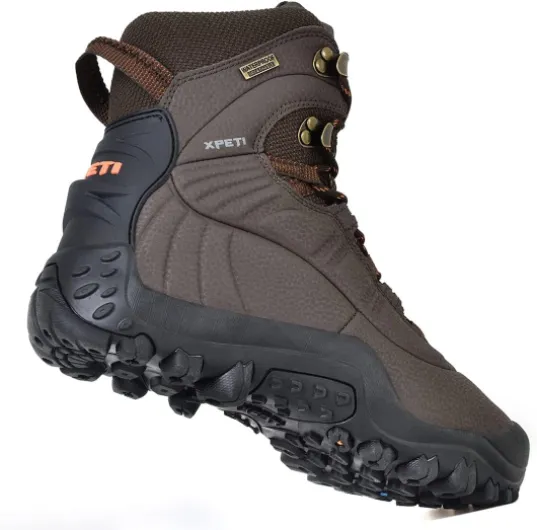
On paper, these XPETI boots tick a lot of boxes: waterproof, ankle-high, rubber sole, EVA midsole, TPU ankle support, rubber toe cap, lace-up closure. It sounds like the standard hiking boot checklist, and that’s basically what you get. They’re clearly designed more for hiking and walking than fashion, which I personally prefer. No shiny metal bits or weird patterns – just a fairly plain brown hiking boot that blends in on the trail.
The boot height is around the ankle, not a high military-style boot, but high enough to give some stability and keep mud and water out better than a low trainer. The shaft is about 8" from the arch according to the specs, and that feels about right on foot. I noticed the ankle padding straight away – it’s quite thick, which is good for support, but it does mean there’s a short break-in period while it softens and molds a bit to your leg.
In terms of sizing, I’d say they run slightly small or at least snug. Several people online mention going half a size up, and I agree. I usually wear a 10 UK, and in these, a 10 is OK with thin to medium socks, but for thick winter hiking socks I’d be happier in a 10.5. If you’re between sizes or like thick socks, I’d go half a size up. The boot is also on the slightly wider side compared to something like a narrow running shoe, which is good if you don’t have super slim feet.
Overall, the presentation is no-nonsense: these are clearly built to be functional walking boots, not lifestyle sneakers. The branding is there but not huge, the brown colour is quite standard, and they don’t scream for attention. If you’re looking for something that looks like a city fashion boot, this isn’t it. But if your goal is “boots that look like proper hiking boots and can handle mud and rain”, then what you see is what you get here.
Pros
- Good waterproofing for rain, mud and wet grass – feet stay dry in normal conditions
- Strong grip with aggressive 7 mm lugs, works well on muddy and uneven terrain
- Comfortable once broken in, with solid ankle support and decent cushioning for long walks
Cons
- Synthetic upper may split or wear faster than premium leather boots, some reports of splitting after a few months
- Runs slightly small; half-size up is often needed, especially with thick socks
Conclusion
Editor's rating
Overall, the XPETI Men’s Waterproof Hiking Boots in size 10 UK brown are solid budget-friendly hiking boots that do the basics well: they keep your feet dry, they grip properly on mud and wet ground, and they offer decent comfort once you’ve broken them in. The ankle support is noticeable and reassuring if you walk on uneven terrain, and the aggressive outsole lugs give you confidence on sloppy trails. For dog walking, weekend hikes, and general bad weather use, they get the job done without costing a fortune.
They’re not perfect, though. The synthetic materials don’t feel premium, and there are some reports of the boots splitting after a few months of heavy use. So if you want something that will survive years of daily punishment, these probably aren’t it. Sizing runs a bit snug, so going half a size up – especially if you wear thick socks – is a smart move. But if you’re realistic about their role as affordable, practical hiking boots, they offer good value for money. I’d recommend them to people who want reliable waterproof boots for regular walking and light hiking. If you’re a serious long-distance hiker or need work-grade durability, I’d say skip these and save up for a tougher, more expensive pair.