
Summary
Editor's rating
Value for money: good if you actually use what you’re paying for
Design: technical look, narrow-ish fit, and smart lacing
Comfort and fit: stiff at first, solid once broken in
Materials and build: tough upper, lots of rubber, proper Vibram sole
Durability: built to take a beating, but not exactly light
Performance on the trail: where these boots actually shine
What you actually get with these Salewa boots
Pros
- Very solid build with 360° rubber rand and Vibram sole that hold up well on rough terrain
- Strong heel lock and stable platform, good for steep descents and carrying a backpack
- Reliable waterproofing with Gore-Tex lining and good grip on mud, grass and rocky trails
Cons
- Quite heavy and stiff compared to lighter hiking shoes, overkill for casual flat walks
- Snug, technical fit that may not suit wide feet without sizing up

Specifications
View full product page →| Brand | Salewa |
Serious boots for people who actually walk in the hills
I’ve been using the Salewa Mountain Trainer Mid Gore-Tex in Asphalt Fluo Orange for a mix of UK hillwalking, muddy forest tracks, and wet winter dog walks. I’m not sponsored, I paid for them, and I came from Meindl and Adidas Terrex before these. So I’ve got a decent base to compare with, from soft sneaker-style hikers to more traditional leather boots.
The first thing to know: these are not soft, casual boots you wear to the pub. They’re on the stiff side, feel quite technical, and clearly built more for rocky trails, steep ground and loaded rucksacks than for strolling around town. Out of the box, I honestly thought I’d made a mistake because they felt quite rigid in the hand and on the first few steps indoors.
After a few outings though, it clicked. The support, the way the heel is locked in, and the grip on wet, messy terrain are all pretty solid. They feel like boots made for people who actually go out in bad weather and don’t just walk on dry gravel paths. If you’re used to softer, trainer-like hiking shoes, there’s a bit of an adjustment period, but you get more stability in return.
To be clear, they’re not perfect: they’re not light, they run a bit snug, and they’re overkill if you mainly walk on flat tarmac. But if you’re regularly in the hills, especially in autumn and winter, they make sense. I’ll break down what worked for me and what bugged me so you can see if they fit your use case or not.
Value for money: good if you actually use what you’re paying for
Price-wise, these sit in the mid-to-high range for hiking boots, roughly in the same ballpark as Meindl, Scarpa and similar brands. If you only walk the dog on flat paths, they might look expensive and a bit pointless. But if you compare them to other proper trekking boots with Gore-Tex and Vibram soles, the price is reasonable, especially considering the build quality and how they’re holding up.
For me, the value comes from a few things: reliability in bad weather, strong grip on mixed terrain, and the feeling that they’ll last several seasons if you look after them. I’ve had cheaper boots where seams opened, soles peeled, or the waterproofing failed within a year. So even if these cost more up front, they can work out better long term if you’d otherwise be replacing cheaper boots more often.
Where the value becomes more debatable is if you don’t need the stiffness and protection. If your hikes are mostly low-level, dry, and without a heavy backpack, a lighter, cheaper shoe will probably feel nicer and still do the job. Also, the fit is not super forgiving, so if you have wide feet and end up needing to size up and add fancy insoles, the total cost creeps up.
Overall, I’d call the value pretty solid for regular hikers and hillwalkers, especially in wet climates. You’re paying for durability, support and weather protection, not for fashion or ultra-lightness. If that lines up with what you actually do outdoors, the price makes sense. If not, you’re probably better off with something simpler and cheaper.
Design: technical look, narrow-ish fit, and smart lacing
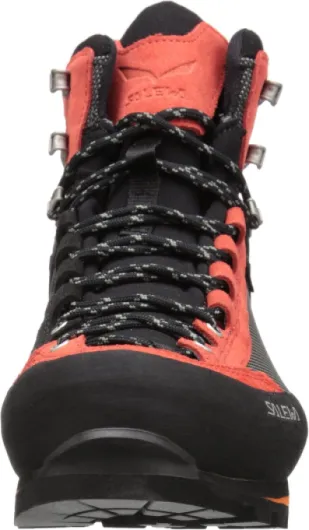
Design-wise, these boots are clearly aimed at people who like a technical, alpine style. The toe is protected with thick rubber, the rand wraps all around, and there’s a lot of stitching and paneling. It doesn’t look clean or minimalist; it looks like gear. Personally, I like that for hiking, but I wouldn’t wear them with jeans for a night out. The orange accents are bright but not ridiculous, and they make the boots easy to spot in the boot room or in the back of the car.
The lacing system is one of the better parts of the design. The laces go quite far down towards the toes, a bit like approach shoes, so you can really dial in the fit over the forefoot. Then you’ve got metal eyelets and hooks higher up that lock the heel in well. Salewa calls this the 3F System, which basically links the heel, lacing and sole to stop your foot sliding forward. In practice, it works: on steep descents I didn’t have my toes smashing into the front, and heel lift was minimal once I got the tension right.
The Flex Collar at the back of the ankle is another design touch that actually does something. The rear of the cuff is cut a bit lower and curved, so when you step downhill with a long stride, it doesn’t dig into your Achilles as much as some stiff boots do. I noticed this most when descending with a full pack – less rubbing and less feeling like the boot is fighting your ankle movement.
If there’s a downside on design, it’s that the overall shape is more on the narrow/technical side than on the wide/comfy side. If you’ve got wide feet or like big, roomy toe boxes, you might find these a bit tight unless you size up. Also, the bulk of the rubber rand and the stiff sole make them look and feel more like a mountain boot than a casual hiker. So the design is very functional, but not subtle and not for everyone’s foot shape.
Comfort and fit: stiff at first, solid once broken in
Comfort was the big question mark for me at the start. Out of the box, these boots felt stiff and a bit unforgiving. Walking around the house, I honestly thought they might be a return. But I gave them a chance and took them on a short 2-hour dog walk over mixed terrain – fields, paths, a bit of tarmac. By the end of that first real outing, they already felt better, and after 3–4 walks they started to settle onto my feet properly.
The fit is on the snug, technical side. I usually wear a UK 11; with these in 12 UK there’s enough space for a mid-weight hiking sock and a bit of toe room for descents, but they’re still closely wrapped around the midfoot and heel. If you’re between sizes or like thicker socks, I’d say go half a size to a size up. Heel hold is one of the strong points: once laced properly, I had almost no heel lift and I didn’t get hot spots or blisters, even on a 5-hour hike straight after the initial break-in.
The ankle support is solid without feeling like a ski boot. The Flex Collar does help on descents – less digging into the back of the ankle compared to some older leather boots I’ve had. Underfoot, the cushioning is firm but not dead. You don’t feel every stone, which is good, but you also don’t get that soft, bouncy feel of a trail runner. For long days with a backpack, I actually prefer this kind of support because my feet feel less beaten up afterwards.
If you mostly walk on flat, easy paths, you might find them overbuilt and a bit tiring. They only really start to make sense when you’re on uneven, rocky or steep ground. Also, if you’ve got very wide feet or need a lot of forefoot volume, these might feel cramped unless you size up significantly. So comfort is very good once broken in and if you have the right foot type, but they’re not a universal fit and they’re not instant slippers out of the box.
Materials and build: tough upper, lots of rubber, proper Vibram sole
The materials are where these boots start to justify their price. The upper is a mix of 1.6 mm suede, synthetic panels and a 360° solid rubber coating around the lower half. In practice, this means you can scrape them on rocks, kick through scree, or push through branches without babying them. After plenty of muddy hikes, some rocky Scottish-style ground and a fair bit of abuse, the upper on mine has scuffs but nothing worrying – no peeling, no stitching coming loose.
Inside, you’ve got a Gore-Tex Extended Comfort lining. That’s the version meant for higher activity levels, so more breathable than some of the older, hotter Gore-Tex boots I’ve used. It’s still a membrane boot, so don’t expect magic – my feet do get warm on long summer days – but for autumn/winter and wet conditions it feels about right. The lining on my pair hasn’t shown any signs of failing yet: no leaks, no wet patches, and still a decent barrier against puddles and wet grass.
The midsole uses Salewa’s Bilight construction, which is a two-layer EVA-style foam that’s shaped to cup your foot a bit. It’s on the firmer side compared to something like a soft trail runner, but that’s what gives you stability with a pack. Under that, you’ve got the Vibram WTC outsole. The rubber feels fairly hard to the touch, which usually means better durability. The lugs are aggressive, with good spacing so mud doesn’t pack in too badly. On wet rock and muddy slopes, the grip has been pretty reliable.
The only material-related gripe I have is weight. All that rubber, suede and stiff midsole add up. At around 700 g per shoe (in my size), you do feel them after a long day if you’re used to lighter shoes. But if you want a boot that shrugs off rough ground and lasts more than one season, the trade-off kind of makes sense. Overall, the materials feel robust and functional, not fancy, and that’s what I want in a serious hiking boot.
Durability: built to take a beating, but not exactly light
Durability is one of the main reasons I’d pick these over softer, trainer-style hiking shoes. After solid use – muddy countryside nearly every week, a couple of mountain trips, and plenty of dog walks in bad weather – the boots have held up very well. The suede has some cosmetic scuffs, but the 360° rubber rand has taken most of the abuse from rocks and roots. No peeling, no big chunks missing, and the stitching still looks clean.
The Vibram outsole shows some wear on the heel edges, which is normal, but the lugs are far from worn down. Compared to some lighter shoes I’ve had where the sole flattens out in a season, these feel like they’ll go several seasons before traction becomes an issue. The midsole hasn’t collapsed or gone mushy; they feel pretty much the same underfoot as they did after the initial break-in, which is what you want from a boot in this category.
Inside, the lining is still intact: no holes at the heel, no fraying. The original insole is basic but hasn’t disintegrated. If you have fussy feet or want extra cushioning, you could swap in a better insole, but for me it’s been fine. The Gore-Tex still seems waterproof – I haven’t had any damp socks from leaks yet, only from my own sweat on warmer days.
The obvious downside of this durability is weight and stiffness. All that rubber and protection adds grams. If you’re used to ultralight gear and don’t usually trash your boots on rocks, you might see this as overbuilt. But if you do a lot of rough hiking and want something that survives more than a year of regular use, these are a solid bet. They feel like boots you buy to keep for a while, not something disposable.
Performance on the trail: where these boots actually shine
On real trails, these boots are clearly tuned for mixed and technical terrain rather than gentle walks. On steep, rocky ground they feel planted and trustworthy. The stiff-ish sole and good torsional support mean your foot doesn’t twist awkwardly when you step on the edge of rocks or roots. I’ve used them on wet UK hills, muddy woodland and a bit of scrambling-type terrain, and they always felt like they had more to give than my legs did.
Grip from the Vibram WTC sole is strong on dirt, grass and rocky paths. On wet rock, they’re decent – not magic, but better than a lot of cheaper hiking shoes I’ve tried. On greasy pavements or polished urban surfaces, they can feel a bit clunky, and sometimes you get that slight slip you get with harder rubber compounds. But their main playground is mud, grass, gravel and rock, and there they behave well. The lugs are deep enough to bite into soft ground, but spaced so you don’t end up walking on a block of mud.
Waterproofing has been solid so far. I’ve walked through ankle-deep puddles, soaked grass and steady rain without water getting in. The Gore-Tex lining does its job. Breathability is okay for a boot like this: on warmer days my feet got warm, but not swampy. In cold weather, with decent socks, my feet stayed warm enough without feeling sweaty. They’re clearly tuned more for autumn/winter and wet shoulder seasons than for hot summer hikes.
Where they really stand out is on descents and longer hikes with weight. The heel lock and Flex Collar combo means less toe banging and less fatigue in the ankles. After a long downhill section with a 10–12 kg pack, my feet felt supported, not smashed. The trade-off is that they feel overkill on a flat 5 km walk around town. So performance-wise, they’re strong if you actually use them in the conditions they’re built for: rough, wet, uneven ground with a bit of elevation.
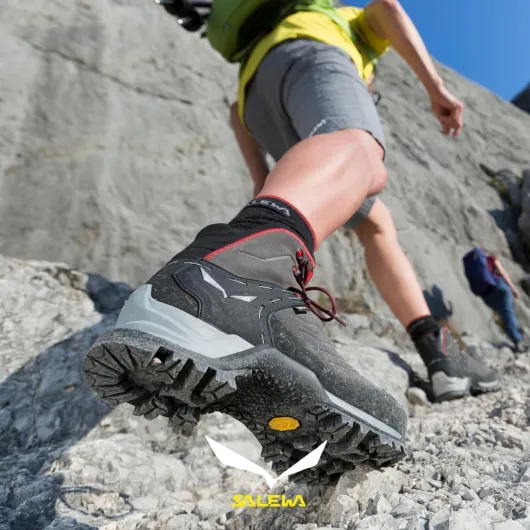
What you actually get with these Salewa boots
On paper, the Salewa Mountain Trainer Mid Gore-Tex is sold as a lightweight trekking boot with a suede and synthetic upper, full rubber rand, Gore-Tex lining and a Vibram WTC sole. In hand, they don’t feel especially lightweight, especially in a UK 12. One shoe is around 700 g, and you do notice that if you’re used to trail runners or light approach shoes. But compared to classic full-leather boots like Meindl Bhutan or similar, they’re a bit less brick-like.
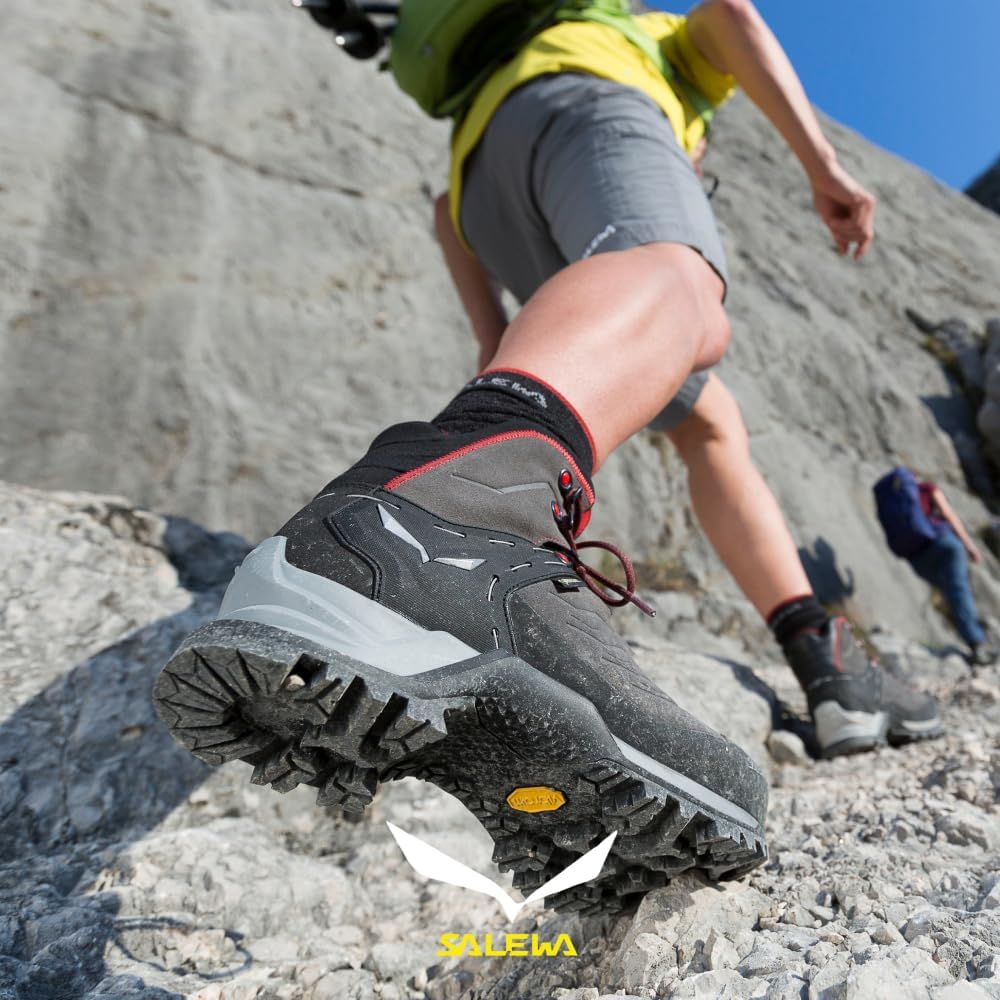
The pair I’ve got is the Asphalt Fluo Orange colourway. In reality, it looks like a dark grey/charcoal body with bright orange details and laces. It’s pretty visible on the hill, which I like, but if you want something low-key, this is not the most discreet option. The overall shape is quite technical: narrowish heel, more precise forefoot than wide comfort boots, and a mid-height cuff with the so-called Flex Collar at the back.
Out of the box, they come laced all the way up with standard Salewa insoles. No extra laces, no fancy packaging, just a regular branded box and paper. It’s the kind of unboxing that tells you the money went into the boot, not the box. I’m fine with that. What you notice straight away is the 360° rubber rand around the lower part of the boot. It gives a very protected feeling, like you can kick rocks and roots without worrying about the suede getting shredded.
Overall, the first impression is: this is a proper mountain-style trekking boot, not lifestyle footwear. If you’re looking for something you can wear straight from an office to a casual walk, this is probably too much. But if your main use is rough paths, wet grass, boggy sections and rocky trails, the presentation matches that kind of use pretty well.
Pros
- Very solid build with 360° rubber rand and Vibram sole that hold up well on rough terrain
- Strong heel lock and stable platform, good for steep descents and carrying a backpack
- Reliable waterproofing with Gore-Tex lining and good grip on mud, grass and rocky trails
Cons
- Quite heavy and stiff compared to lighter hiking shoes, overkill for casual flat walks
- Snug, technical fit that may not suit wide feet without sizing up
Conclusion
Editor's rating
If I had to sum up the Salewa Mountain Trainer Mid Gore-Tex in a sentence, I’d say: serious, stiff-ish hiking boots that make sense for rough, wet ground and proper hill days, but overkill for casual strolls. They’re well built, hold the heel firmly, grip well on real trails, and the waterproofing has been reliable. Once broken in, they’re comfortable in a firm, supportive way, not in a soft slipper way.
They’re a good fit for people who hike regularly in places like the Lakes, Scotland, Wales or any terrain with mud, rock and long descents, especially if you carry a backpack. If you’ve used Meindl, Scarpa or similar and want something a bit more technical with strong ankle support and a tough upper, these are worth a look. The Flex Collar and 3F lacing system actually do something useful, and the Vibram sole feels like it will last.
On the flip side, if you mainly walk on paved paths, canal towpaths or dry, easy trails, these are probably too heavy and too stiff. People with wide feet might struggle with the snug fit unless they size up. And if you want a boot you can wear all day in hot summer conditions, the Gore-Tex and solid build can feel a bit warm. So: good boots if you actually push them in the hills; a bit too much boot if your use is mostly casual.