
Summary
Editor's rating
Value for money: fair price for what you get
Design: looks like a work boot, not a sneaker
Comfort: light for a safety boot, but not a sneaker
Materials: full-grain leather and fully non-metallic
Durability: leather holds up, laces are the weak link
Performance on the job: protection and grip are the main strengths
What you actually get out of the box
Pros
- Full S3 HRO SRC protection with non-metallic toe and midsole in a relatively light boot
- Durable leather upper with scuff cap that handles kneeling and rough surfaces well
- Neutral, unbranded look that works with most uniforms and doesn’t scream “safety boot”
Cons
- Stock laces wear out too fast and will likely need early replacement
- Comfort is only average with the original EVA insole, especially for long shifts
- Design is quite basic and traditional if you prefer modern trainer-style safety shoes

Specifications
View full product page →| Brand | Rock Fall |
A safety boot that tries to look normal
I’ve been wearing the Rock Fall RF440A Flint safety boots in black (size 39 EU) for a few weeks on mixed jobs: warehouse, a bit of construction, and some outdoor site visits. I picked them because I wanted something that didn’t look like a chunky building-site brick but still met S3 standards. On paper they tick a lot of boxes: composite toe, flexi midsole, water repellent leather, non-metallic, and supposedly lightweight.
In real life, they feel like a decent compromise between safety and everyday wear. They’re not as sleek as the product photos suggest, but they also don’t scream “massive work boot” like some other brands I’ve used. I’ve done full 8–10 hour shifts in them, walking on concrete, climbing stairs, and standing at machines. No blisters, no major pain, but also not the “walking on clouds” feeling some marketing blurbs promise.
The Amazon rating around 3.4/5 is pretty much in line with my experience: they’re okay, with a few strong points and a couple of annoying details. They protect your feet, they don’t feel like anchors, but they’re not flawless either. I’d call them “solid mid-range boots” rather than anything premium.
If you’re expecting a miracle boot that does everything perfectly, this isn’t it. If you want something that gets the job done, looks reasonably normal, and doesn’t weigh a ton, then they’re worth a look. Just be ready to replace the laces sooner than you’d like and maybe add an insole if you’re on your feet all day.
Value for money: fair price for what you get
In terms of value, the Rock Fall RF440A Flint sits in that middle ground: not the cheapest safety boot on the market, but also not in the premium price bracket. For the money, you’re getting S3 HRO SRC certification, non-metallic protection, full-grain leather, and a scuff cap. If you actually need all those features for work, then the price starts to make sense.
Where the value feels good is the combination of relatively low weight and full safety specs. Compared to older steel-toe, steel-midsole boots in the same price range, these feel lighter and more comfortable to wear all day. Also, the leather and build don’t feel bargain-bin cheap. You can tell it’s built as actual PPE, not as a fashion boot with a token toe cap.
On the flip side, the Amazon rating of around 3.4/5 shows that not everyone is fully happy. The main complaints seem to be around durability of small parts like laces or general comfort for long shifts. If you end up buying better insoles and new laces, that adds a bit to the total cost. At that point, you’re not far off some slightly more comfortable trainer-style safety shoes from other brands, so it depends what style you prefer.
Overall, I’d say the value is pretty solid if you want a traditional leather boot and don’t mind doing small upgrades (insoles, laces). If you’re on a tight budget and just want something cheap for occasional use, you can probably find lower-priced options. If you’re willing to pay more for top comfort and lighter, sportier designs, there are better choices. This one sits comfortably in the middle: not a bargain, not overpriced, just fair for what it offers.
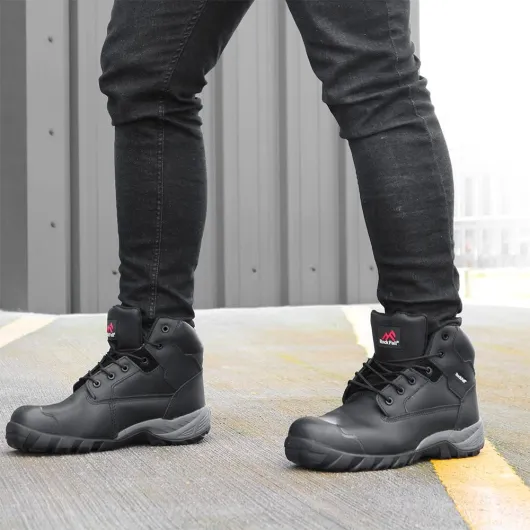
Design: looks like a work boot, not a sneaker
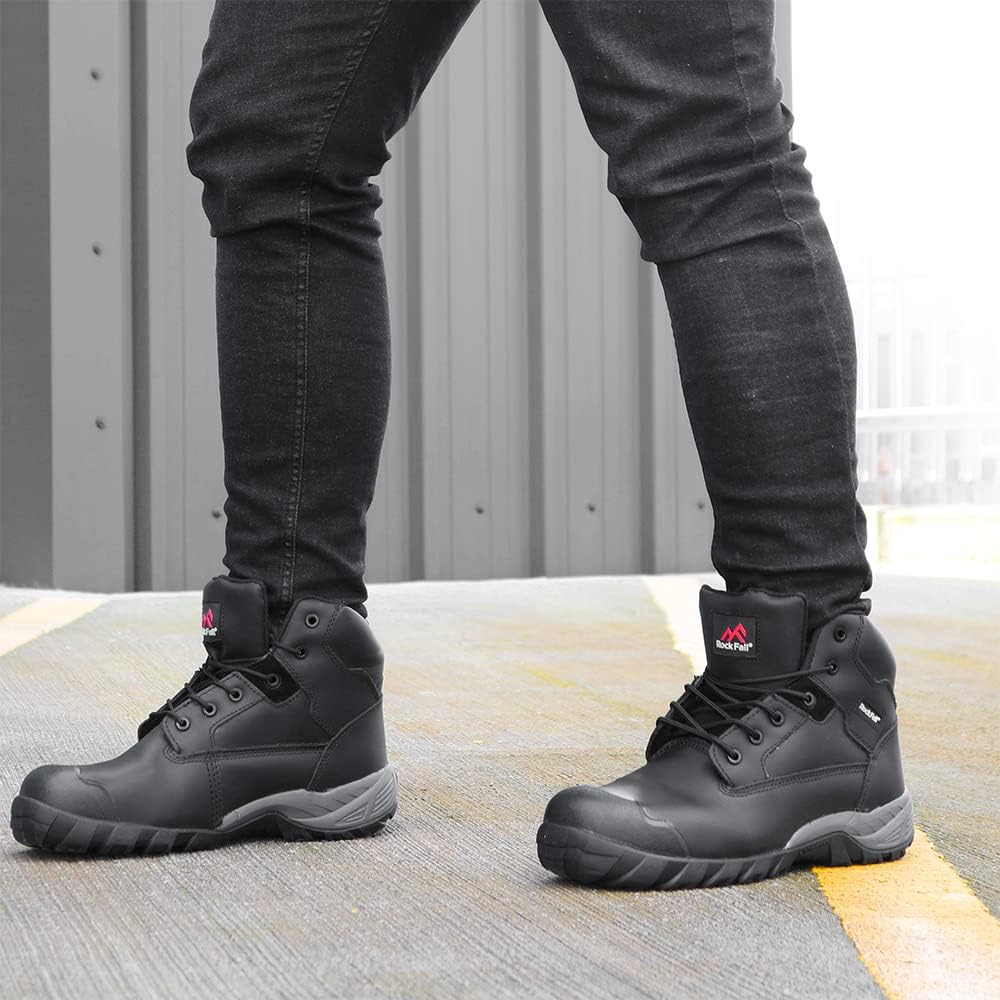
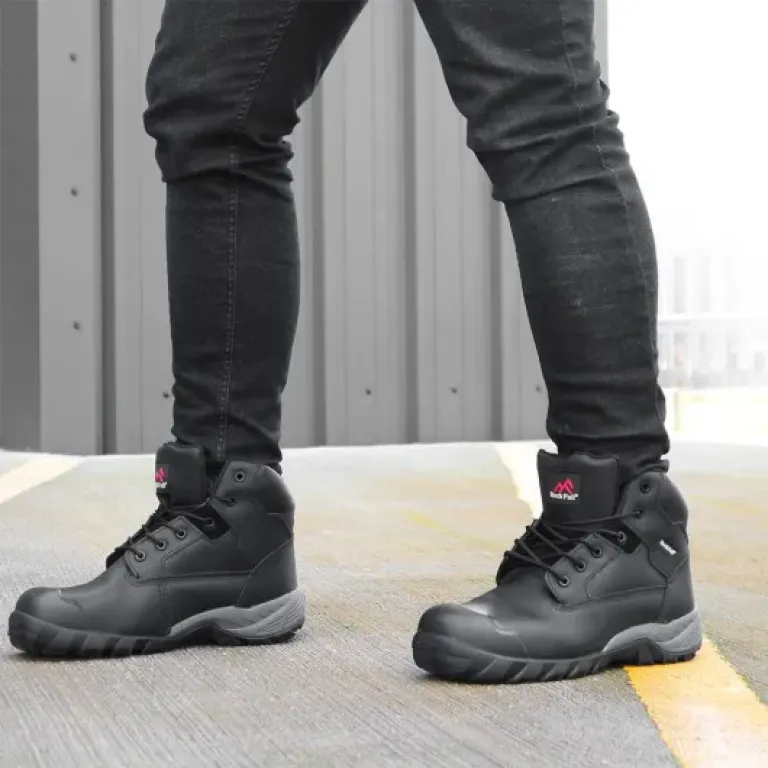
Design-wise, Rock Fall sells this as one of their more “stylish” safety styles. In reality, it’s a fairly standard black work boot with a slightly cleaner look. The plain black leather and minimal branding help if you don’t want to look like you’re wearing high-vis on your feet. With work trousers or jeans over the top, it passes as a normal, slightly chunky boot.
The ankle height is practical: enough support without locking your ankle like a ski boot. The shaft circumference is around 30 cm, which for a size 39 felt okay on my relatively narrow ankles. There’s some padding around the collar but not loads. The toe scuff cap is visible and adds a bit of bulk to the front. It’s not pretty, but when you start kneeling on concrete you quickly stop caring about that and appreciate not destroying the leather in a week.
The lacing system is basic: standard eyelets all the way up, no speed hooks. It works, but it’s not the quickest to take on and off. One thing that annoyed me is the laces themselves. They feel a bit thin and, judging from one of the Amazon reviews and my own early fraying after a few weeks, they’re clearly a weak point. They work, but I’d plan to replace them with sturdier laces fairly soon.
Compared to more modern trainer-style safety shoes, these are definitely more on the traditional side. If you want something that looks like a sports shoe, this isn’t it. If you want a classic leather work boot that doesn’t shout for attention and still looks okay with a uniform or basic workwear, the design is fine. Nothing special, but it’s practical and neutral, which is often what you want on site.
Comfort: light for a safety boot, but not a sneaker
Comfort is where I was the most curious, because they’re sold as “super lightweight and flexible”. For a safety boot, I’d say they’re on the lighter side but still clearly a boot. The pair weighs around 1.23 kg, which you do feel, but it’s less tiring than older steel-toe boots I’ve worn. After a full 8–10 hour shift, my feet were tired but not destroyed, which is already a win in my book.
The first two days, the leather upper felt a bit stiff around the ankle and across the top of the foot. Nothing crazy, but I did feel some pressure when bending down a lot. After about a week of daily use, the leather broke in and it got more comfortable. The inner leather lining helps avoid that sweaty plastic feeling. Breathability is okay, but don’t expect a ventilated running shoe; my feet were warm by the end of the day, especially in a heated warehouse.
The EVA insole gives basic cushioning but not much arch support. If you’re on smooth concrete all day, you’ll probably want to add a better insole to save your knees and lower back. I tried them one day with my own orthotic insoles, and the difference was clear: much less heel impact and better arch stability. There’s enough volume inside the boot to fit a slightly thicker insole without crushing your toes.
Fit-wise, they felt true to size in length but a bit roomy in width, which for a safety boot is actually good if your feet swell during the day or if you wear thick socks in autumn. The composite toe doesn’t get icy like steel in cold weather, which is a nice plus. Overall, comfort is decent once broken in, but it’s not top-tier. Good enough for regular shifts, but if you have foot problems or do 12-hour shifts nonstop, I’d definitely upgrade the insoles.
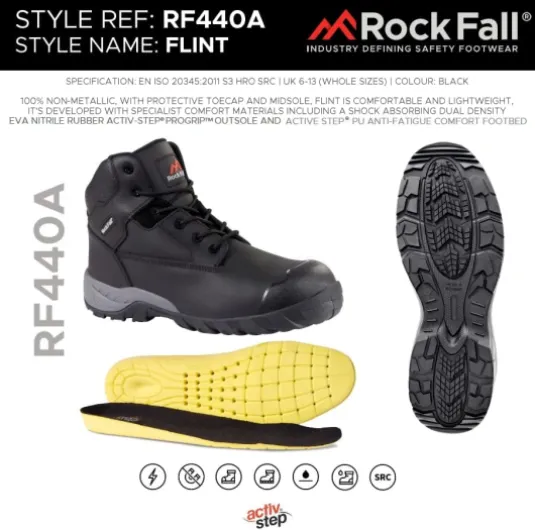
Materials: full-grain leather and fully non-metallic
The main material is black waxy full-grain leather, inside and out. The outer leather has that slightly oily, water-repellent feel. After a few wet mornings and some muddy areas, the water resistance was decent: splashes and light rain just beaded off. It’s not a full-on waterproof boot like a well-sealed welly, but for normal site conditions and walking through damp grass and shallow puddles, it held up fine.
Inside, the lining is also leather, which is better than cheap synthetic linings that peel after a month. It feels a bit stiff at first, but it does soften over a week or so. The insole is EVA (ethylene vinyl acetate), which is standard: light, a bit of cushioning, but nothing special. If you’ve got sensitive feet or plantar fasciitis, I’d strongly recommend swapping it for a more supportive insole after a short test period.
The safety parts are fibreglass toe cap and composite anti-penetration flexi midsole. On the plus side, there’s no cold metal, and the boot stays fairly light and flexible compared to older steel-toe models. On the downside, composite toes are usually a bit bulkier, and you can feel that in the toe shape being slightly more rounded and wide. The outsole is labelled as shock-absorbing and heat-resistant (HRO), with SRC slip resistance. On dry and slightly oily concrete it gripped fine; I didn’t feel any sudden slips.
The only material weak spot I’ve seen so far is the laces and maybe the stitching around high-wear zones. The laces started to fluff earlier than I’d like. The leather itself looks like it will age okay if you just wipe it down and throw some basic leather conditioner or wax on it every now and then. So overall, the materials are decent for a mid-range safety boot: not premium, not trash, just solid and functional.
Durability: leather holds up, laces are the weak link
Durability is always hard to judge in a short test, but I can give a mix of my experience and what I’ve seen from other users. After a few weeks of use, the leather upper still looks in good shape: a few creases where you’d expect, but no cracking or peeling. The waxy finish makes it fairly easy to wipe off dirt and dust. A quick wipe with a damp cloth and a bit of leather conditioner, and they look presentable again.
The outsole shows normal wear: some smoothing of the lugs where I walk the most, but no chunks missing or obvious separation between sole and upper. The scuff cap definitely takes the hit when kneeling or scraping against rough surfaces, and that’s exactly what it’s there for. If you’re in a job that destroys toe areas quickly, this cap alone will probably extend the life of the boots compared to models without it.
The weakest part is clearly the laces. One Amazon reviewer mentioned both laces disintegrating after three months, and my pair already showed early fraying near the eyelets. It’s not catastrophic, but it’s annoying. The good point is that Rock Fall’s customer service seems responsive – that reviewer got free replacement laces within 48 hours. Still, I’d rather have stronger laces from the start. Stitching around high-flex areas (like where the boot bends at the toes) looks okay so far, but that’s something I’d keep an eye on after six months.
If you treat them as work boots – regular cleaning, occasional leather treatment, and replacing the laces and insole when needed – they should last a fair while. I wouldn’t call them indestructible, but for normal construction, warehouse, or utilities work, they seem good enough to give you solid service life. Just budget a few extra euros for new laces and maybe a better insole down the line.
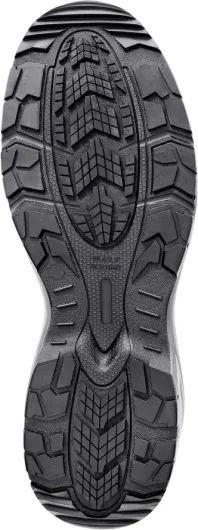
Performance on the job: protection and grip are the main strengths
On site, the RF440A Flint does what a safety boot is supposed to do. The fibreglass toe cap gives the usual solid front protection. I had a couple of minor bumps with pallets and tools, and my toes didn’t feel a thing. The composite midsole is flexible enough so you can kneel and squat without feeling like the sole is a rigid board, but it still gives that peace of mind against random screws or nails on the ground.
The outsole is rated SRC, which covers slip resistance on ceramic and steel surfaces with various contaminants. In real life, I tested them on wet concrete, dusty floors, and a bit of oily patch near machinery. No scary slips, and the grip felt predictable. On ladders, the sole edges bite reasonably well, so you don’t feel like you’re on ice. The shock absorption is okay: better than old-school hard soles, but not as cushioned as some sporty safety trainers I’ve tried.
Water repellency is decent. I walked through wet grass, light rain, and shallow puddles, and my feet stayed dry. In heavy, constant rain for long periods, I’d still go for a full waterproof boot or add gaiters, but for normal construction or warehouse use, these handle moisture fine. The scuff cap is actually more useful than it looks; after a few days of kneeling, I could see marks on the cap but the leather behind it was untouched.
Overall, performance is solid and reliable. Nothing fancy, but the core safety stuff is there and works: protection, grip, and reasonable comfort. The only thing that holds it back from a higher score is that you can get slightly more cushioned and breathable models from other brands in the same rough price bracket, especially if you prefer trainer-style safety shoes. But if you want classic leather boots that meet S3 HRO SRC and don’t feel like bricks, these do the job.
What you actually get out of the box
Out of the box, the Rock Fall RF440A Flint feels like a straightforward work boot. The packaging is basic: a plain Rock Fall box, paper stuffing, and the boots. No spare laces, no extra insoles, no little care leaflet beyond the usual safety tags. You’re basically paying for the boot and nothing else, which is fine, but don’t expect any nice extras.
The first thing you notice is the black waxy full-grain leather. It has a slightly oily, matte finish that looks more like a traditional work boot than a fashion boot. There’s an injection-moulded scuff cap over the toe area that’s clearly there to take abuse. It doesn’t look fancy, but it makes sense if you’re kneeling a lot or scraping your toes on rough surfaces. The composite toe and non-metallic midsole mean there are no metal parts, so airports and metal detectors should be simpler.
The model I tried is ankle-high, with a fairly standard lace-up system and flat heel. The boot looks unisex and pretty neutral: no bright colours, no big logos shouting in your face. On the tag you see the EN ISO 20345:2011 S3 HRO SRC rating, so it’s certified for toe protection, penetration resistance, and slip resistance, plus heat-resistant outsole. All the right codes are there if your employer checks PPE standards.
Overall, the presentation is functional and no-nonsense. It doesn’t feel cheap in the hand, but it also doesn’t give a premium vibe. Just a work boot that seems ready to take some abuse. If you judge products by fancy packaging, you’ll be disappointed. If you only care that it’s certified and looks tidy enough with work trousers, it does the job.
Pros
- Full S3 HRO SRC protection with non-metallic toe and midsole in a relatively light boot
- Durable leather upper with scuff cap that handles kneeling and rough surfaces well
- Neutral, unbranded look that works with most uniforms and doesn’t scream “safety boot”
Cons
- Stock laces wear out too fast and will likely need early replacement
- Comfort is only average with the original EVA insole, especially for long shifts
- Design is quite basic and traditional if you prefer modern trainer-style safety shoes
Conclusion
Editor's rating
The Rock Fall RF440A Flint Safety Boot is a solid, no-nonsense work boot that does the basics right: proper S3 protection, non-metallic construction, decent grip, and a leather upper that can handle rough use. It’s lighter than old-school steel safety boots and reasonably comfortable once broken in, especially if you add a better insole. The scuff cap and composite midsole make it practical for real site conditions where toes get scraped and sharp objects are on the floor.
It’s not perfect. The stock laces are clearly a weak point, and overall comfort is good but not outstanding. If you’re on your feet for 10–12 hours straight, you’ll probably want to tweak the setup with your own insoles and maybe thicker socks. The design is plain and functional rather than stylish, despite the marketing talk, but at least it looks neutral enough to work with most uniforms and workwear.
I’d recommend these boots for people in construction, warehouses, utilities, or security who want a traditional leather safety boot that’s non-metallic and not overly heavy. If you prefer trainer-style safety shoes, ultra-soft cushioning, or you’re very picky about comfort, you might be happier looking at higher-end models or more sporty designs. For the average worker who needs reliable protection and doesn’t mind doing small upgrades, the RF440A Flint is a decent, workmanlike choice.